

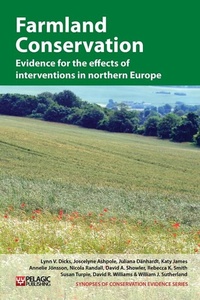
Farmland Conservation
Evidence for the effects of interventions in northern and western Europe
1st Edition
Published on 7. April 2014
400 pages
978-1-907807-95-4 (ISBN)
Description

This synopsis covers evidence for the effects of conservation interventions for native farmland wildlife. It is restricted to evidence captured on the website www.conservationevidence.com. It includes papers published in the journal Conservation Evidence, evidence summarized on our database and systematic reviews collated by the Collaboration for Environmental Evidence. It is the thrid volume in the series Synopses of Conservation Evidence.
Evidence was collected from all European countries west of Russia, but not those south of France, Switzerland, Austria, Hungary and Romania.
A list of interventions to conserve wildlife on farmland was developed collaboratively by a team of thirteen experts. A number of interventions that are not currently agri-environment options were added during this process, such as 'Provide nest boxes for bees (solitary or bumblebees)' and 'Implement food labelling schemes relating to biodiversity-friendly farming'. Interventions relating to the creation or management of habitats not considered commercial farmland (such as lowland heath, salt marsh and farm woodland) were removed.
The list of interventions was organized into categories based on the International Union for the Conservation of Nature (IUCN) classifications of direct threats and conservation actions. Interventions that fall under the threat category 'Agriculture' are grouped by farming system, with separate sections for interventions that apply to arable or livestock farms, or across all farming types.
Evidence was collected from all European countries west of Russia, but not those south of France, Switzerland, Austria, Hungary and Romania.
A list of interventions to conserve wildlife on farmland was developed collaboratively by a team of thirteen experts. A number of interventions that are not currently agri-environment options were added during this process, such as 'Provide nest boxes for bees (solitary or bumblebees)' and 'Implement food labelling schemes relating to biodiversity-friendly farming'. Interventions relating to the creation or management of habitats not considered commercial farmland (such as lowland heath, salt marsh and farm woodland) were removed.
The list of interventions was organized into categories based on the International Union for the Conservation of Nature (IUCN) classifications of direct threats and conservation actions. Interventions that fall under the threat category 'Agriculture' are grouped by farming system, with separate sections for interventions that apply to arable or livestock farms, or across all farming types.
Reviews / Votes
The authors are to be congratulated in summarising this huge mass of information for conservationists. -- John Badmin * British Journal of Entomology and Natural History *More details
Series
Language
English
Place of publication
Exeter
United Kingdom
Target group
Professional and scholarly
ISBN-13
978-1-907807-95-4 (9781907807954)
Copyright in bibliographic data and cover images is held by Nielsen Book Services Limited or by the publishers or by their respective licensors: all rights reserved.
Schweitzer Classification
Other editions
Additional editions
Lynn V. Dicks | Joscelyne E. Ashpole | Juliana Daenhardt
Farmland Conservation
Evidence for the effects of interventions in northern and western Europe
Book
07/2014
1st Edition
Pelagic Publishing
€60.80
Shipment within 10-15 days
Persons
Lynn V. Dicks is a Research Fellow in the Department of Zoology, University of Cambridge.
Joscelyne E. Ashpole is a Research Assistant in the Department of Zoology, University of Cambridge.
Juliana Daenhardt has a PhD in animal ecology and is currently employed as Research Administrator at the Centre for Environmental and Climate Research, Lund University.
Katy James is a Researcher at Harper Adams University.
Annelie M. Joensson is a PhD student in the Department of Biology at Lund University, Sweden.
Nicola Randall is a Senior Lecturer in the Department of Crop and Environmental Science and Director of the Centre for Evidence-Based Agriculture at Harper Adams University.
David A. Showler is an Ecological Consultant based in Norwich, UK.
Rebecca K. Smith is a Research Associate in the Department of Zoology, University of Cambridge.
Susan Turpie is an Agri-Environment Policy Officer in the Natural Heritage Management Team, Scottish Government.
David Williams is a Doctoral Student in the Department of Zoology, University of Cambridge.
William J. Sutherland is the Miriam Rothschild Professor of Conservation Biology at the University of Cambridge.
Joscelyne E. Ashpole is a Research Assistant in the Department of Zoology, University of Cambridge.
Juliana Daenhardt has a PhD in animal ecology and is currently employed as Research Administrator at the Centre for Environmental and Climate Research, Lund University.
Katy James is a Researcher at Harper Adams University.
Annelie M. Joensson is a PhD student in the Department of Biology at Lund University, Sweden.
Nicola Randall is a Senior Lecturer in the Department of Crop and Environmental Science and Director of the Centre for Evidence-Based Agriculture at Harper Adams University.
David A. Showler is an Ecological Consultant based in Norwich, UK.
Rebecca K. Smith is a Research Associate in the Department of Zoology, University of Cambridge.
Susan Turpie is an Agri-Environment Policy Officer in the Natural Heritage Management Team, Scottish Government.
David Williams is a Doctoral Student in the Department of Zoology, University of Cambridge.
William J. Sutherland is the Miriam Rothschild Professor of Conservation Biology at the University of Cambridge.
Content
1. About this book.
2. All farming systems.
3. Arable farming.
4. Perennial (non-timber) crops.
5. Livestock farming.
6. Residential and commercial development.
7. Agri-chemicals.
8. Transport and service corridors.
9. Hunting and trapping.
10. Natural system modification.
11. Invasive and other problematic species.
12. Education and awareness.
2. All farming systems.
3. Arable farming.
4. Perennial (non-timber) crops.
5. Livestock farming.
6. Residential and commercial development.
7. Agri-chemicals.
8. Transport and service corridors.
9. Hunting and trapping.
10. Natural system modification.
11. Invasive and other problematic species.
12. Education and awareness.
