

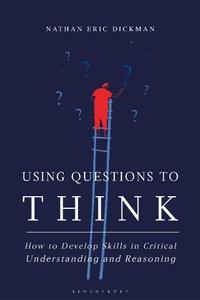
Using Questions to Think
How to Develop Skills in Critical Understanding and Reasoning
1st Edition
Published on 6. May 2021
288 pages
978-1-350-17769-7 (ISBN)
Description

Our ability to think, argue and reason is determined by our ability to question. Questions are a vital component of critical thinking, yet we underestimate the role they play. Using Questions to Think puts questioning back in the spotlight.
Naming the parts of questions at the same time as we name parts of thought, this one-of-a-kind introduction allows us to see how questions relate to the definitions of propositions, premises, conclusions, and the validity of arguments. Why is this important? Making the role of questions visible in thinking reasoning and dialogue, allows us to:
- Ask better questions
- Improve our capability to understand an argument
- Exercise vigilance in the act of questioning
- Make explicit what you already know implicitly
- Engage with ideas that contradict our own
- See ideas in broader context
Breathing new life into our current approach to critical thinking, this practical, much-needed textbook moves us away from the traditional focus on formal argument and fallacy identification, combines the Kantian critique of reason with Hans-Georg Gadamer's hermeneutics and reminds us why thinking can only be understood as an answer to a question.
Naming the parts of questions at the same time as we name parts of thought, this one-of-a-kind introduction allows us to see how questions relate to the definitions of propositions, premises, conclusions, and the validity of arguments. Why is this important? Making the role of questions visible in thinking reasoning and dialogue, allows us to:
- Ask better questions
- Improve our capability to understand an argument
- Exercise vigilance in the act of questioning
- Make explicit what you already know implicitly
- Engage with ideas that contradict our own
- See ideas in broader context
Breathing new life into our current approach to critical thinking, this practical, much-needed textbook moves us away from the traditional focus on formal argument and fallacy identification, combines the Kantian critique of reason with Hans-Georg Gadamer's hermeneutics and reminds us why thinking can only be understood as an answer to a question.
More details
Edition
1. Auflage
Language
English
Place of publication
London
United Kingdom
Publishing group
Bloomsbury Publishing PLC
ISBN-13
978-1-350-17769-7 (9781350177697)
Copyright in bibliographic data and cover images is held by Nielsen Book Services Limited or by the publishers or by their respective licensors: all rights reserved.
Schweitzer Classification
Other editions
Additional editions
Nathan Eric Dickman
Using Questions to Think
How to Develop Skills in Critical Understanding and Reasoning
Book
06/2021
Bloomsbury Academic
€30.00
Shipment within 15-20 days
Person
Nathan Eric Dickman is Assistant Professor of Philosophy at the University of the Ozarks, USA.
Content
Preface
Introduction: An Age of Answers
Part I: Make Questions Explicit for Thinking
1. Thinking Only Happens in Complete Thoughts
2. What Do Questions Do to Complete Thoughts?
3. A Logic of Question-and-Answer
Part II: Make Questions Explicit for Reasoning
4. Reasoning Only Happens in Explicit Arguments
5. What Do Questions Do to Arguments?
6. A Rationality of Questioning-and-Reasoning
Part III: Make Questions Explicit in Dialogue
7. Dialogue Only Happens in Constructive Reconciliations
8. What Do Questions Do to Dialogues?
9. A Dialectic of Questionability-and-Responsibility
Conclusion: The End(s) of Questions
Appendix for Instructors
Glossary
Bibliography
Index
Introduction: An Age of Answers
Part I: Make Questions Explicit for Thinking
1. Thinking Only Happens in Complete Thoughts
2. What Do Questions Do to Complete Thoughts?
3. A Logic of Question-and-Answer
Part II: Make Questions Explicit for Reasoning
4. Reasoning Only Happens in Explicit Arguments
5. What Do Questions Do to Arguments?
6. A Rationality of Questioning-and-Reasoning
Part III: Make Questions Explicit in Dialogue
7. Dialogue Only Happens in Constructive Reconciliations
8. What Do Questions Do to Dialogues?
9. A Dialectic of Questionability-and-Responsibility
Conclusion: The End(s) of Questions
Appendix for Instructors
Glossary
Bibliography
Index
