

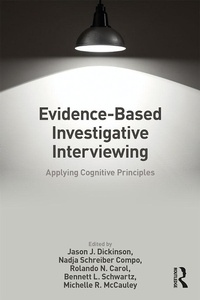
Evidence-based Investigative Interviewing
Applying Cognitive Principles
1st Edition
Published on 21. February 2019
282 pages
978-1-351-66201-7 (ISBN)
Description

For as long as we have been researching human memory, psychologists have been investigating how people remember and forget. This research is regularly drawn upon in our legal systems. Historically, we have relied upon eyewitness memory to help judge responsibility and adjudicate truth, but memory is malleable, prone to error, and susceptible to bias. Even confident eyewitnesses make mistakes, and even accurate witnesses sometimes find their testimony subjected to harsh scrutiny.
Emerging from this environment, the Cognitive Interview (CI) became a means of assisting cooperative witnesses with recalling more information without sacrificing accuracy. First used by police interviewing adult witnesses, it is now used with many populations in many contexts, including public health, accident reconstruction, and the interrogation of terror suspects. Evidence-Based Investigative Interviewing reviews the application of cognitive research to investigative interviewing, revealing how principles of cognition, memory, and social dynamics may increase the accuracy of eyewitness testimony. It provides evidence-based applications for investigators beyond the forensic domain in areas such as eyewitness identification, detecting deception, and interviewing children.
Drawing together the work of thirty-three authors across both the academic and practice communities, this comprehensive collection is essential reading for researchers in psychology, forensics, and disciplines such as epidemiology and gerontology.
Emerging from this environment, the Cognitive Interview (CI) became a means of assisting cooperative witnesses with recalling more information without sacrificing accuracy. First used by police interviewing adult witnesses, it is now used with many populations in many contexts, including public health, accident reconstruction, and the interrogation of terror suspects. Evidence-Based Investigative Interviewing reviews the application of cognitive research to investigative interviewing, revealing how principles of cognition, memory, and social dynamics may increase the accuracy of eyewitness testimony. It provides evidence-based applications for investigators beyond the forensic domain in areas such as eyewitness identification, detecting deception, and interviewing children.
Drawing together the work of thirty-three authors across both the academic and practice communities, this comprehensive collection is essential reading for researchers in psychology, forensics, and disciplines such as epidemiology and gerontology.
More details
Edition
1. Auflage
Language
English
Place of publication
London
United Kingdom
Publishing group
Taylor & Francis Ltd
Target group
College/higher education
Illustrations
3 Tables, black and white
File size
18,15 MB
ISBN-13
978-1-351-66201-7 (9781351662017)
Copyright in bibliographic data and cover images is held by Nielsen Book Services Limited or by the publishers or by their respective licensors: all rights reserved.
Schweitzer Classification
Other editions
Additional editions
Jason J. Dickinson | Nadja Schreiber Compo | Rolando Carol
Evidence-based Investigative Interviewing
Applying Cognitive Principles
Book
03/2019
1st Edition
Routledge
€70.00
Shipment within 10-20 days
Jason J. Dickinson | Nadja Schreiber Compo | Rolando Carol
Evidence-based Investigative Interviewing
Applying Cognitive Principles
Book
03/2019
1st Edition
Routledge
€207.90
Shipment within 10-20 days
Persons
Jason J. Dickinson, Ph.D., is a professor of psychology and the Director of the Robert D. McCormick Center for Child Advocacy and Policy at Montclair State University.
Nadja Schreiber Compo, Ph.D., is an associate professor of psychology at Florida International University
Rolando N. Carol, Ph.D. is an assistant professor at Auburn University at Montgomery.
Bennett L. Schwartz, Ph.D., is a professor of psychology at Florida International University.
Michelle R. McCauley, Ph.D. is a professor of psychology at Middlebury College.
Nadja Schreiber Compo, Ph.D., is an associate professor of psychology at Florida International University
Rolando N. Carol, Ph.D. is an assistant professor at Auburn University at Montgomery.
Bennett L. Schwartz, Ph.D., is a professor of psychology at Florida International University.
Michelle R. McCauley, Ph.D. is a professor of psychology at Middlebury College.
Content
1. Fisher, R.P. & Geiselman, R. E. Expanding the Cognitive Interview to Non-Criminal Investigations 2. Bull, R., Paulo, R., & Albuquerque, P. The Impact of the Cognitive Interview in the UK and Recent Research in Portugal 3. Hope, L., & Gabbert, F. Expanding the Legacy of the Cognitive Interview: Developments and Innovations in Evidence-based Investigative Interviewing 4. Milne, R., Griffiths, A., Clarke, C., & Dando, C. The Cognitive interview - A Tiered Approach in the Real World 5. Altman, C., Schreiber Compo, N., Hagsand, A. V., & Evans, J. R. State of Intoxication: A Review of the Effects of Alcohol on Witnesses Memory 6. Mosser, A. E., & Evans, J. From the Police Station to the Hospital Bed: Using the Cognitive Interview to Enhance Epidemiological Interviewing 7.Vrij, A., & Nahari, G. The Verifiability Approach 8. Brandon, S. E., & Wells, S. Commonalities and Complementaries Among Science-based Interview Methods: Towards a Theory of Interrogation 9. Leins, D. A., & Zimmerman, L. A. Navigating the Interview: Judgment and Decision-making in Investigative Interviewing 10. Zajac, R. Mussa, M. Westra, N. J., & Powell, M. Multi-disciplinary Stakholder's Views on Improving Investigative Interviews With Adult Sexual Assault Complainants 11. Lytle. N. E., Dickinson, J. J., & Poole, D. A. Techniques for Interviewing Reluctant Child Witnesses 12. Brubacher, S. P., & Earhart, B. Investigative Interviewing About Repeated Experiences 13. McCauley, M. R. & Santee A. Viewing the CI Through the Lens of Self Determination Theory
