

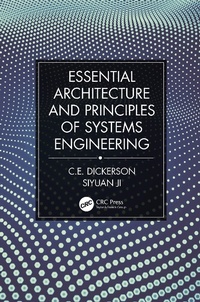
Essential Architecture and Principles of Systems Engineering
1st Edition
Published on 28. September 2021
260 pages
978-1-000-45279-2 (ISBN)
Description

This book is for everyone interested in systems and the modern practice of engineering. The revolution in engineering and systems that has occurred over the past decade has led to an expansive advancement of systems engineering tools and languages. A new age of information-intensive complex systems has arrived with new challenges in a global business market. Science and information technology must now converge into a cohesive multidisciplinary approach to the engineering of systems if products and services are to be useful and competitive.
For the non-specialist and even for practicing engineers, the subject of systems engineering remains cloaked in jargon and a sense of mystery. This need not be the case for any reader of this book and for students no matter what their background is. The concepts of architecture and systems engineering put forth are simple and intuitive. Readers and students of engineering will be guided to an understanding of the fundamental principles of architecture and systems and how to put them into engineering practice.
This book offers a practical perspective that is reflected in case studies of real-world systems that are motivated by tutorial examples. The book embodies a decade of research and very successful academic instruction to postgraduate students that include practicing engineers. The material has been continuously improved and evolved from its basis in defence and aerospace towards the engineering of commercial systems with an emphasis on speed and efficiency. Most recently, the concepts, processes, and methods in this book have been applied to the commercialisation of wireless charging for electric vehicles.
As a postgraduate or professional development course of study, this book will lead you into the modern practice of engineering in the twenty-first century. Much more than a textbook, though, Essential Architecture and Principles of Systems Engineering challenges readers and students alike to think about the world differently while providing them a useful reference book with practical insights for exploiting the power of architecture and systems.
For the non-specialist and even for practicing engineers, the subject of systems engineering remains cloaked in jargon and a sense of mystery. This need not be the case for any reader of this book and for students no matter what their background is. The concepts of architecture and systems engineering put forth are simple and intuitive. Readers and students of engineering will be guided to an understanding of the fundamental principles of architecture and systems and how to put them into engineering practice.
This book offers a practical perspective that is reflected in case studies of real-world systems that are motivated by tutorial examples. The book embodies a decade of research and very successful academic instruction to postgraduate students that include practicing engineers. The material has been continuously improved and evolved from its basis in defence and aerospace towards the engineering of commercial systems with an emphasis on speed and efficiency. Most recently, the concepts, processes, and methods in this book have been applied to the commercialisation of wireless charging for electric vehicles.
As a postgraduate or professional development course of study, this book will lead you into the modern practice of engineering in the twenty-first century. Much more than a textbook, though, Essential Architecture and Principles of Systems Engineering challenges readers and students alike to think about the world differently while providing them a useful reference book with practical insights for exploiting the power of architecture and systems.
Reviews / Votes
As both a practicing engineer and mature student studying an MSc in Safety Critical Systems Engineering at the University of York, this book is an invaluable resource for understanding and applying essential architecture principles of System Engineering in both the academic and professional environment.The book is both clear and systematic, building the readers understanding of the subject progressively through a carefully considered structure and layout with effective tutorial case studies and exercises to embed the learning.
If you are a practicing engineer, engineering manager, safety professional, student or person who has an interest in Systems Engineering (including what Architecture really is, Model Based Systems Engineering (MBSE) and the use of modelling languages such as SysML and UML) and desires/ requires to understand more with respect to both the theory and the practice simply and intuitively, I highly recommend this easily accessible book.
- Neil Morley, University of York
More details
Edition
1. Auflage
Language
English
Place of publication
London
United Kingdom
Publishing group
Taylor & Francis Ltd
Target group
Professional and scholarly
Product notice
Reflowable
Illustrations
5 Tables, black and white; 72 Line drawings, black and white; 72 Illustrations, black and white
ISBN-13
978-1-000-45279-2 (9781000452792)
Copyright in bibliographic data and cover images is held by Nielsen Book Services Limited or by the publishers or by their respective licensors: all rights reserved.
Schweitzer Classification
Other editions
Additional editions
Charles Dickerson | Siyuan Ji
Essential Architecture and Principles of Systems Engineering
Book
09/2021
1st Edition
CRC Press
€150.20
Shipment within 10-20 days
Charles Dickerson | Siyuan Ji
Essential Architecture and Principles of Systems Engineering
Book
09/2021
1st Edition
CRC Press
€74.50
Shipment within 10-20 days
Persons
Charles E. Dickerson is Professor and Chair of Systems Engineering at Loughborough University in the United Kingdom. His appointment as the Royal Academy of Engineering Chair of Systems Engineering in 2007 began a transition into a sharply focused programme of research after 25 years' experience in aerospace and defence systems in the United States. His aerospace and defence experience includes the Lockheed Skunkworks and Northrop Advanced Systems in the United States. He was a member of the Research Staff in Lincoln Laboratory at the Massachusetts Institute of Technology. He has served secondments as the Aegis Systems Engineer for the US Navy Ballistic Missile Defence programme and then as the Director of Architecture for the Chief Engineer in the Office of the Assistant Secretary of the Navy for Research, Development, and Acquisition. Before coming to the UK, he was a Technical Fellow with BAE Systems in the United States.
Siyuan Ji is a Lecturer of Safety-Critical Systems Engineering in the Department of Computer Science at the University of York in the United Kingdom. His research and teaching are focused on model-based safety assessment and assurance. In his academic duties, he has worked closely with both the aerospace and automotive industries to include BAE Systems and Jaguar Land Rover. He also works closely with the Object Management Group and was the task force lead for the UML Profile for ROSETTA (UPR) that was adopted in 2018. The Relational Oriented Systems Engineering Technology Trade-off and Analysis framework (ROSETTA) is foundational to the methodologies in this book. Dr Ji is also an active member of the IEEE with several publications in the Systems Journal.
Siyuan Ji is a Lecturer of Safety-Critical Systems Engineering in the Department of Computer Science at the University of York in the United Kingdom. His research and teaching are focused on model-based safety assessment and assurance. In his academic duties, he has worked closely with both the aerospace and automotive industries to include BAE Systems and Jaguar Land Rover. He also works closely with the Object Management Group and was the task force lead for the UML Profile for ROSETTA (UPR) that was adopted in 2018. The Relational Oriented Systems Engineering Technology Trade-off and Analysis framework (ROSETTA) is foundational to the methodologies in this book. Dr Ji is also an active member of the IEEE with several publications in the Systems Journal.
Content
Preface
Acknowledgements
About the Authors
List of Abbreviations
Principles of Architecture and Systems Engineering
Part I Architecture and Systems in the 21st Century
Chapter 1 Introduction
Chapter 2 Logical and Scientific Approach
Chapter 3 Concepts, Standards, and Terminology
Chapter 4 Structured Methods
Part II Tutorial Case Study: End-to-End Demonstration
Chapter 5 Tutorial I: Air Traffic Control System Essential Model
Chapter 6 Tutorial II: Air Traffic Control System Architecture
Chapter 7 Tutorial III: Air Traffic Control System Final Solution
Part III Modelling Languages
Chapter 8 Modelling Languages I: Functionality and Behaviour
Chapter 9 Modelling Languages II: Structure and Interoperation
Chapter 10 Modelling Languages III: SysML Extensions
Part IV Case Studies for Practice and Practitioners
Chapter 11 Case Study: Traffic Management System of Systems Architecture
Chapter 12 Case Study: System of Actuator Systems Architecture
Annex A-1: Essential Mathematics
Annex A-2: Logical Modelling of Language
Annex A-3: Terminology for Architecture and Systems
Annex A-4: Research Impact and Commercialisation
Annex A-5: Using This Book for a One-Semester Module of Lectures
Index
Acknowledgements
About the Authors
List of Abbreviations
Principles of Architecture and Systems Engineering
Part I Architecture and Systems in the 21st Century
Chapter 1 Introduction
Chapter 2 Logical and Scientific Approach
Chapter 3 Concepts, Standards, and Terminology
Chapter 4 Structured Methods
Part II Tutorial Case Study: End-to-End Demonstration
Chapter 5 Tutorial I: Air Traffic Control System Essential Model
Chapter 6 Tutorial II: Air Traffic Control System Architecture
Chapter 7 Tutorial III: Air Traffic Control System Final Solution
Part III Modelling Languages
Chapter 8 Modelling Languages I: Functionality and Behaviour
Chapter 9 Modelling Languages II: Structure and Interoperation
Chapter 10 Modelling Languages III: SysML Extensions
Part IV Case Studies for Practice and Practitioners
Chapter 11 Case Study: Traffic Management System of Systems Architecture
Chapter 12 Case Study: System of Actuator Systems Architecture
Annex A-1: Essential Mathematics
Annex A-2: Logical Modelling of Language
Annex A-3: Terminology for Architecture and Systems
Annex A-4: Research Impact and Commercialisation
Annex A-5: Using This Book for a One-Semester Module of Lectures
Index
