

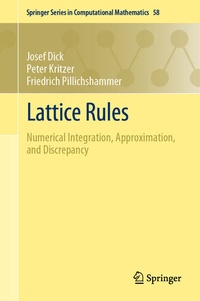
Lattice Rules
Description

More details
Other editions
Additional editions
Persons
Peter Kritzer is a Senior Scientist at the Johann Radon Institute for Computational and Applied Mathematics (RICAM) of the Austrian Academy of Sciencesin Linz, Austria, where he leads a work group doing research on quasi-Monte Carlo methods, multivariate algorithms, and Information-Based Complexity. Peter Kritzer's research focuses on mostly theoretical aspects of high-dimensional numerical integration, function approximation, and Information-Based Complexity. He has worked at Austrian and Australian universities and research institutions and has been awarded several prizes, such as the Information-Based Complexity Young Researcher Award, the Prize for Achievements in Information-Based Complexity, and the Christian Doppler Award. Apart from his research work at the Austrian Academy of Sciences, he teaches at Johannes Kepler University Linz and serves as an editorial board member of the Journal of Complexity.
Friedrich Pillichshammer is an Associate Professor in the Institute for Financial Mathematics and Applied Number Theory at the Johannes Kepler University Linz, Austria. He is an author with Josef Dick of the book"Digital Nets and Sequences - Discrepancy Theory and Quasi-Monte Carlo Methods" and with Gunther Leobacher of the book "Introduction to Quasi-Monte Carlo Integration and Applications". Friedrich Pillichshammer's work is devoted to the theory and foundations of quasi-Monte Carlo methods. This comprises his research work but also teaching experience. For his work he received several honors. Examples are the Information-Based-Complexity award, a best paper award from the Journal of Complexity and awards from the Austrian Mathematical Society and from the Austrian Academy of Sciences. He is member of scientific committees and editorial boards like the steering committee of the MCQMC conference series, the editorial board of the Journal of Complexity and Managing Editor of the journal Uniform Distribution theory.
