

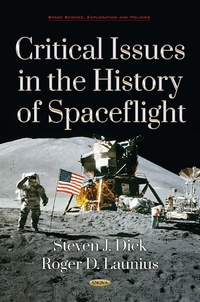
Critical Issues in the History of Spaceflight
Published on 1. June 2018
552 pages
978-1-5361-3696-8 (ISBN)
Description

At a May 1981 ''Proseminar in Space History'' held at the Smithsonian Institution's National Air and Space Museum (NASM) in Washington, DC, historians came together to consider the state of the discipline of space history. It was an historic occasion. The community of scholars interested in the history of spaceflight was not large; previously, well-meaning but untrained aficionados consumed with artifacts had dominated the field, to the exclusion of the larger context. At a fundamental level, this proseminar represented a ''declaration of independence'' for what might be called the ''new aerospace history.'' In retrospect, it may be interpreted as marking the rise of space history as a recognizable subdiscipline within the field of U.S. history. Bringing together a diverse collection of scholars to review the state of the art in space history, this proseminar helped in a fundamental manner to define the field and to chart a course for future research. Its participants set about the task of charting a course for collecting, preserving, and disseminating the history of space exploration within a larger context of space policy and technology. In large measure, the course charted by the participants in this 1981 proseminar aided in advancing a very successful agenda of historical research, writing, and understanding of space history. Not every research project has yielded acceptable results, nor can it be expected to do so, but the sum of the effort since 1981 has been impressive. The opportunities for both the exploration of space and for recording its history have been significant. Both endeavors are noble and aimed at the enhancement of humanity. Whither the history of spaceflight Only time will tell. But there has been an emergent ''new aerospace history'' of which space history is a central part that moves beyond an overriding concern for the details of the artifact to emphasize the broader role of the spacecraft. More importantly, it emphasizes the whole technological system, including not just the vehicle but also the other components that make up the aerospace climate, as an integral part of the human experience. It suggests that many unanswered questions spur the development of flight and that inquisitive individuals seek to know that which they do not understand.
More details
Other editions
Additional editions
Steven J. Dick | Roger D. Launius
Critical Issues in the History of Spaceflight
Book
06/2018
Nova Science Publishers Inc
€409.20
Shipment within 15-20 days
Content
- Intro
- Contents
- Introduction*
- Acronyms and Abbreviations
- Section 1. Motivations for Spaceflight
- Introduction
- Chapter 1
- Seeking Newer Worlds: An Historical Context for Space Exploration
- Islands in the Mist: The Case for Ages of Discovery
- Great Voyages: The First Age
- Corps of Discovery: The Coming of the Second Age
- Lost Worlds: The Waning of the Second Age
- Boldly Going Where No One Is: The Third Age
- Back to the Future: Beyond the Third Age
- Chapter 2
- Compelling Rationales for Spaceflight? History and the Search for Relevance
- A Question of Motivation
- Five Rationales for Spaceflight
- Human Destiny/Survival of the Species
- Geopolitics/National Pride and Prestige
- National Security and Military Applications
- Economic Competitiveness and Satellite Applications
- Scientific Discovery and Understanding
- History and the Search for Relevance
- Section 2. Human and Robotic Exploration
- Introduction
- Chapter 3
- Observations on the Robotic versus Human Issue in Spaceflight
- Classical Approaches to Space Exploration
- History and the Human Spaceflight Vision
- Robots in Space
- Astrophysics and the Electromagnetic Space Program
- A Postbiological Perspective
- Conclusion
- Chapter 4
- Human-Machine Issues in the Soviet Space Program
- Automation on Vostok: Technological, Disciplinary, and Medical Factors
- Vostok Dual Use: Military/Civilian and Automatic/Manual
- The Voskhod 2 Mission: The Cosmonaut Takes Control
- Designing a Cosmonaut for Soyuz
- Soyuz Flights: Dividing Glory and Responsibility between Human and Machine
- The Role of Ground Control
- The Paradox of Disciplined Initiative
- The Lunar Program: A Turn Toward Manual Control
- Defining the Cosmonaut Profession
- Automation in Context
- Directions for Further Research
- Chapter 5
- Human and Machine in the History of Spaceflight
- Between Human and Machine
- The Case of Apollo
- The Test Pilots
- Systems Thinking and the Role of the Human
- X-15 Human and Machine
- Rethinking Apollo
- An Agenda for Research
- Section 3. NASA and External Relations
- Introduction
- Chapter 6
- NASA and the Aerospace Industry: Critical Issues and Research Prospects
- Nasa and Industry: Four Core Issues
- Initially Designing and Building Aerospace Artifacts
- Redesigning, Testing and Reworking Aerospace Artifacts
- Contests and Alliances between/among Contractors and NASA Units
- Conceptualizing Contracting Relations and Production on Technology's Edges
- Nasa and Industry: Two Key Studies
- Industry and NASA: Mercury Moments and Closing Questions
- Chapter 7
- NASA and the Department of Defense: Enduring Themes in Three Key Areas
- Developing, Organizing and Implementing America's Space Age Vision in the 1950s
- The Technological Capabilities Panel and NSC-5520
- Responding to the Sputniks and Creating NASA
- Completing the Organizational Structure
- Wrestling with the Rationale for Human Spaceflight in the Early Space Program
- Jockeying for Human Spaceflight Missions
- The Rise and Fall of Dyna-Soar
- The MOL Program and the Demise of Military Spaceflight Dreams
- DOD and the Development of the Space Shuttle
- The Military, Space Transportation Policy and STS Operations
- Chapter 8
- Technology, Foreign Policy, and International Cooperation in Space
- The Johnson Administration and the ELDO Crisis
- The Obstacles to the Support for ELDO
- Finding a Way Around the Obstacles
- Denouement
- Conclusion
- Section 4. Access to Space
- Introduction
- Chapter 9
- "A Failure of National Leadership": Why No Replacement for the Space Shuttle?
- What Does "Replacing the Space Shuttle" Mean?
- An Album of Frustration
- The Root Causes of the Failure to Develop a Shuttle Replacement
- Technological Hubris and Organizational Outputs
- The Political Process and the Strength of the Pro-Shuttle Coalition
- Human Spaceflight as a National Enterprise
- So Has There Really Been a Failure?
- Epilogue: An Achievable Vision?
- Chapter 10
- Reusable Launch Vehicles or Expendable Launch Vehicles? A Perennial Debate
- The Spaceplane Concept
- Dyna-Soar
- Lifting Bodies
- The RASV
- The National Aero-Space Plane
- The Delta Clipper
- NASA's "X" Vehicles
- Commercial Launchers
- Analysis of a Perennial Debate
- Policy
- The Era of Space Transportation
- A Mixed Fleet
- A New World (Dis) Order?
- The Vision Thing
- The NASA Access to Space Study
- Defense Department Studies
- The 1994 Space Transportation Policy
- The RLV Bubble Bursts
- The New Bush
- Historiography
- A Question
- Section 5. NASA Cultures
- Introduction
- Chapter 11
- Changing NASA: The Challenges of Organizational System Failures
- NASA's Slippery Slope: O-Rings, Foam Debris, and Normalizing Deviance
- Two Accidents: The Reproduction of System Effects
- The Presidential Commission: Connecting Causes and Strategies for Control
- The CAIB: Connecting Causes with Strategies for Control
- Signals of Danger and the Normalization of Deviance
- The Culture of Production: NASA's Political/Economic Environment
- The Organization: NASA Structure and Culture
- Conclusion: Lessons Learned
- Chapter 12
- Accidents, Engineering, and History at NASA, 1967-2003
- Apollo 204
- Challenger
- Columbia
- Reading Accident Reports as History
- Computing
- Engineering Education
- The Systems Approach
- Further Research
- Chapter 13
- Institutional Issues for Continued Space Exploration: High-Reliability Systems Across Many Operational Generations-Requisites for Public Credibility
- Pursuing Highly Reliable Operations
- Internal Processes
- Organizationally Defined Intention
- Reliability-Enhancing Operations
- Organizational Culture of Reliability
- External Relationships
- Assuring Institutional Constancy and Faithfulness in the Future
- Conditions Encouraging Institutional Constancy
- Institutional Purpose
- The Infrastructure of Constancy
- Concluding Reflections
- Section 6. Space History: State of the Art
- Introduction
- Chapter 14
- American Space History: Legacies, Questions, and Opportunities for Future Research
- Exploration
- Competition and National Security
- Artifactual and Programmatic Histories
- Nose Cone History
- New History
- Political History
- History of Technology
- Social History
- Cultural History
- Conclusion
- Chapter 15
- The History and Historiography of National Security Space
- Overview Sources
- Ballistic Missiles and Military Space Launchers
- Early Warning and Space Surveillance
- Command and Control
- Communications
- Ballistic Missile Defense
- Space Intelligence and Reconnaissance
- Military Human Spaceflight
- Weather and Science
- Navigation
- Antisatellites and Space Warfare
- Organization, Management, and Acquisition
- Space Power Theory
- Conclusion-Holes in the Literature
- Holes in the Research
- Chapter 16
- Critical Theory as a Toolbox: Suggestions for Space History's Relationship to the History Subdisciplines
- A Brief History of Space History
- The New Aerospace History
- Critical Theory as a Toolbox
- Chapter 17
- Space Artifacts: Are They Historical Evidence?
- Why Artifacts Are Marginalized as Historical Evidence
- Things as "Congealed Culture
- Addressing the Issue: Rationales for Collecting
- Why Preserve Objects? The Views and Actions of Individuals
- So, Why Collect?
- Afterword
- Section 7. Postscript
- Afterword: Community and Explanation in Space History (?)
- Community
- Explanation
- The NASA History Series
- Reference Works, NASA SP-4000
- Management Histories, NASA SP-4100
- Project Histories, NASA SP-4200
- Center Histories, NASA SP-4300
- General Histories, NASA SP-4400
- Monographs in Aerospace History, NASA SP-4500
- Electronic Media, NASA SP-4600
- Conference Proceedings, NASA SP-4700
- About the Authors*
- Index
- Blank Page
