

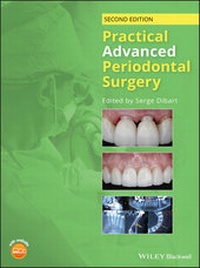
Practical Advanced Periodontal Surgery
Description

Practical Advanced Periodontal Surgery, Second Edition is a step-by-step guide to cutting-edge surgical techniques and interdisciplinary treatment approaches in periodontology. Written by leading experts in the field, the book provides solutions to complex daily dental challenges with innovative approaches to each treatment modality. Procedures are described in a practical and accessible style, highlighting complex and advanced procedures using a highly illustrated visual format.
This expanded edition includes three new chapters that cover IV sedation, digital technologies in clinical restorative dentistry, and advanced implant therapies in the esthetic zone post extraction. Well balanced and solidly grounded in the science, this reference work is an indispensable resource for the practitioner of advanced dentistry. This important guide:
* Offers an easy-to-use, practical step-by-step format
* Contains clinical photographs that detail the surgical procedures presented
* Reviews the most advanced techniques in periodontal surgery and their integration with digital treatment planning and workflow
* Discusses the pros and cons for each procedure, as well as limitations and potential complications
* Features video clips illustrating key points in the procedures described on a companion website
Written for periodontists, periodontal residents and general or restorative dentists, this revised edition of Practical Advanced Periodontal Surgery is a practical and complete clinical manual filled with illustrations for easy reference.
More details
Other editions
Additional editions
Person
The Editor
Serge Dibart is Professor and Chair of the department of periodontology at Boston University's Henry M. Goldman School of Dental Medicine in Boston, Massachusetts, USA.
Content
List of Contributors xi
Acknowledgments xiii
About the Companion Website xv
Introduction 1 Thomas Van Dyke
1 Conscious IV Sedation Utilizing Midazolam 3 Jess Liu
Introduction 3
Midazolam (Versed) 3
Armamentarium 4
Steps in IV Sedation 4
2. Bone Physiology and Metabolism 11 Jean-Pierre Dibart
Bone Composition 11
Bone Types 11
Bone Formation 11
Bone Density Measuring Techniques 14
Implications for Dental Treatments 15
3. Anatomy of the Dental/Alveolar Structures and Wound Healing 19 Albert Price
Anatomic Review (Emphasis on Vascular Supply) 19
Vascular Supply: Macro and Micro 19
Blood Supply Within the Alveolar and Basal Bone of the Dental Arches 21
Microarchitecture of the Bone/Tooth Relationship and the Interface of Soft and Hard Connective Tissues 21
Anatomy and Vascular Supply of the Investing Soft Connective Tissues 25
Cementum 28
Antatomy and Vascular Supply of the Epithelial Structures 28
The Wound-Healing Process 29
4. PiezocisionTM Assisted Orthodontics in Everyday Practice 35 Serge Dibart, Elif Keser, and Donald Nelson
Introduction 35
The Technique 35
Computer Guided Piezocision-Orthodontics 35
Dynamically Guided Piezocision 37
Piezocision Assisted Orthodontics With Clear Aligners 38
Incorporating Piezocision in Multidisciplinary Treatment 39
Post-Operative Care 41
Contraindications for Piezocision 42
Potential Complications 42
5. The Contribution of Periodontics to Endodontic Therapy: The Surgical Management of Periradicular Periodontitis 43 Mani Moulazadeh
History and Evolution 43
Tooth Conservation Versus Implants 43
Treatment of Failed Root Canal Therapy 44
Rationale for Endodontic Surgery 44
Indications for Endodontic Surgery 44
Contraindications for Endodontic Surgery 46
Types of Endodontic Surgery 48
Periradicular Surgery 51
Phases of Apicoectomy and Surgical Technique 52
Recall 60
6. The Contribution of Periodontics to Prosthodontics: Treatment Planning of Patients Requiring Combined Periodontal and Prosthodontic Care 61 Haneen N. Bokhadoor, Nawaf J. Al-Dousari, and Steven Morgano
Introduction 61
Diagnostic Phase (Data Collection) 61
Treatment-Planning Phase 63
Final Prognosis 63
Conclusion 105
7. The Contribution of Periodontics to the Correction of Vertical Alveolar Ridge Deficiencies 107 Serge Dibart
Alveolar Distraction Osteogenesis Surgery 107
8. Papillary Construction After Dental Implant Therapy 117 Peyman Shahidi, Serge Dibart, and Yun Po Zhang
History 117
Indications 117
Contraindications 117
Armamentarium 117
Technique 117
Postoperative Instructions 119
Surgical Indexing 119
Possible Complications 119
Healing 119
9. Dental Implant Placement Including the Use of Short Implants 121 Albert Price and Ming Fang Su
History 121
Indications 123
Surgical Technique 123
Implant Placement 125
Site Preparation 125
The Fixture (Implant) Installation 130
Possible Problems and Complications 130
10. Periodontal Medicine Including Biopsy Techniques 137 Vikki Noonan and Sadru Kabani
Gingival Nodules 137
Parulis 137
Fibroma 137
Peripheral Ossifying Fibroma 137
Pyogenic Granuloma 138
Peripheral Giant Cell Granuloma 138
Diagnosis and Treatment of Reactive Gingival Nodules 139
Gingival Cyst of the Adult 139
Mucocele 139
Desquamative Gingivitis 140
Lichen Planus 140
Pemphigus Vulgaris 141
Mucous Membrane (Cicatricial) Pemphigoid 141
Diagnosis and Treatment of Desquamative Gingival Lesions 142
Plasma Cell Gingivitis 142
Erythema Multiforme 143
Gingival Enlargement 144
Epulis Fissuratum 144
Medication-Induced Gingival Overgrowth 144
Hyperplastic Gingivitis 144
Leukemia 145
Gingival Fibromatosis 145
Ligneous Gingivitis and Conjunctivitis 145
Wegener's Granulomatosis 146
Pigmented Lesions 146
Physiologic Pigmentation 146
Medication-Induced Pigmentation 146
Smoker's Melanosis 147
Amalgam Tattoo 147
Melanotic Macule 148
Oral Melanoacanthoma (Melanoacanthosis) 148
Oral Melanocytic Nevus 148
Oral Melanoma 149
Sanguinaria-Induced Leukoplakia 149
Proliferative Verrucous Leukoplakia 149
Malignant Neoplasia 150
Squamous Cell Carcinoma 150
Verrucous Carcinoma 151
Metastatic Disease 151
Infections 152
Herpes 152
HIV-Associated Gingivitis 152
Oral Soft Tissue Biopsy Techniques 153
Armamentarium 153
Incisional Scalpel Biopsy 153
Excisional Scalpel Biopsy 154
Biopsy Data Sheet 154
11. Sinus Augmentation Using Tissue-Engineered Bone 159 Ulrike Schulze-Späte, Luigi Montesani, and Lorenzo Montesani
History 159
Indications 159
Contraindications 160
Armamentarium 160
Sinus Augmentation Using Tissue-Engineered Bone Discs 160
Transplant Implantation Surgery (Sinus Augmentation Procedure Using Tissue-Engineered Bone Discs) 161
Sinus Lift Using Autogenous Mesenchymal Cells Processed Chairside 165
12. Extraction Site Management in the Esthetic Zone: Hard and Soft Tissue Reconstruction 169 Sherif Said
Introduction 169
The Influence of Tissue Volume on the Peri-Implant "Pink" Esthetics 169
Tissue Volume Availability and Requirements 169
Pre-Operative Implant Site Assessment 172
Tissue Augmentation at the Time of Tooth Extraction 175
Management of Class I Sockets 177
Armamentarium 177
Three-Dimensional Implant Positioning 179
Selection of the Bone Graft Material 180
Rationale 181
Socket Seal 183
Autogenous Tissue for Concomitant Buccal Volume Augmentation and Socket Seal Procedures 186
Sub-Epithelial Connective Tissue Graft 186
Compromised Sockets 192
Flapless Ridge Preservation 192
Ridge Preservation Utilizing Barrier Membranes 193
Esthetic Ridge Augmentation 194
Open Flap Approach for Extraction Site Management 197
Site Analysis and Classification 197
Surgical Phase 198
Suturing of the Graft 203
Stabilization of the Graft 205
Closure 205
Managing Implant Tissue Deficiencies 206
Conclusion 210
13. Digital Technologies in Clinical Restorative Dentistry 213 Vygandas Rutkunas, Rokas Borusevicius, Agne¿ Geciauskaite, and Justinas Pletkus
From Conventional to Digital Technologies 213
Digital Solutions for Planning and Manufacturing of Teeth-Supported Restorations 214
Digital Solutions for Planning and Manufacturing of Implant-Supported Restorations 223
Future Perspectives 227
Index 233
Chapter 1
Conscious IV Sedation Utilizing Midazolam
Jess Liu
INTRODUCTION
Dental fear and anxiety are the common reasons why patients avoid seeking proper dental care. A survey conducted in the US has reported up to 30.5% of both US adults and adolescents experience a moderate to high dental fear (Gatchel 1989). Therefore, it is important for dentists to understand the management of dental fear and anxiety as an integral component of the overall treatment.
As defined by the American Society of Anesthesiologists (see Table 1.1), the continuums of depth of sedation are:
- Minimal Sedation: Normal response to verbal stimulation.
- Moderate Sedation: Purposeful response to verbal or tactile stimulation.
- Deep Sedation: Purposeful response following repeated or painful stimulation.
- General Anesthesia: Unarousable even with painful stimulus.
According to the American Society of Anesthesiologists moderate sedation is also known as "Conscious Sedation," and by definition, conscious sedation is "a drug-induced depression of consciousness during which patients respond purposefully to verbal commands, either alone or accompanied by light tactile stimulation. No interventions are required to maintain a patent airway, and spontaneous ventilation is adequate. Cardiovascular function is usually maintained."
Conscious sedation can be achieved by different routes of administration such as enteral or parenteral administration. For the purpose of this chapter, parenteral administration of conscious sedation limited to intravenous administration of Midazolam (Versed) will be reviewed.
Training in Intravenous Conscious Sedation
While IV conscious sedation is relatively safe to practice, only a qualified and well-trained healthcare provider who is able to manage emergency complications should perform the practice. Dentists who practice IV conscious sedation are mandated by all states to be certified by an approved continuing education program. Furthermore, each state is governed by its own rules and regulations for the administration of conscious sedation, therefore it is important to verify with the individual state dental board for the proper requirements to obtain a permit to practice IV conscious sedation.
MIDAZOLAM (VERSED)
Midazolam is a water soluble, short acting benzodiazepine central nervous system (CNS) depressant. Pharmacologically, it produces anxiolytic, hypnotic, anterograde amnestic, muscle relaxation, and anticonvulsant effects (Reves et al. 1985). Metabolized in the liver by cytochrome P450 enzymes, its mechanism of action is through binding of the GABAA receptors, (causing an influx of chloride ion which causes hyperpolarization of the neuron's membrane potential) creating a neural inhibition effect.
The onset of intravenous administration of midazolam is relatively fast with a short acting duration. Intravenous administration of 5 mg of midazolam in healthy adults has shown to take effect one to two minutes after administration and has a half-life of approximately one to three hours (Smith et al. 1981).
It is important to understand that the use of midazolam is to produce conscious sedative effects and does not replace the need for proper local anesthesia. Therefore proper anesthetic should be administered prior to the starting of the dental procedure.
Table 1.1 Continuum of sedation: definition and levels (2004).
Continuum of depth of sedation: definition of general anesthesia and levels of sedation/analgesia Minimal sedation (Anxiolysis) Moderate sedation/analgesia (Conscious sedation) Deep sedation/Analgesia General anesthesia Responsiveness Normal response to verbal stimulation Purposefula response to verbal stimulation Purposefula response following repeated or painful stimulation Unarousable even with painful stimulus Airway Unaffected No intervention required Intervention may be required Intervention often required Spontaneous Ventilation Unaffected Adequate May be inadequate Frequently inadequate Cardiovascular Function Unaffected Usually maintained Usually maintained May be impaireda Reflex withdrawal from a painful stimulus is NOT considered a purposeful response.
ARMAMENTARIUM
- Monitoring equipment for:
- Non-invasive Blood Pressure (NIBP)
- Electrocardiogram (EKG)
- Pulse Oximetry
- Capnography
- IV Supplies:
- 0.9% Sodium Chloride Injection 250 ml bag
- Primary IV set (100")
- 22 Gauge × 1" Introcan Safety® IV Catheter
- 24 Gauge × ¾" Introcan Safety IV Catheter
- Basic Supplies:
- 1 ml Insulin Syringe
- Blunt Plastic Cannula
- Nasal Cannula
- Supplemental Oxygen
- 1" Latex free Tourniquet
- 3M Tegaderm Film Transparent Film Dressing
- 3M Transpore Tape
- Gauze
- Band-Aids
- Alcohol Wipes
- Basic Medications:
- Midazolam 5 mg/1 cc
- Flumazenil 5 cc
- ACLS Emergency Medical Kit (HealthFirst)
Please see Figure 1.1.
STEPS IN IV SEDATION
Patient pre-op evaluation: As with all dental procedures, a thorough review of the patient's medical history is essential to ensure safe and successful treatment. Review of the patient's medical history with complete review of the system, current medications, as well as drug allergies will provide you the necessary information to assess the patient utilizing the ASA Physical Status Classification System (see Table 1.2). The authors recommend limiting the administration of conscious sedation with patients with ASA Physical status of 2 or less to reduce the chance of medical emergencies.
- Contraindication:
- Hypersensitivity
- Acute narrow-angle glaucoma
- Hypotension
- Pregnancy
- Renal disease
- Critically ill patients
- Pre-op instructions
- No food or drinks eight hours prior to procedure.
- Please wear comfortable loose-fitting clothing with short sleeves to allow for monitoring of your blood pressure.
- Must be accompanied by a person of legal age to escort you home.
- No sedatives for 24 hours before appointment.
- Day of Procedure:
- Seat the patient
- Review medical history. If patient has medical history of asthma instruct patient to take two puffs of asthma inhaler prior to starting of procedure.
Figure 1.1 Armamentarium needed to provide sedation: monitor, drug, IV sedation set.
Table 1.2 ASA physical status classification (American Society of Anesthesiologists 2015).
ASA physical status classification system ASA Physical Status 1 A normal healthy patient ASA Physical Status 2 A patient with mild systemic disease ASA Physical Status 3 A patient with severe systemic disease ASA Physical Status 4 A patient with severe systemic disease that is a constant threat to life ASA Physical Status 5 A moribund patient who is not expected to survive without the operation ASA Physical Status 6 A declared brain-dead patient whose organs are being removed for donor purposesFigure 1.2 Pulse oximetry, oxygen cannula, blood pressure cuff.
- Attach patient monitors (See Figure 1.2) for:
- Blood pressure
- Electrocardiography (EKG)
- Pulse oximetry (Oxygen saturation)
- Capnography (CO2 partial pressure) Give earliest warning of respiratory distress
- Record pre-operatory vital signs: Blood pressure, pulse, respiratory rate, oxygen saturation, end tidal CO2 level. If vital signs not within normal range re-evaluate patient for the procedure.
Pre-operative vital signs chart
Diagnosis Systolic (mm Hg) Diastolic (mm Hg) Normal Less than 120 and Less than 80 Prehypertension 120-139 or 80-89 Hypertension Stage 1 140-159 or 90-99 Hypertension Stage 2 160 or higher or 100 or...