

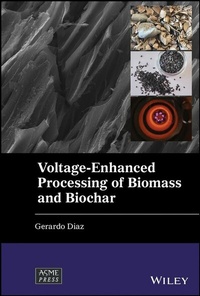
Voltage-Enhanced Processing of Biomass and Biochar
Description

A detailed introduction to voltage-enhanced processing of carbonaceous materials
While there are many well-established biomass processing techniques that are suitable for a variety of different situations, the utilization of voltage-driven techniques for the processing of biomass and biochar has been shown to have advantages for certain applications. Specifically, the field of thermal plasma gasification--where plasma provides the conversion energy--is relied upon in certain commercial equipment that is already available on the market. Crucially, however, the field of non-thermal plasma pyrolysis and gasification--chemical reactions are intensified by the presence of the plasma discharge--is still a developing subject with a great scope for innovation in research and development.
A timely book considering its potential applications in a greener market, Voltage-Enhanced Processing of Biomass and Biochar helpfully provides a detailed description of voltage-enhanced processing of carbonaceous materials. The book explains aspects of this processing method in thermal and non-thermal plasmas, as well as describing the effects of Joule heating as part of the temperature distribution and conversion rate. In many ways, this book presents a detailed description of different processes and plasma discharges currently available, with the provision of experimental and simulation results gathered over years of research and development. Importantly, it also offers many methods by which we can be environmentally friendly when working with biomass and biochar.
Voltage-Enhanced Processing of Biomass and Biochar readers will also find:
* Simulation results of Joule heating of biomass, biochar, and pyrolytic graphite
* Descriptions of thermal plasma torches currently available in the market
* Accounts of the experimental results of conversion utilizing steam plasma
* Comparison of results against provided numerical models that predict synthesis gas composition under the presence of thermal plasma discharge
Voltage-Enhanced Processing of Biomass and Biochar is a useful reference for researchers and practitioners working on applications of plasma for the conversion of biomass and biochar, as well as graduate students studying mechanical, electrical, and chemical engineering.
More details
Other editions
Additional editions
Person
Gerardo Diaz, PhD, is a Professor of Mechanical Engineering and Director of the Sustainable Plasma Gasification Lab at the University of California at Merced. He received his PhD in Mechanical Engineering from the University of Notre Dame in 2000.
Content
Contributors xi
Preface xiii
Acknowledgments xv
Acronyms xvii
Introduction xix
1 Carbonaceous Material Characterization 1
1.1 Material Characterization 2
1.1.1 Thermophysical properties 3
1.1.2 Moisture Content 3
1.1.3 Ultimate and Proximate analysis 4
1.1.4 Dielectric and electrical properties 4
1.2 Biomass 6
1.3 Biochar 7
1.3.1 Surface area, cation exchange capacity, and pH 9
1.4 Activated carbon 11
1.5 Pyrolytic graphite 11
Bibliography 12
2 Conventional Processing Methods 21
2.1 Biomass Processing 22
2.1.1 Biomass Pyrolysis 23
2.1.2 Biomass Gasification 26
2.2 Biochar production and post processing 28
2.2.1 Biochar Activation 34
Bibliography 44
3 Introduction to Plasmas 49
3.1 Thermal Plasmas 50
3.1.1 Mathematical model 53
3.2 Non-thermal Plasmas 56
3.2.1 DC non-thermal electrical discharges 59
3.2.2 Dielectric barrier discharge 64
3.2.3 Pulsed discharges 65
3.2.4 Gliding arc 66
3.2.5 Microwave-induced discharges 67
3.3 Impedance matching 68
3.4 Discharges in liquids 71
3.4.1 Contact glow discharge electrolysis 72
3.4.2 Plasma electrolysis with AC power 76
3.4.3 Gliding arc in glycerol for hydrogen generation 77
Bibliography 78
4 Voltage-Enhanced Processing of Biomass 85
4.1 Biomass gasification with thermal plasma 86
4.1.1 Plasma parameters 87
4.1.2 Syngas composition 88
4.1.3 Energy balance 92
4.1.4 Temperature decay in plasma/biomass discharge 95
4.2 Dielectric breakdown of biomass 97
4.2.1 Biomass-in-the-loop 98
4.3 Biomass gasification with non-thermal plasma 99
4.3.1 Tar breakdown 100
4.3.2 Circuit configuration 104
4.3.3 Scaling up of the technology 107
Bibliography 107
5 Voltage-Enhanced Processing of Biochar 113
5.1 DC Power Applied to Biochar 114
5.1.1 Joule heating of biochar 114
5.1.2 Joule heating of activated carbon 118
5.1.3 Recent Trends in Mathematical modelling 150
5.2 Physical activation of biochar with non-thermal plasma 159
5.2.1 Plasma-steam activation 160
Bibliography 162
6 Numerical simulations 167
6.1 Background 167
6.2 Modeling approaches 168
6.2.1 Kinetic approach 169
6.2.2 Fluid model approach 172
6.3 Examples of non-thermal plasma modeling 175
6.3.1 Cathode fall of a DC glow discharge 176
6.3.2 RF plasma discharge 179
6.3.3 Plasma chemistry 185
Bibliography 191
7 Control of plasma systems 195
7.1 Control of thermal plasma torches 196
7.1.1 Dynamics 198
7.1.2 Control 201
7.2 Control of nonthermal plasma discharges 207
7.2.1 Plasma diagnostics 208
7.2.2 AI-based control 209
Bibliography 214
1
Carbonaceous Material Characterization
1.1 Material Characterization
The thermochemical conversion of biomass by means of processes such as torrefaction, pyrolysis, or gasification, produces a char-like material with properties that differ considerably from the original feedstock. Further processing in the form of chemical or physical activation continues to modify the properties of the carbonaceous materials produced. The following Sections (1.1.1-1.1.4) provide a description of the main properties needed to characterize carbon-based materials for applications of biochar production and energy conversion.
1.1.1 Thermophysical Properties
Thermophysical properties are directly related to the structure and composition of the carbon-based materials. There is a large volume of studies that have analyzed their variation due to the effects of thermochemical conversion processes (Balogun et al., 2018). These properties not only have an impact in the operating conditions of processing equipment but also affect transportation costs and pollutant emissions. The thermal and physical properties have a strong dependence on parameters such as moisture content and temperature (James, 1975; Skaar, 1988; Dietenberger et al., 1999; Zelinka et al., 2007); therefore, various models have been developed to represent them as a function of these factors. The most relevant properties include thermal conductivity, density, and specific heat. However, a more detailed description of properties for biomass can be found in Ross (2010), De Jong (2014), Goss and Miller (1992), and Gaur and Reed (1995).
1.1.2 Moisture Content
The moisture content is defined as the mass of moisture (water) divided by the ovendry mass of the sample (Goss and Miller, 1992). The moisture content can be obtained by placing the sample in an oven filled with inert gas at a temperature of 105 C for 24 hours, and then applying Eq. (1.1) to calculate the fraction of moisture in the sample.
(1.1)where is the mass of the specimen at a given moisture content and is the mass of the ovendry specimen.
1.1.3 Ultimate and Proximate Analysis
The description of the composition of carbonaceous materials is usually obtained by performing an ultimate and proximate analysis. The ultimate analysis provides the chemical composition of a material, providing information about the contents of carbon, hydrogen, nitrogen, oxygen (by difference), and sulfur of a dry sample on a weight basis (CHNOS analysis). In addition, the analysis provides the heating value of the sample, which provides the energy released due to combustion of the material. The high heating value (HHV) considers that water present in the sample as well as water formed during the combustion process are in liquid state. On the other hand, the low heating value (LHV) considers that water has not been condensed. The proximate analysis provides the information about moisture, volatile matter, fixed carbon, and ash content of a particular sample. A detailed description of these analyses can be found in De Jong (2014).
1.1.4 Dielectric and Electrical Properties
Dielectric properties are important for the study of storage and dissipation of electric energy in materials (Bain and Chand, 2017). A dielectric is an insulating material that is a very poor conductor of electric current. Wood and other types of biomass behave as dielectrics, but as high voltages are applied, breakdown can occur, which constitutes an irreversible change of the material that allows current to flow through it. The main dielectric properties for applications of thermochemical conversion are the relative permittivity and loss tangent. The relative permittivity (also called dielectric constant) describes the ability of a material to absorb and store energy from an applied electric field (James, 1975), and it is defined as (Barker-Jarvis et al., 2001):
(1.2)where is the relative permittivity, is the absolute permittivity of the material, (F/m) is the permittivity of vacuum, and and are the real and imaginary parts of the relative permittivity. The relative permittivity can be represented by a scalar for a perfectly insulating material subject to DC voltage, but for AC voltage it is represented as a complex number given by Eq. (1.2), that varies significantly with respect to the applied frequency. The loss tangent denotes the dissipation of electric energy of a material and is defined as:
(1.3)In addition, as biomass is subject to thermochemical conversion, the char-like material produced has a higher electrical conductivity (an electrical property) than the original feedstock. When an electric field is applied to a material and a flow of current is established, part of the energy is dissipated as heat. As the resistivity of the material decreases due to thermal decomposition, the electrical conductivity characterizes the ability of the material to conduct electricity.
1.2 Biomass
Biomass is composed of renewable organic material that comes from plants and animals.1 The most common types of biomass used for power or heat generation come from forest or agricultural waste. Municipal solid waste (MSW) is not considered in this chapter due to the mixing of organic materials with other types of waste. The description of the dependency of biomass properties with respect to temperature and moisture is described in this section.
- Thermal conductivity: The thermal conductivity corresponds to the intrinsic ability of a material to conduct heat. According to the Handbook of Wood (Ross, 2010), for wood with moisture contents below 25%, the thermal conductivity can be obtained with the expression: (1.4) where is the specific gravity at moisture content (in %), and where , , and , for , and a temperature around 24 C, with %.
- Specific heat: The specific heat can be interpreted as the amount of heat required per unit of mass to raise the temperature of a sample by one degree (Sonntag et al., 1998). Its value as a function of temperature for dry wood can be approximated by the expression: (1.5) where the temperature is in Kelvin. For wood that contains a percentage of moisture, the specific heat can be calculated as: (1.6) where kJ/(kg K) is the specific heat of water and is a correction factor equal to: (1.7) where , and .
- Electrical conductivity: The electrical conductivity of wood depends on temperature and it can be approximated as (Skaar, 1988): (1.8) where has units of ( m). The dielectric constant can be estimated by a constant value of 800 (James, 1975; Dietenberger et al., 1999).
Tables 1.1-1.4 provide a list of properties for a number of biomass types.
1.3 Biochar
When biomass is heated to temperatures in the range between C in conditions of limited or no oxygen supply, char formation exists (White and Dietenberger, 2001), and its properties change dramatically with respect to the original biomass feedstock. Biochar is a material produced with the intention of using it as soil amendment. However, in many published works, this material is still referred to as biochar even if it is produced for other purposes such as liquid or gas filtration or as construction material.
In this chapter, average properties of biochar produced at C are summarized in Table 1.1. A more detailed summary of biochar properties can be found (Yang et al., 2017).
Table 1.1 List of thermophysical properties
Material Specific gravity W/(m K) (12% MC) Specific heata) kJ/(kg K) Hardwoodsb) 1.63 Ash (white) 0.63 0.17 Birch (yellow) 0.66 0.18 Elm (rock) 0.67 0.18 Maple (sugar) 0.66 0.18 Oak (red) 0.65 0.18 Oak (white) 0.72 0.19 Softwoodsb) 1.63 Cedar (Western red) 0.33 0.10 Douglas-fir (coast) 0.51 0.14 Pine (ponderosa) 0.42 0.12 Reedwood (old growth) 0.41 0.12 Biochar (peach pits) 0.5 0.38 1.1 Graphite 1.78 113 0.72Table 1.2 List of dielectric and...
