

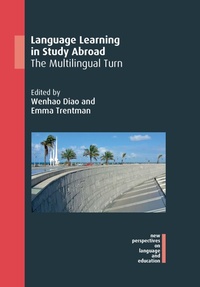
Language Learning in Study Abroad
The Multilingual Turn
Published on 4. March 2021
240 pages
978-1-80041-135-7 (ISBN)
Description

Vestiges of monolingual bias are present in the portrayal of study abroad as an idealized monolingual immersion experience and the steps many programs take to encourage or enforce target language monolingualism. In reality, study abroad is often inherently multilingual. This book addresses the need for a recognition of the multilingual realities of study abroad across a variety of traditional and non-traditional national contexts and target languages. The chapters examine multilingual socialization and translanguaging with peers, local hosts and instructors; how the target language is necessarily entwined in global, local and historical contexts; and how students negotiate the use of local and global varieties of English. Together the chapters present a powerful argument for scholars and study abroad practitioners to consider and critically incorporate multilingual realities into their research and planning.
Reviews / Votes
This compelling book ushers research on language learning in study abroad into a new era of commitment to social justice. Countering the myth of monolingual immersion, exploring the multilingual realities of student experiences and expanding the contexts under investigation, the volume will be a landmark contribution to the field. * Celeste Kinginger, Pennsylvania State University, USA * This timely volume uniquely illuminates hidden spaces of study abroad research by exposing plurilingual, translingual, and lingua franca realities. Chapters offer new perspectives on study abroad in demystifying the assumptions of monolingual, monocultural, and authentic immersion experiences. The book provides useful insights on linguistic, geographic, and ethnoracial multiplicities of study abroad. * Ryuko Kubota, University of British Columbia, Canada * ...this truly global book critiques a monolingual bias all too present across the academy-especially in study abroad program offerings for students [...] Having directed a faculty-led study abroad program for more than 20 years, this reviewer found the chapters timely and relevant with a solid theoretical grounding. The concluding chapter directly addresses next steps, and this reviewer was pleased to see the inclusion of the section on race and ethnicity as a key theme of this book. An excellent resource for faculty planning and/or leading study abroad programs in fields across the spectrum of higher education. -- D.M. Moss, University of Connecticut, USA * CHOICE Vol. 59 No. 6 *More details
Series
Language
English
Place of publication
Bristol
United Kingdom
Target group
College/higher education
Product notice
Reflowable
Dimensions
Height: 234 mm
Width: 156 mm
ISBN-13
978-1-80041-135-7 (9781800411357)
Copyright in bibliographic data and cover images is held by Nielsen Book Services Limited or by the publishers or by their respective licensors: all rights reserved.
Schweitzer Classification
Other editions
Additional editions
Book
03/2021
Multilingual Matters
€55.90
Shipment within 10-20 days
Persons
Wenhao Diao is an Associate Professor in the Department of East Asian Studies and the doctoral program of Second Language Acquisition and Teaching at the University of Arizona, USA. Her research focuses on the sociocultural and sociolinguistic aspects of Chinese language learning and teaching.
Emma Trentman is an Associate Professor of Arabic at the University of New Mexico, USA. She is co-editor of the journal Critical Multilingualism Studies. Her research focuses on multilingual approaches to Arabic language teaching and learning.
Emma Trentman is an Associate Professor of Arabic at the University of New Mexico, USA. She is co-editor of the journal Critical Multilingualism Studies. Her research focuses on multilingual approaches to Arabic language teaching and learning.
Content
Acknowledgements
Contributors
Emma Trentman and Wenhao Diao: Introduction
Chapter 1. Jamie A. Thomas: Ghanaian Multilinguals on Study Abroad in Tanzania: Learning Swahili through Akan/Twi and Cultures of Storytelling
Chapter 2. Uju Anya: When the Foreign is Familiar: An Afro-Dominican-American Woman's Experience Translanguaging Race, Ethnicity and Cultural Heritage Learning Portuguese in Brazil
Chapter 3. Janice McGregor: An Investigation of L2 Learning Peer Interactions in Short Term Study Abroad
Chapter 4. Emma Trentman: Monolingual Expectations and Plurilingual Realities in Arabic Study Abroad
Chapter 5. Wenhao Diao: Language Use, Class, and Study Abroad in China
Chapter 6. Lucien Brown: 'Sorry, I don't speak any English': An Activity-Theoretic Account of Language Choice in Study Abroad in South Korea
Chapter 7. Tracy Quan: Study Abroad as a Transformative Translanguaging Space for Heritage Speakers of Spanish
Chapter 8. Brandon Tullock: Encountering Multilingualism in Study Abroad: Sojourners' Orientations to Linguistic Diversity and Language Hierarchies in Barcelona
Chapter 9. Lourdes Ortega: Research on Language Learning during Study Abroad: What Next?
Contributors
Emma Trentman and Wenhao Diao: Introduction
Chapter 1. Jamie A. Thomas: Ghanaian Multilinguals on Study Abroad in Tanzania: Learning Swahili through Akan/Twi and Cultures of Storytelling
Chapter 2. Uju Anya: When the Foreign is Familiar: An Afro-Dominican-American Woman's Experience Translanguaging Race, Ethnicity and Cultural Heritage Learning Portuguese in Brazil
Chapter 3. Janice McGregor: An Investigation of L2 Learning Peer Interactions in Short Term Study Abroad
Chapter 4. Emma Trentman: Monolingual Expectations and Plurilingual Realities in Arabic Study Abroad
Chapter 5. Wenhao Diao: Language Use, Class, and Study Abroad in China
Chapter 6. Lucien Brown: 'Sorry, I don't speak any English': An Activity-Theoretic Account of Language Choice in Study Abroad in South Korea
Chapter 7. Tracy Quan: Study Abroad as a Transformative Translanguaging Space for Heritage Speakers of Spanish
Chapter 8. Brandon Tullock: Encountering Multilingualism in Study Abroad: Sojourners' Orientations to Linguistic Diversity and Language Hierarchies in Barcelona
Chapter 9. Lourdes Ortega: Research on Language Learning during Study Abroad: What Next?
