

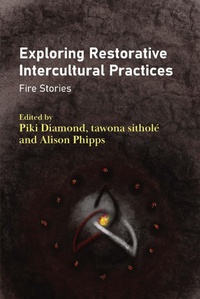
Exploring Restorative Intercultural Practices
Fire Stories
Published on 12. May 2026
296 pages
978-1-83668-078-9 (ISBN)
Description

Offers both a guide in restorative narrative methods for use with marginalised and exploited groups, and examples of what successful, guided work can look like in practice.
This book is a groundbreaking introduction to restorative intercultural practices. It explores the understanding of the narration and positionality of the researcher in a more-than-human world. Following a collaborative, call and response structure, the book explores how Indigenous people and refugees can lead the development of research methods in social scientific research.
It shows how practices from 'back home' and 'on the land' might be taught to researchers for ethical and consensual use. Beginning with the practices of the dare from Southern Africa and pepeha from Aotearoa New Zealand it offers a fresh discourse of restorative narrative research methodology. Above all it is an insight into how innovative academic work can develop from a context that prioritises collaboration, care and a holistic approach to humans and their experiences.
This book is open access under a CC BY ND licence.
This book is a groundbreaking introduction to restorative intercultural practices. It explores the understanding of the narration and positionality of the researcher in a more-than-human world. Following a collaborative, call and response structure, the book explores how Indigenous people and refugees can lead the development of research methods in social scientific research.
It shows how practices from 'back home' and 'on the land' might be taught to researchers for ethical and consensual use. Beginning with the practices of the dare from Southern Africa and pepeha from Aotearoa New Zealand it offers a fresh discourse of restorative narrative research methodology. Above all it is an insight into how innovative academic work can develop from a context that prioritises collaboration, care and a holistic approach to humans and their experiences.
This book is open access under a CC BY ND licence.
Reviews / Votes
This highly creative anthology demonstrates restorative practices of creating and sharing knowledge. It underlines the centrality of personal stories and individual voices, while foregrounding the interdependency of new narratives that emerge. Essential reading for all those wishing to understand what decolonizing and Indigenizing scholarship could and should look like. Join the open circle of the firepit. Accept the invitation to listen and to learn. * Charles Forsdick, University of Cambridge, UK * This is a profoundly significant work, exceptionally readable and suitable for a broad readership. By recounting personal experiences, the authors convey profound insights into how to transform challenges into invaluable sources of personal growth in a cross-cultural context. The narratives within are thoughtful, elegant, and compelling, emphasizing that in intercultural practice, what truly matters is not merely 'what occurred', but 'who we become through the experience'. * Jixia Lu, China Agricultural University * Koutou, nga kaikawe purakau e hono ana nga reo a tupuna, ki nga reo a taiao, paoho atu. Paoho atu nga kupu i runga i nga ia o nga hau, ki nga ao o nga rangi, mai i te ao turoa, ki te ao marama.Mauri ora!
Those of you whose stories connect the voices of the ancestors with the voices of the environment, spread the word. Transmit the words on the currents of the winds, to the worlds of the universe. From the natural world to the world of light and enlightenment.
Living energies! * Herewini Easton, Te Herenga Waka - Victoria University of Wellington, Aotearoa - New Zealand *
More details
Language
English
Place of publication
Bristol
United Kingdom
Publishing group
Channel View Publications Ltd
Target group
College/higher education
Product notice
Reflowable
File size
86,74 MB
ISBN-13
978-1-83668-078-9 (9781836680789)
Copyright in bibliographic data and cover images is held by Nielsen Book Services Limited or by the publishers or by their respective licensors: all rights reserved.
Schweitzer Classification
Other editions
Additional editions
Piki Diamond | tawona ganyamatope sithole | Alison Phipps
Exploring Restorative Intercultural Practices
Fire Stories
Book
05/2026
Multilingual Matters
€36.90
Shipment within 3-4 weeks
Persons
Piki Diamond is General Manager, Ruawhetu Charitable Trust, Aotearoa New Zealand.
tawona sithole is a poet and Lecturer in Creative Practice Education at the University of Glasgow, Scotland.
Alison Phipps is a poet and holds the UNESCO Chair in Refugee Integration through Education, Languages and Arts at the University of Glasgow, Scotland.
tawona sithole is a poet and Lecturer in Creative Practice Education at the University of Glasgow, Scotland.
Alison Phipps is a poet and holds the UNESCO Chair in Refugee Integration through Education, Languages and Arts at the University of Glasgow, Scotland.
Content
Images
Introduction
Part 1: The Fireside
Welcome to the Fireside
Come Gather Round
Alison's Story
Piki's Story
tawona's story
The Fire's Story - Open Circles
Practical Instructions
Designing Your Personal Pepeha
Mutupo Circles
Style Guide for Authors
Part 2: Stories from Fire: An Anthology of Storied Lives, Lands and Voyages
Introduction
Anika
Sadie
Hyab
Lucy
Sarah S
Pinar
Piki
Po ki runga o Whiria
Hannah
tawona
Leena
Hope
Esa
Nerea
Helene
Sarah T
Erdem
Paria
Dobrochna
Effie
Daniel
Catrin
Carly
Samira
Alison
Imagining for Real
Part 3: The Embers
Restorative Narrative Methodologies: Some Reflections on Care and Cultural Safety Work
How to Feed (Back) (Please Note)
Long Breath Out. This is a Poem. This is a Wave.
Acknowledgements Chorus
Author Biographies
Indicative References
Introduction
Part 1: The Fireside
Welcome to the Fireside
Come Gather Round
Alison's Story
Piki's Story
tawona's story
The Fire's Story - Open Circles
Practical Instructions
Designing Your Personal Pepeha
Mutupo Circles
Style Guide for Authors
Part 2: Stories from Fire: An Anthology of Storied Lives, Lands and Voyages
Introduction
Anika
Sadie
Hyab
Lucy
Sarah S
Pinar
Piki
Po ki runga o Whiria
Hannah
tawona
Leena
Hope
Esa
Nerea
Helene
Sarah T
Erdem
Paria
Dobrochna
Effie
Daniel
Catrin
Carly
Samira
Alison
Imagining for Real
Part 3: The Embers
Restorative Narrative Methodologies: Some Reflections on Care and Cultural Safety Work
How to Feed (Back) (Please Note)
Long Breath Out. This is a Poem. This is a Wave.
Acknowledgements Chorus
Author Biographies
Indicative References
