

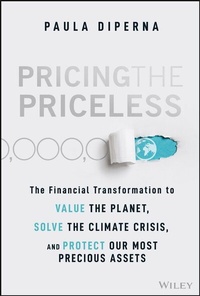
Pricing the Priceless
Description

In Pricing the Priceless: The Financial Transformation to Value the Planet, Solve the Climate Crisis, and Protect Our Most Precious Assets, renowned environmental strategist, speaker, world traveler and author Paula DiPerna brings a unique voice and optic to de-mystify and unveil today's most fascinating financial disruption--pricing the priceless to flip conventional ideas of how we value natural assets and why. She asks the provocative question long ignored: Why do we value the indispensable atmosphere at zero, but dispensable production in the trillions? She digs into alternatives, with real-life examples from around the globe of fascinating and pioneering financial innovations--controversial and paradoxical, but essential. In the book, you'll travel from rainforests to Wall Street, Board Rooms to the Vatican, coral reefs to mangroves to China's carbon markets. Timely, adventurous, eclectic, and accessible, Pricing the Priceless brings alive the critical financial transformation that will determine future planetary health and social stability.
With power, clarity and real-world experience, the author also examines:
* Fascinating new financial inventions and experiments--insurance, bonds, markets, investment funds--all aimed at pricing what is precious and vital to human well-being
* How the great current intergenerational shift in wealth and attitudes is redefining investment trends and the idea of what constitutes wealth and return
* How climate change and other urgent environmental problems now require entirely new financial thinking to trigger solutions
* How once-radical ideas about measuring economic progress are now re-imagining the very purpose of capitalism
* Why finance needs critical re-invention to remain credible in the face of increasing public skepticism of business-as-usual economic practice
A can't-miss read for thought leaders, business executives, investors, activists, and entrepreneurs, Pricing the Priceless is a landmark that will shape the world and future, bridging the tangible and intangible to answer a critical question of rising economic and social inspiration: What is money for?
More details
Other editions
Additional editions
Person
Content
1 Michelangelo's Finger: The Pope and the Atmosphere 1
2 Marooned: The Island of Wrong Things Measured 15
3 One of a Kind: The Gamble of Rarity and Price 31
4 Art in a Box: Pricelessness Saves Detroit 39
5 Mangroves and Money: All of Nature Is an Economic Machine 55
6 The Cosmic Penthouse: Carbon Pricing, Carbon Markets 69
7 Dare to Surmount: China Joins the Marathon 103
8 Wall Street to the Rescue? Nauru May Answer 121
9 Never Another Drop: The Flow of Water Markets 151
10 Wildlife and Wonderment: The Rhino Bond 177
11 Premiums to the Coral: Coral Reef Insurance 189
12 Forests as Infrastructure: The Forest Resilience Bond 197
13 Off Limits: The Value of Do Not Touch 213
14 Infinite Value: Return to Rome 241
References 247
Acknowledgments 253
Index 255
1
Michelangelo's Finger: The Pope and the Atmosphere
There was no hush when Pope Francis entered the Sala Clementina in the private Apostolic Palace in Rome. Instead, we flew to our feet in a standing ovation-some even hooted and cheered as if for a baseball hero who had hit it out of the park. But if this was not the standard decorum for the occasion, the pope did not seem to mind. He broke into a broad smile, walked across the room to greet his cardinals, and then took his place.
The pope does not usually grant audiences in July, we were told, but he was making an exception because of his stirring commitment to the topic at hand: climate change and its deleterious impacts especially on the poor, the core theme of his landmark environmental encyclical, Laudato Si, issued in 2015 just before a pivotal UN Climate Change Conference to be held in Paris. The encyclical placed the pope at the forefront of leadership on insisting that governments address the care of our common home, planet earth. The encyclical was not static, and the pope seemed intent on keeping it topical and in the public eye.
This meeting with him marked the third anniversary of Laudato Si, and we had all been invited to the Vatican to make suggestions for advancing the statement's meaning and impact.
My trip to Rome began in London, where I had flown from New York so I could spend the night and continue on reasonably rested first thing the next morning. I left my hotel so early that the lone night porter had to let me out, lifting the heavy brass bar bolted across the antique wooden lobby door.
Nearly alone on the city streets, the taxi driver peppered the trip with curious chitchat.
"Where are you flying?" he asked.
"To Rome," I replied.
"And what's that for, dearie?" he probed. "Vacation?"
I could not resist. "Believe it or not, I have an audience with the pope."
"Well, that's a big one, isn't it?" he said. Then, speechless for barely a second, he let out the long tale of how he had happened to get married twice. We all have our priorities, I thought.
Gatwick Airport was wide awake, its serpentine gallery of duty-free shops chock-full of dallying passengers, as if planes were no longer the point of airports.
At last I got to my gate, the zigzag aluminum boarding ramp shaking like a portable dock on a summer lake-no carved marble masterpiece staircases leading into grand Vatican meeting rooms quite yet.
But in Rome, American Express was keen to let us know where we'd arrived. "Don't tackle tagliatelle without it," warned the billboard in the customs hall.
I entered the joyful state of listening to Italian, trotting out my basic version. I had chosen a hotel just outside the Vatican, thinking I had better be a stone's throw from the action.
The driver knew the street but not the specific address. "Is it on the right or the left side of Concilazione?" he wondered. "If we knew, I could avoid a lot of turns." I didn't know and neither did his GPS.
We pushed on. The driver took a second to point out the Castel'Sant Angelo in full view nearby, and then said, "So signora, let's take a guess. What do you think-left or right?"
Life is always some sort of gamble in Italy, some aspect of a pursuit of the artful. "What would Tosca say?" I teased him back, knowing he'd get the Puccini opera reference for sure as we passed 'Sant'Angelo, site of the opera's last scene. He burst out laughing.
"Let's try right," said I.
That was wrong, but the driver gave me a stately bow as he dropped me on the nearest corner. My hotel was just a few suitcase rolls away, and so was St. Peter's Cathedral, icon of multitudes but that day, off-season, standing alone in silent gleaming white marble perfection. I had only to raise my eyes to take it all in.
In the morning, I found a Daily Gospel under my door. It turned out that the hotel doubled as the home base of the Salvatorians, a monastic order founded in the 1880s. I left the gospel on my desk and headed out.
Above, a sky-diving unbroken blue sky, and Rome's summer heat was very present. At the vaulted entrance to the square, homeless men were still curled up inside their overnight cardboard boxes, and trash was tucked between bricks as if treasured possessions left for future generations to find. In the street, a woman draped in black bent herself into a right angle like a bracket holding up a shelf, whispering her misery in such a choked yet audible voice, she might have been cast by Shakespeare to play a pauper hag to break our hearts.
Security guards and carabinieri were everywhere, and I could feel the eyes of the police on my back as I bent to tie my shoe, heading for the private Uffizi gate entrance.
What was I doing here, I, who had left the practice of Catholicism years ago? For one thing, I had a lifelong fear of all things Church dating back to my First Communion days, when the nuns commanded that we keep our heads down while the priests did their magic on the altar, turning bread and wine into the body and blood of Christ. Ask no questions, we were told, and so I peeked often, widening my fingers just enough to see if I alone was sneaking a look, thinking I was flirting with going to hell. In this cradle of obedience where rigid authority ruled, popes were beyond us all, out of imagination and out of reach.
But this new pope, the former cardinal from Argentina named Jorge Mario Bergoglio, elected Pope Francis in 2013, was close to real life, venturing directly into the concerns of real people wrestling with complexities and ambiguities. After all, when he declared shortly after becoming pope, "Who am I to judge?" about gay people of goodwill seeking their god, he stunned the world with his thoughtful grasp of the boundaries between theory and practice, and I welcomed with relief and admiration his astonishing rejection of dogma.
The pope was also bringing his moral authority to knotty environmental and economic issues, such as climate change, which have festered for decades without resolution because they, like some social issues, have also been prisoners of dogma and preconception. The major environmental problems that plague us today have defied resolution mostly because they defy certainty and easy rules.
The sweeping Laudato Si, published to global acclaim in the buildup to the UN conference in Paris, was intended to add the weight of the pope's voice to the impending international negotiations and clearly stated that nature is a common inheritance of all people equally. The pope urged all nations to once and for all accept the science of climate change as irrefutable and all environmental problems as a universal responsibility.
Still, on the subject of tactics and what to actually do, I felt obliged to challenge a few misguided but influential paragraphs in the pope's encyclical that would not help the cause. Refreshingly flexible on social issues, the pope seemed stuck like many with a tired, rigid mantra when it came to climate change and environment-that money, capitalism, and markets were the root of environmental evils. Specifically, the pope had too roundly reproached carbon markets and "carbon credits" as false, mere reflections of commercialism and permitting what he termed "the guise of a certain commitment to the environment."
However, I believed that when properly designed, monitored, and implemented, carbon markets were vital to implementing the pope's best hopes for Laudato Si. They are integral to the vital idea of "putting a price on carbon," for one thing, and so may be one of the very few effective economic means to reckon with global environmental urgency.
Pricing carbon means attaching a clear financial cost to emitting deleterious carbon dioxide and other greenhouse gases (GHGs) into the atmosphere from the burning of fossil fuels, otherwise a cost-free act of pollution. "Pricing carbon," a goal of environmental advocacy for decades, has never quite established itself in the financial mainstream because carbon markets have been set up in fits and starts in a patchwork of inconsistent policies, nation to nation.
Then, just as carbon markets had a chance to be accepted and coalesce globally, scheduled to be a high-priority discussion at the impending Paris conference, the pope was condemning them. So, to try to avoid this setback, I wrote the pope a letter to seek a change in his view. The subject line was "Laudato Si and 'Carbon Credits'-observations and possibly useful advice."
Dear Holy Father, it is in the spirit of mutual dedication and belief that I humbly bring to your attention some references in the Laudato Si that may benefit from reflection and modification and which may have resulted in advice that did not have the benefit of complete information on the topic, namely, environmental markets . that have tended to undermine confidence in useful tools . and the policy relative to a "price on carbon," an unfortunate shorthand that oversimplifies a complex matter. .
First, I would like to provide some philosophical and moral context for my views. As you well know, all of time stands still in Michelangelo's "Creation of Adam" on the ceiling of the Sistine Chapel,...
