

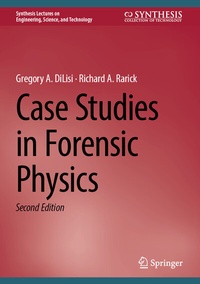
Case Studies in Forensic Physics
Description

This book applies basic principles of physics to conduct forensics-style re-examinations of several historical events. The authors familarize readers with introductory-level physics while demonstrating how physics concepts can be utilized to resolve historical debates about unsolved mysteries and controversial events. Each chapter introduces a new physics concept, then applies that concept to case studies in detail. The authors also identify the advantages of using case studies as a pedagogical approach to understanding physics. This second edition expands the number of physics principles and case studies covered. The book provides readers with the tools of a good forensic physicist and the ability to utilize them for real-world applications.
More details
Other editions
Additional editions
Previous edition
Persons
Gregory A. DiLisi, Ph.D., is a Professor of Education at John Carroll University. He earned his B.S. from Cornell University followed by his M.S. and Ph.D. from Case Western Reserve University. He has authored over 30 peer-reviewed journal articles, seven books, and has presented at numerous scientific and educational conferences of various professional societies. His research focuses on liquid crystals and complex fluids as well as science education.
Richard A. Rarick is a Lecturer in the Department of Electrical Engineering and Computer Science at Cleveland State University. He earned his B.S. and M.S. from Cleveland State University and has worked in the private sector as an engineer in the fields of digital signal processing and control theory. His research interests include electronics, control theory, electro-mechanical energy conversion, and embedded systems.
