


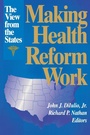
Making Health Reform Work
The View from the States
Published on 1. December 2010
190 pages
978-0-8157-4641-6 (ISBN)
Description

Nearly everyone agrees that the nation's health care system needs to be reformed. By mid-1994 over a half-dozen major reform plans were under consideration in Congress. But beyond the political challenge of passing a reform package lies an even bigger challenge¿how to make health reform work!
Critics of the Clinton plan have charged that it's too complex and doomed to administrative failure. Are they right? The nation's health care finance and delivery systems are already immensely complex and problem-ridden. Is it possible to achieve meaningful reforms without adopting new administrative strategies and structures that are equally complex? What role do the states now play in administering the nation's health care system? Is it possible to design administrative success into national health reform plans from the start?
Produced in close consultation with state health care officials from all around the country, this important volume offers practical and timely recommendations for how to make health reform work. It addresses the central implementation, management, and federalism dimensions of reform. Chapters by some of the country's leading health policy and public management experts explore the administrative challenges of reform as they relate to health alliances, cost containment, quality of care, medical education and training, and other key issues. They discuss various working principles for developing an administratively sound health reform policy.
The contributors are Lawrence D. Brown and Michael Sparer, Columbia University; Gerald Garvey, Princeton University; Donald F. Kettl, University of Wisconsin-Madison; James R. Tallon, United Hospital Fund; James W. Fossett and Frank J. Thompson, State University of New York, Albany.
Critics of the Clinton plan have charged that it's too complex and doomed to administrative failure. Are they right? The nation's health care finance and delivery systems are already immensely complex and problem-ridden. Is it possible to achieve meaningful reforms without adopting new administrative strategies and structures that are equally complex? What role do the states now play in administering the nation's health care system? Is it possible to design administrative success into national health reform plans from the start?
Produced in close consultation with state health care officials from all around the country, this important volume offers practical and timely recommendations for how to make health reform work. It addresses the central implementation, management, and federalism dimensions of reform. Chapters by some of the country's leading health policy and public management experts explore the administrative challenges of reform as they relate to health alliances, cost containment, quality of care, medical education and training, and other key issues. They discuss various working principles for developing an administratively sound health reform policy.
The contributors are Lawrence D. Brown and Michael Sparer, Columbia University; Gerald Garvey, Princeton University; Donald F. Kettl, University of Wisconsin-Madison; James R. Tallon, United Hospital Fund; James W. Fossett and Frank J. Thompson, State University of New York, Albany.
More details
Language
English
Place of publication
United States
Publishing group
Bloomsbury Publishing Plc
Target group
Professional and scholarly
File size
9,95 MB
ISBN-13
978-0-8157-4641-6 (9780815746416)
Copyright in bibliographic data and cover images is held by Nielsen Book Services Limited or by the publishers or by their respective licensors: all rights reserved.
Schweitzer Classification
Other editions
Additional editions
Book
09/1994
Brookings Institution
€28.30
Shipment within 10-20 days
Persons
John J. DiIulio, Jr., Frederic Fox Leadership Professor of politics, religion, and civil society at University of Pennsylvania and a nonresident senior fellow at Brookings, was a former assistant to the President and has served as a consultant for the National Institute of Justice and the National Institute of Corrections. He has authored and coauthored numerous books, including What's God Got to Do with the American Experiment? (Brookings, 2000), Body Count: Moral Poverty... and How to Win America's War Against Crime and Drugs (Simon & Schuster, 1996), Inside the Reinvention Machine: Appraising Governmental Reform (Brookings, 1995), and No Escape: The Future of American Corrections (Basic Books, 1991). Richard P. Nathan is professor of political science and public policy at the State University of New York, Albany. He also serves as director of the Nelson A. Rockefeller Institute of Government and as provost of the Rockefeller College of Public Affairs and Policy at the university.
