

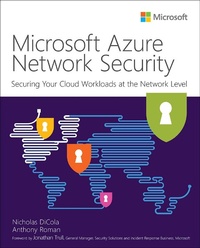
Microsoft Azure Network Security
1st Edition
Published on 2. June 2021
208 pages
978-0-13-725199-5 (ISBN)
Description

Master a complete strategy for protecting any Azure cloud network environment!
Network security is crucial to safely deploying and managing Azure cloud resources in any environment. Now, two of Microsoft's leading experts present a comprehensive, cloud-native approach to protecting your network, and safeguarding all your Azure systems and assets. Nicholas DiCola and Anthony Roman begin with a thoughtful overview of network security's role in the cloud. Next, they offer practical, real-world guidance on deploying cloud-native solutions for firewalling, DDOS, WAF, and other foundational services - all within a best-practice secure network architecture based on proven design patterns.
Two of Microsoft's leading Azure network security experts show how to:
Review Azure components and services for securing network infrastructure, and the threats to consider in using them
Layer cloud security into a Zero Trust approach that helps limit or contain attacks
Centrally direct and inspect traffic with the managed, stateful, Platform-as-a-Service Azure Firewall
Improve visibility into Azure traffic with Deep Packet Inspection
Optimize the way network and web application security work together
Use Azure DDoS Protection (Basic and Standard) to mitigate Layer 3 (volumetric) and Layer 4 (protocol) DDoS attacks
Enable log collection for Firewall, DDoS, WAF, and Bastion; and configure NSG Flow Logs and Traffic Analytics
Continually monitor network security with Azure Sentinel, Security Center, and Network Watcher
Customize queries, playbooks, workbooks, and alerts when Azure's robust out-of-the-box alerts and tools aren't enough
Build and maintain secure architecture designs that scale smoothly to handle growing complexity
About This Book
For Security Operations (SecOps) analysts, cybersecurity/information security professionals, network security engineers, and other IT professionals
For individuals with security responsibilities in any Azure environment, no matter how large, small, simple, or complex
Network security is crucial to safely deploying and managing Azure cloud resources in any environment. Now, two of Microsoft's leading experts present a comprehensive, cloud-native approach to protecting your network, and safeguarding all your Azure systems and assets. Nicholas DiCola and Anthony Roman begin with a thoughtful overview of network security's role in the cloud. Next, they offer practical, real-world guidance on deploying cloud-native solutions for firewalling, DDOS, WAF, and other foundational services - all within a best-practice secure network architecture based on proven design patterns.
Two of Microsoft's leading Azure network security experts show how to:
Review Azure components and services for securing network infrastructure, and the threats to consider in using them
Layer cloud security into a Zero Trust approach that helps limit or contain attacks
Centrally direct and inspect traffic with the managed, stateful, Platform-as-a-Service Azure Firewall
Improve visibility into Azure traffic with Deep Packet Inspection
Optimize the way network and web application security work together
Use Azure DDoS Protection (Basic and Standard) to mitigate Layer 3 (volumetric) and Layer 4 (protocol) DDoS attacks
Enable log collection for Firewall, DDoS, WAF, and Bastion; and configure NSG Flow Logs and Traffic Analytics
Continually monitor network security with Azure Sentinel, Security Center, and Network Watcher
Customize queries, playbooks, workbooks, and alerts when Azure's robust out-of-the-box alerts and tools aren't enough
Build and maintain secure architecture designs that scale smoothly to handle growing complexity
About This Book
For Security Operations (SecOps) analysts, cybersecurity/information security professionals, network security engineers, and other IT professionals
For individuals with security responsibilities in any Azure environment, no matter how large, small, simple, or complex
More details
Series
Edition
1. Auflage
Language
English
Place of publication
Boston
United States
Publishing group
Pearson Education (US)
Target group
Professional and scholarly
File size
26,26 MB
ISBN-13
978-0-13-725199-5 (9780137251995)
Copyright in bibliographic data and cover images is held by Nielsen Book Services Limited or by the publishers or by their respective licensors: all rights reserved.
Schweitzer Classification
Other editions
Additional editions
Nicholas DiCola | Anthony Roman
Microsoft Azure Network Security
Book
06/2021
Addison Wesley
€37.50
Shipment within 15-20 days
Persons
Nicholas DiCola is the principal director of the Cloud Security Customer Experience Engineering (CxE) team. CxE helps customers with deployments of Cloud Security products such as Azure Security Center, Azure Sentinel, Azure Network Security, Azure Information Protection, Microsoft Defender for Identities, and Microsoft Cloud Application Security. CxE is responsible for driving use of Cloud Security products and taking feedback from customers to improve the products. Nicholas has been with Microsoft since 2006 when he started in Microsoft Consulting Services. He has a Master of Business Administration with a concentration in information systems and various industry certifications such as CISSP and CEH.
Anthony Roman is the senior PM manager leading the Azure network security Get-To- Production team within Cloud Security CxE. The team works with customers and network security engineering to ensure that products are fulfilling customer security requirements. Anthony joined Microsoft in 2019 and has held positions in IT and security since he made the transition from bartender to IT security professional a decade earlier. His Bachelor of Arts degree in philosophy is complemented by several industry certifications and plenty of on-the-job and home lab experience.
Anthony Roman is the senior PM manager leading the Azure network security Get-To- Production team within Cloud Security CxE. The team works with customers and network security engineering to ensure that products are fulfilling customer security requirements. Anthony joined Microsoft in 2019 and has held positions in IT and security since he made the transition from bartender to IT security professional a decade earlier. His Bachelor of Arts degree in philosophy is complemented by several industry certifications and plenty of on-the-job and home lab experience.
Content
Chapter 1 Introduction to Azure Network Security
Chapter 2 Secure Azure Network architectures
Chapter 3 Controlling traffic with Azure Firewall
Chapter 4 Traffic Inspection in Azure Networks
Chapter 5 Secure application delivery with Azure Web Application Firewall
Chapter 6 Mitigating DDoS attacks
Chapter 7 Enabling Network Security log collection
Chapter 8 Security monitoring with Azure Sentinel, Security Center, and Network Watcher
Chapter 9 Combining Azure resources for a wholistic network security strategy
Chapter 2 Secure Azure Network architectures
Chapter 3 Controlling traffic with Azure Firewall
Chapter 4 Traffic Inspection in Azure Networks
Chapter 5 Secure application delivery with Azure Web Application Firewall
Chapter 6 Mitigating DDoS attacks
Chapter 7 Enabling Network Security log collection
Chapter 8 Security monitoring with Azure Sentinel, Security Center, and Network Watcher
Chapter 9 Combining Azure resources for a wholistic network security strategy
