

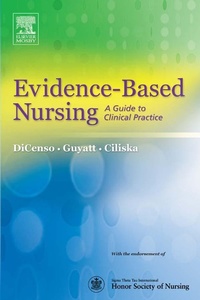
Evidence-Based Nursing
A Guide to Clinical Practice
Published on 10. January 2005
640 pages
978-0-323-08090-3 (ISBN)
Description

Evidence Based Nursing is written in response to numerous requests by nurse practitioners and other graduate faculty for a nursing literature resource. This reader-friendly, accessible guide features plentiful examples from the nursing literature and the addition of specific nursing issues such as qualitative research, with direct application for clinical practice. The guide enables nurses to: frame their clinical questions in a way that will help them find the evidence to support their opinions; distinguish between strong and weak evidence; clearly understand study results; weigh the risks and benefits of management options; and apply the evidence to their individual patients to improve outcomes. Part One provides a basic approach to the problems faced by nurses when determining optimal care, predicting patient progress, and protecting patients from potentially harmful side effects, in addition to including a literature assessment summary and management recommendations. Part Two expands on Part One, providing concrete examples through case studies.
- This is the only book of its kind that helps nurses use the nursing literature effectively to solve patient problems.
- Three-step approach to dissecting a problem - to help find the best evidence and improve patient care, most questions can be divided into three parts: (1) Are the results valid? (2) What are the results? and (3) How can I apply the results to patient care?
- Part One - The Basics: Using the Nursing Literature provides a basic approach to the problems faced by nurses when determining optimal care, predicting patient progress, and protecting patients from potentially harmful side effects and includes a literature assessment summary and management recommendations.
- Part Two - Beyond the Basics: Using and Teaching the Principles of Evidence-Based Nursing expands on Part One, providing concrete examples through the presentation of cases.
- Two-part organization helps both beginners and those more accomplished at using the nursing literature.
- Clinical Scenario provides a brief but detailed description of a clinical situation that requires the application of research through a critical thinking process.
- Using the Guide examines a clinical scenario, and then evaluates the way in which research findings are collected, analyzed, and applied to the resolution of the problem presented in the scenario.
- Free CD-ROM contains everything found in the book, allowing for electronic outlining, content filtering, full-text searching, and alternative content organizations.
More details
Other editions
Additional editions
Book
01/2005
Mosby
€58.17
Article exhausted; check different version
Content
PART I - The Basics: Using the Nursing LiteratureChapter 1: Introduction to Evidence-Based NursingChapter 2: Finding the EvidenceChapter 3: Health Care Interventions and Harm: An IntroductionChapter 4: Health Care InterventionsChapter 5: HarmChapter 6: DiagnosisChapter 7: PrognosisChapter 8: Qualitative ResearchChapter 9: Summarizing the Evidence Through Systematic ReviewsChapter 10: Moving from Evidence to Action Using Clinical Practice GuidelinesChapter 11: Changing Nursing Practice in an OrganizationPART II - Beyond the Basics: Using and Teaching the Principles of Evidence-Based NursingUnit I: Health Care InterventionsChapter 12: Quality of LifeChapter 13: Surrogate OutcomesChapter 14: Surprising Results of Randomized Controlled TrialsChapter 15: The Principle of Intention-to-TreatChapter 16: When to Believe a Subgroup AnalysisUnit II: Health Services ResearchChapter 17: Health Services InterventionsChapter 18: Economic EvaluationChapter 19: Computer Decision Support SystemsUnit III: DiagnosisChapter 20: Clinical Manifestations of DiseaseChapter 21: Differential DiagnosisChapter 22: Clinical Prediction RulesUnit IV: Summarizing the Evidence Through Systematic ReviewsChapter 23: Publication BiasChapter 24: Evaluating Differences in Study ResultsChapter 25: Fixed-Effects and Random-Effects ModelsUnit V: Understanding the ResultsChapter 26: Bias and Random ErrorChapter 27: Measures of AssociationChapter 28: HypothesisTestingChapter 29: Confidence IntervalsChapter 30: Measuring Agreement Beyond Chance Chapter 31: Regression and CorrelationUnit VI: Moving from Evidence to ActionChapter 32: Number Needed to TreatChapter 33: Applying Results to Individual PatientsChapter 34: Incorporating Patient ValuesChapter 35: Interpreting Levels of Evidence and Grades of Health Care RecommendationsChapter 36: Recommendations about ScreeningAppendixGlossaryIndexCD-ROM Installation Instructions
