

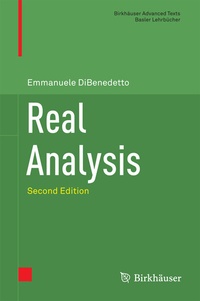
Real Analysis
Description

The second edition of this classic textbook presents a rigorous and self-contained introduction to real analysis with the goal of providing a solid foundation for future coursework and research in applied mathematics. Written in a clear and concise style, it covers all of the necessary subjects as well as those often absent from standard introductory texts. Each chapter features a "Problems and Complements" section that includes additional material that briefly expands on certain topics within the chapter and numerous exercises for practicing the key concepts.
The first eight chapters explore all of the basic topics for training in real analysis, beginning with a review of countable sets before moving on to detailed discussions of measure theory, Lebesgue integration, Banach spaces, functional analysis, and weakly differentiable functions. More topical applications are discussed in the remaining chapters, such as maximal functions, functions of bounded mean oscillation, rearrangements, potential theory, and the theory of Sobolev functions. This second edition has been completely revised and updated and contains a variety of new content and expanded coverage of key topics, such as new exercises on the calculus of distributions, a proof of the Riesz convolution, Steiner symmetrization, and embedding theorems for functions in Sobolev spaces.
Ideal for either classroom use or self-study, Real Analysis is an excellent textbook both for students discovering real analysis for the first time and for mathematicians and researchers looking for a useful resource for reference or review.
Praise for the First Edition:
"[This book] will be extremely useful as a text. There is certainly enough material for a year-long graduate course, but judicious selection would make it possible to use this most appealing book in a one-semester course for well-prepared students."
-Mathematical Reviews
Reviews / Votes
"The book is a valuable, comprehensive reference source on real analysis. The first eight chapters cover core material that is part of most courses taught on the subject, followed by a collection of special topics that stay within the framework of real analysis. In addition to the content, what makes the book especially useful as a reference source is its organization. . Summing Up: Recommended. Graduate students and faculty. This work should be used solely as a reference." (M. Bona, Choice, Vol. 54 (9), May, 2017)
"The reader can find many interesting details which serve to illuminate the diamonds of analysis. The list of references contains the main books and articles which form the modern real analysis. The book can be recommended as one of the main readings on real analysis for those who are interested in this subject and its numerous applications." (Sergei V. Rogosin, zbMATH 1353.26001, 2017)More details
Other editions
Additional editions
Previous edition
Person
Content
- Intro
- Preface to the Second Edition
- Preface to the First Edition
- Acknowledgments
- Contents
- 1 Preliminaries
- 1 Countable Sets
- 2 The Cantor Set
- 3 Cardinality
- 3.1 Some Examples
- 4 Cardinality of Some Infinite Cartesian Products
- 5 Orderings, the Maximal Principle, and the Axiom of Choice
- 6 Well Ordering
- 6.1 The First Uncountable
- 1c Countable Sets
- 2c The Cantor Set
- 2.1c A Generalized Cantor Set of Positive Measure
- 2.2c A Generalized Cantor Set of Measure Zero
- 2.3c Perfect Sets
- 3c Cardinality
- 2 Topologies and Metric Spaces
- 1 Topological Spaces
- 1.1 Hausdorff and Normal Spaces
- 2 Urysohn's Lemma
- 3 The Tietze Extension Theorem
- 4 Bases, Axioms of Countability and Product Topologies
- 4.1 Product Topologies
- 5 Compact Topological Spaces
- 5.1 Sequentially Compact Topological Spaces
- 6 Compact Subsets of mathbbRN
- 7 Continuous Functions on Countably Compact Spaces
- 8 Products of Compact Spaces
- 9 Vector Spaces
- 9.1 Convex Sets
- 9.2 Linear Maps and Isomorphisms
- 10 Topological Vector Spaces
- 10.1 Boundedness and Continuity
- 11 Linear Functionals
- 12 Finite Dimensional Topological Vector Spaces
- 12.1 Locally Compact Spaces
- 13 Metric Spaces
- 13.1 Separation and Axioms of Countability
- 13.2 Equivalent Metrics
- 13.3 Pseudo Metrics
- 14 Metric Vector Spaces
- 14.1 Maps Between Metric Spaces
- 15 Spaces of Continuous Functions
- 15.1 Spaces of Continuously Differentiable Functions
- 15.2 Spaces of Hölder and Lipschitz Continuous Functions
- 16 On the Structure of a Complete Metric Space
- 16.1 The Uniform Boundedness Principle
- 17 Compact and Totally Bounded Metric Spaces
- 17.1 Pre-Compact Subsets of X
- 1c Topological Spaces
- 1.12c Connected Spaces
- 1.19c Separation Properties of Topological Spaces
- 4c Bases, Axioms of Countability and Product Topologies
- 4.10c The Box Topology
- 5c Compact Topological Spaces
- 5.8c The Alexandrov One-Point Compactification of {X
- mathcalU} ([3])
- 7c Continuous Functions on Countably Compact Spaces
- 7.1c Upper-Lower Semi-continuous Functions
- 7.2c Characterizing Lower-Semi Continuous Functions in mathbbRN
- 7.3c On the Weierstrass-Baire Theorem
- 7.4c On the Assumptions of Dini's Theorem
- 9c Vector Spaces
- 9.3c Hamel Bases
- 9.6c On the Dimension of a Vector Space
- 10c Topological Vector Spaces
- 13c Metric Spaces
- 13.10c The Hausdorff Distance of Sets
- 13.11c Countable Products of Metric Spaces
- 14c Metric Vector Spaces
- 15c Spaces of Continuous Functions
- 15.1c Spaces of Hölder and Lipschitz Continuous Functions
- 16c On the Structure of a Complete Metric Space
- 16.3c Completion of a Metric Space
- 16.4c Some Consequences of the Baire Category Theorem
- 17c Compact and Totally Bounded Metric Spaces
- 17.1c An Application of the Lebesgue Number Lemma
- 3 Measuring Sets
- 1 Partitioning Open Subsets of mathbbRN
- 2 Limits of Sets, Characteristic Functions, and s-Algebras
- 3 Measures
- 3.1 Finite, s-Finite, and Complete Measures
- 3.2 Some Examples
- 4 Outer Measures and Sequential Coverings
- 4.1 The Lebesgue Outer Measure in mathbbRN
- 4.2 The Lebesgue--Stieltjes Outer Measure [89, 154]
- 5 The Hausdorff Outer Measure in mathbbRN [71]
- 5.1 Metric Outer Measures
- 6 Constructing Measures from Outer Measures [26]
- 7 The Lebesgue--Stieltjes Measure on mathbbR
- 7.1 Borel Measures
- 8 The Hausdorff Measure on mathbbRN
- 9 Extending Measures from Semi-algebras to s-Algebras
- 9.1 On the Lebesgue--Stieltjes and Hausdorff Measures
- 10 Necessary and Sufficient Conditions for Measurability
- 11 More on Extensions from Semi-algebras to s-Algebras
- 12 The Lebesgue Measure of Sets in mathbbRN
- 12.1 A Necessary and Sufficient Condition of Measurability
- 13 Vitali's Nonmeasurable Set [168]
- 14 Borel Sets, Measurable Sets, and Incomplete Measures
- 14.1 A Continuous Increasing Function f:[0,1]to[0,1]
- 14.2 On the Preimage of a Measurable Set
- 14.3 Proof of Propositions 14.1 and 14.2
- 15 Borel Measures
- 16 Borel, Regular, and Radon Measures
- 16.1 Regular Borel Measures
- 16.2 Radon Measures
- 17 Vitali Coverings
- 18 The Besicovitch Covering Theorem
- 19 Proof of Proposition 18.1
- 20 The Besicovitch Measure-Theoretical Covering Theorem
- 1c Partitioning Open Subsets of mathbbRN
- 2c Limits of Sets, Characteristic Functions and s-Algebras
- 3c Measures
- 3.1c Completion of a Measure Space
- 4c Outer Measures
- 5c The Hausdorff Outer Measure in mathbbRN
- 5.1c The Hausdorff Dimension of a Set EsubsetmathbbRN
- 5.2c The Hausdorff Dimension of the Cantor Set is ln 2/ln 3
- 8c The Hausdorff Measure in mathbbRN
- 8.1c Hausdorff Outer Measure of the Lipschitz Image of a Set
- 8.2c Hausdorff Dimension of Graphs of Lipschitz Functions
- 9c Extending Measures from Semi-algebras to s-Algebras
- 9.1c Inner and Outer Continuity of ? on Some Algebra mathcalQ
- 10c More on Extensions from Semi-algebras to s-Algebras
- 10.1c Self-extensions of Measures
- 10.2c Nonunique Extensions of Measures ? on Semi-algebras
- 12c The Lebesgue Measure of Sets in mathbbRN
- 12.1c Inner Measure and Measurability
- 12.2c The Peano--Jordan Measure of Bounded Sets in mathbbRN
- 12.3c Lipschitz Functions and Measurability
- 13c Vitali's Nonmeasurable Set
- 14c Borel Sets, Measurable Sets and Incomplete Measures
- 16c Borel, Regular and Radon Measures
- 16.1c Regular Borel Measures
- 16.2c Regular Outer Measures
- 17c Vitali Coverings
- 17.1c Pointwise and Measure-Theoretical Vitali Coverings
- 18c The Besicovitch Covering Theorem
- 18.1c The Besicovitch Theorem for Unbounded E
- 18.2c The Besicovitch Measure-Theoretical Inner Covering of Open Sets EsubsetmathbbRN
- 18.3c A Simpler Form of the Besicovitch Theorem
- 18.4c Another Besicovitch-Type Covering
- 4 The Lebesgue Integral
- 1 Measurable Functions
- 2 The Egorov--Severini Theorem [39, 145]
- 2.1 The Egorov--Severini Theorem in mathbbRN
- 3 Approximating Measurable Functions by Simple Functions
- 4 Convergence in Measure (Riesz [125], Fisher [46])
- 5 Quasicontinuous Functions and Lusin's Theorem
- 6 Integral of Simple Functions ([87])
- 7 The Lebesgue Integral of Nonnegative Functions
- 8 Fatou's Lemma and the Monotone Convergence Theorem
- 9 More on the Lebesgue Integral
- 10 Convergence Theorems
- 11 Absolute Continuity of the Integral
- 12 Product of Measures
- 13 On the Structure of (mathcalAtimesmathcalB)
- 14 The Theorem of Fubini--Tonelli
- 14.1 The Tonelli Version of the Fubini Theorem
- 15 Some Applications of the Fubini--Tonelli Theorem
- 15.1 Integrals in Terms of Distribution Functions
- 15.2 Convolution Integrals
- 15.3 The Marcinkiewicz Integral ([101, 102])
- 16 Signed Measures and the Hahn Decomposition
- 17 The Radon-Nikodým Theorem
- 17.1 Sublevel Sets of a Measurable Function
- 17.2 Proof of the Radon-Nikodým Theorem
- 18 Decomposing Measures
- 18.1 The Jordan Decomposition
- 18.2 The Lebesgue Decomposition
- 18.3 A General Version of the Radon-Nikodým Theorem
- 1c Measurable Functions
- 1.1c Sublevel Sets
- 2c The Egorov--Severini Theorem
- 3c Approximating Measurable Functions by Simple Functions
- 4c Convergence in Measure
- 7c The Lebesgue Integral of Nonnegative Measurable Functions
- 7.1c Comparing the Lebesgue Integral with the Peano-Jordan Integral
- 7.2c On the Definition of the Lebesgue Integral
- 9c More on the Lebesgue Integral
- 10c Convergence Theorems
- 10.1c Another Version of Dominated Convergence
- 11c Absolute Continuity of the Integral
- 12c Product of Measures
- 12.1c Product of a Finite Sequence of Measure Spaces
- 13c On the Structure of (mathcalAtimesmathcalB)
- 13.1c Sections and Their Measure
- 14c The Theorem of Fubini--Tonelli
- 15c Some Applications of the Fubini--Tonelli Theorem
- 15.1c Integral of a Function as the ``Area Under the Graph''
- 15.2c Distribution Functions
- 17c The Radon-Nikodým Theorem
- 18c A Proof of the Radon-Nikodým Theorem When Both µ and ? Are s-Finite
- 5 Topics on Measurable Functions of Real Variables
- 1 Functions of Bounded Variation ([78])
- 2 Dini Derivatives ([37])
- 3 Differentiating Functions of Bounded Variation
- 4 Differentiating Series of Monotone Functions
- 5 Absolutely Continuous Functions ([91, 169])
- 6 Density of a Measurable Set
- 7 Derivatives of Integrals
- 8 Differentiating Radon Measures
- 9 Existence and Measurability of Dµ?
- 9.1 Proof of Proposition 9.2
- 10 Representing Dµ?
- 10.1 Representing Dµ? for ?llµ
- 10.2 Representing Dµ? for ?perpµ
- 11 The Lebesgue-Besicovitch Differentiation Theorem
- 11.1 Points of Density
- 11.2 Lebesgue Points of an Integrable Function
- 12 Regular Families
- 13 Convex Functions
- 14 The Jensen's Inequality
- 15 Extending Continuous Functions
- 15.1 The Concave Modulus of Continuity of f
- 16 The Weierstrass Approximation Theorem
- 17 The Stone-Weierstrass Theorem
- 18 Proof of the Stone-Weierstrass Theorem
- 18.1 Proof of Stone's Theorem
- 19 The Ascoli-Arzelà Theorem
- 19.1 Pre-compact Subsets of C(barE)
- 1c Functions of Bounded Variations
- 1.1c The Function of The Jumps
- 1.2c The Space BV[a,b]
- 2c Dini Derivatives
- 2.1c A Continuous, Nowhere Differentiable Function ([167])
- 2.2c An Application of the Baire Category Theorem
- 4c Differentiating Series of Monotone Functions
- 5c Absolutely Continuous Functions
- 5.1c The Cantor Ternary Function ([23])
- 5.2c A Continuous Strictly Monotone Function with a.e. Zero Derivative
- 5.3c Absolute Continuity of the Distribution Function of a Measurable Function
- 7c Derivatives of Integrals
- 7.1c Characterizing BV[a,b] Functions
- 7.2c Functions of Bounded Variation in N Dimensions [55]
- 13c Convex Functions
- 13.8c Convex Functions in mathbbRN
- 13.14c The Legendre Transform ([92])
- 13.15c Finiteness and Coercivity
- 13.16c The Young's Inequality
- 14c Jensen's Inequality
- 14.1c The Inequality of the Geometric and Arithmetic Mean
- 14.2c Integrals and Their Reciprocals
- 15c Extending Continuous Functions
- 16c The Weierstrass Approximation Theorem
- 17c The Stone-Weierstrass Theorem
- 19c A General Version of the Ascoli-Arzelà Theorem
- 6 The Lp Spaces
- 1 Functions in Lp(E) and Their Norm
- 2 The Hölder and Minkowski Inequalities
- 3 More on the Spaces Lp and Their Norm
- 3.1 Characterizing the Norm "026B30D f"026B30D p for 1lep&infty
- 3.2 The Norm "026B30D cdot"026B30D infty for E of Finite Measure
- 3.3 The Continuous Version of the Minkowski Inequality
- 4 Lp(E) for 1lepleinfty as Normed Spaces of Equivalence Classes
- 4.1 Lp(E) for 1lePleinfty as a Metric Topological Vector Space
- 5 Convergence in Lp(E) and Completeness
- 6 Separating Lp(E) by Simple Functions
- 7 Weak Convergence in Lp(E)
- 7.1 Counterexample
- 8 Weak Lower Semi-continuity of the Norm in Lp(E)
- 9 Weak Convergence and Norm Convergence
- 9.1 Proof of Proposition 9.1 for pge2
- 9.2 Proof of Proposition 9.1 for 1&p&2
- 10 Linear Functionals in Lp(E)
- 11 The Riesz Representation Theorem
- 11.1 Proof of Theorem 11.1: The Case of {X,mathcalA,µ} Finite
- 11.2 Proof of Theorem 11.1: The Case of {X,mathcalA,µ} s-Finite
- 11.3 Proof of Theorem 11.1: The Case 1&p&infty
- 12 The Hanner and Clarkson Inequalities
- 12.1 Proof of Hanner's Inequalities
- 12.2 Proof of Clarkson's Inequalities
- 13 Uniform Convexity of Lp(E) for 1&p&infty
- 14 The Riesz Representation Theorem By Uniform Convexity
- 14.1 Proof of Theorem 14.1. The Case 1&p&infty
- 14.2 The Case p=1 and E of Finite Measure
- 14.3 The Case p=1 and {X,mathcalA,µ} s-Finite
- 15 If EsubsetmathbbRN and pin[1,infty), then Lp(E) Is Separable
- 15.1 Linfty(E) Is Not Separable
- 16 Selecting Weakly Convergent Subsequences
- 17 Continuity of the Translation in Lp(E) for 1lep&infty
- 17.1 Continuity of the Convolution
- 18 Approximating Functions in Lp(E) with Functions in Cinfty(E)
- 19 Characterizing Pre-compact Sets in Lp(E)
- 1c Functions in Lp(E) and Their Norm
- 1.1c The Spaces Lp for 0&p&1
- 1.2c The Spaces Lq for q&0
- 1.3c The Spaces ellp for 1lePleinfty
- 2c The Inequalities of Hölder and Minkowski
- 2.1c Variants of the Hölder and Minkowski Inequalities
- 2.2c Some Auxiliary Inequalities
- 2.3c An Application to Convolution Integrals
- 2.4c The Reverse Hölder and Minkowski Inequalities
- 2.5c Lp(E)-Norms and Their Reciprocals
- 3c More on the Spaces Lp and Their Norm
- 3.4c A Metric Topology for Lp(E) when 0&p&1
- 3.5c Open Convex Subsets of Lp(E) for 0&p&1
- 5c Convergence in Lp(E) and Completeness
- 5.1c The Measure Space {X,mathcalA,µ} and the Metric Space {mathcalA
- d}
- 6c Separating Lp(E) by Simple Functions
- 7c Weak Convergence in Lp(E)
- 7.3c Comparing the Various Notions of Convergence
- 7.5c Weak Convergence in ellp
- 9c Weak Convergence and Norm Convergence
- 9.1c Proof of Lemmas 9.1 and 9.2
- 11c The Riesz Representation Theorem
- 11.1c Weakly Cauchy Sequences in Lp(X) for 1& pleinfty
- 11.2c Weakly Cauchy Sequences in Lp(X) for p=1
- 11.3c The Riesz Representation Theorem in ellp
- 14c The Riesz Representation Theorem By Uniform Convexity
- 14.1c Bounded Linear Functional in Lp(E) for 0&p&1
- 14.2c An Alternate Proof of Proposition 14.1c
- 15c If EsubsetmathbbRN and pin[1,infty), then Lp(E) Is Separable
- 18c Approximating Functions in Lp(E) with Functions in Cinfty(E)
- 18.1c Caloric Extensions of Functions in Lp(mathbbRN)
- 18.2c Harmonic Extensions of Functions in Lp(mathbbRN)
- 18.3c Characterizing Hölder Continuous Functions
- 19c Characterizing Pre-compact Sets in Lp(E)
- 19.1c The Helly's Selection Principle
- 20c The Vitali-Saks-Hahn Theorem [59, 138, 170]
- 21c Uniformly Integrable Sequences of Functions
- 22c Relating Weak and Strong Convergence and Convergence in Measure
- 23c An Independent Proof of Corollary 22.1c
- 7 Banach Spaces
- 1 Normed Spaces
- 1.1 Semi-norms and Quotients
- 2 Finite and Infinite Dimensional Normed Spaces
- 2.1 A Counterexample
- 2.2 The Riesz Lemma
- 2.3 Finite Dimensional Spaces
- 3 Linear Maps and Functionals
- 4 Examples of Maps and Functionals
- 4.1 Functionals
- 4.2 Linear Functionals on C(barE)
- 4.3 Linear Functionals on Ca(barE) for Some ain(0,1)
- 5 Kernels of Maps and Functionals
- 6 Equibounded Families of Linear Maps
- 6.1 Another Proof of Proposition 6.1
- 7 Contraction Mappings
- 7.1 Applications to Some Fredholm Integral Equations
- 8 The Open Mapping Theorem
- 8.1 Some Applications
- 8.2 The Closed Graph Theorem
- 9 The Hahn--Banach Theorem
- 10 Some Consequences of the Hahn--Banach Theorem
- 10.1 Tangent Planes
- 11 Separating Convex Subsets of a Hausdorff, Topological Vector Space {X
- mathcalU}
- 11.1 Separation in Locally Convex, Hausdorff, Topological Vector Spaces {X
- mathcalU}
- 12 Weak Topologies
- 12.1 Weak Boundedness
- 12.2 Weakly and Strongly Closed Convex Sets
- 13 Reflexive Banach Spaces
- 14 Weak Compactness
- 14.1 Weak Sequential Compactness
- 15 The Weak* Topology of X*
- 16 The Alaoglu Theorem
- 17 Hilbert Spaces
- 17.1 The Schwarz Inequality
- 17.2 The Parallelogram Identity
- 18 Orthogonal Sets, Representations and Functionals
- 18.1 Bounded Linear Functionals on H
- 19 Orthonormal Systems
- 19.1 The Bessel Inequality
- 19.2 Separable Hilbert Spaces
- 20 Complete Orthonormal Systems
- 20.1 Equivalent Notions of Complete Systems
- 20.2 Maximal and Complete Orthonormal Systems
- 20.3 The Gram--Schmidt Orthonormalization Process ([142])
- 20.4 On the Dimension of a Separable Hilbert Space
- 1c Normed Spaces
- 1.1c Semi-Norms and Quotients
- 2c Finite and Infinite Dimensional Normed Spaces
- 3c Linear Maps and Functionals
- 6c Equibounded Families of Linear Maps
- 8c The Open Mapping Theorem
- 9c The Hahn--Banach Theorem
- 9.1c The Complex Hahn--Banach Theorem
- 9.2c Linear Functionals in Linfty(E)
- 11c Separating Convex Subsets of X
- 11.1c A Counterexample of Tukey [164]
- 11.2c A Counterexample of Goffman and Pedrick [56]
- 11.3c Extreme Points of a Convex Set
- 11.4c A General Version of the Krein--Milman Theorem
- 12c Weak Topologies
- 12.1c Infinite Dimensional Normed Spaces
- 12.2c About Corollary 12.5
- 12.3c Weak Closure and Weak Sequential Closure
- 14c Weak Compactness
- 14.1c Linear Functionals on Subspaces of C(barE)
- 14.2c Weak Compactness and Boundedness
- 15c The Weak* Topology of X*
- 15.1c Total Sets of X
- 15.2c Metrization Properties of Weak* Compact Subsets of X*
- 16c The Alaoglu Theorem
- 16.1c The Weak* Topology of X**
- 16.2c Characterizing Reflexive Banach Spaces
- 16.3c Metrization Properties of the Weak Topology of the Closed Unit Ball of a Banach Space
- 16.4c Separating Closed Sets in a Reflexive Banach Space
- 17c Hilbert Spaces
- 17.1c On the Parallelogram Identity
- 18c Orthogonal Sets, Representations and Functionals
- 19c Orthonormal Systems
- 8 Spaces of Continuous Functions, Distributions, and Weak Derivatives
- 1 Bounded Linear Functionals on Co(mathbbRN)
- 1.1 Positive Linear Functionals on Co(mathbbRN)
- 1.2 The Riesz Representation Theorem
- 2 Partition of Unity
- 3 Proof of Theorem 1.1. Constructing µ
- 4 An Auxiliary Positive Linear Functional on Co(mathbbRN)+
- 4.1 Measuring Compact Sets by T+
- 5 Representing T+ on Co(mathbbRN)+ as in (1.1) for a Unique µmathcalB
- 6 Proof of Theorem 1.1. Representing T on Co(mathbbRN) as in (1.3) for a Unique µ-Measurable w
- 7 A Topology for Coinfty(E) for an Open Set EsubsetmathbbRN
- 8 A Metric Topology for Coinfty(E)
- 8.1 Equivalence of These Topologies
- 8.2 D(E) Is Not Complete
- 9 A Topology for Coinfty(K) for a Compact Set KsubsetE
- 9.1 mathcalD(K) Is Complete
- 9.2 Relating the Topology of D(E) to the Topology of mathcalD(K)
- 10 The Schwartz Topology of mathcalD(E)
- 11 mathcalD(E) Is Complete
- 11.1 Cauchy Sequences in mathcalD(E) and Completeness
- 11.2 The Topology of mathcalD(E) Is Not Metrizable
- 12 Continuous Maps and Functionals
- 12.1 Distributions in E
- 12.2 Continuous Linear Maps T:mathcalD(E)tomathcalD(E)
- 13 Distributional Derivatives
- 14 Fundamental Solutions
- 14.1 The Fundamental Solution of the Wave Operator in mathbbR2
- 14.2 The Fundamental Solution of the Laplace Operator
- 15 Weak Derivatives and Main Properties
- 16 Domains and Their Boundaries
- 16.1 E of Class C1
- 16.2 Positive Geometric Density and E Piecewise Smooth
- 16.3 The Segment Property
- 16.4 The Cone Property
- 16.5 On the Various Properties of E
- 17 More on Smooth Approximations
- 18 Extensions into mathbbRN
- 19 The Chain Rule
- 20 Steklov Averagings
- 20.1 Characterizing W1,p(E) for 1&p&infty
- 20.2 Remarks on W1,infty(E)
- 21 The Rademacher's Theorem
- 1c Bounded Linear Functionals on Co(mathbbRN
- mathbbRm)
- 2c Convergence of Measures
- 3c Calculus with DistributionsMost of the problems in Sections 3c-6c, were provided by U. Gianazza and V. Vespri.
- 4c Limits in mathcalD
- 5c Algebraic Equations in mathcalD
- 6c Differential Equations in mathcalD
- 7c Miscellaneous Problems
- 9 Topics on Integrable Functions of Real Variables
- 1 A Vitali-Type Covering
- 2 The Maximal Function (Hardy--Littlewood [69] and Wiener [175])
- 3 Strong Lp Estimates for the Maximal Function
- 3.1 Estimates of Weak and Strong Type
- 4 The Calderón--Zygmund Decomposition Theorem [20]
- 5 Functions of Bounded Mean Oscillation
- 5.1 Some Consequences of the John--Nirenberg Theorem
- 6 Proof of the John--Nirenberg Theorem 5.1
- 7 The Sharp Maximal Function
- 8 Proof of the Fefferman--Stein Theorem
- 9 The Marcinkiewicz Interpolation Theorem
- 9.1 Quasi-linear Maps and Interpolation
- 10 Proof of the Marcinkiewicz Theorem
- 11 Rearranging the Values of a Function
- 12 Some Integral Inequalities for Rearrangements
- 12.1 Contracting Properties of Symmetric Rearrangements
- 12.2 Testing for Measurable Sets E Such that E=E* a.e. in mathbbRN
- 13 The Riesz Rearrangement Inequality
- 13.1 Reduction to Characteristic Functions of Bounded Sets
- 14 Proof of (13.1) for N=1
- 14.1 Reduction to Finite Union of Intervals
- 14.2 Proof of (13.1) for N=1. The Case T+SleR
- 14.3 Proof of (13.1) for N=1. The Case S+T&R
- 14.4 Proof of the Lemma 14.1
- 15 The Hardy's Inequality
- 16 The Hardy--Littlewood--Sobolev Inequality for N=1
- 16.1 Some Reductions
- 17 Proof of Theorem 16.1
- 18 The Hardy--Littlewood--Sobolev Inequality for Nge1
- 18.1 Proof of Theorem 18.1
- 19 Potential Estimates
- 20 Lp Estimates of Riesz Potentials
- 20.1 Motivating Lp Estimates of Riesz Potentials as Embeddings
- 21 Lp Estimates of Riesz Potentials for p=1 and p&N
- 22 The Limiting Case p=N
- 23 Steiner Symmetrization of a Set EsubsetmathbbRN
- 24 Some Consequences of Steiner's Symmetrization
- 24.1 Symmetrizing a Set About the Origin
- 24.2 The Isodiametric Inequality
- 24.3 Steiner Rearrangement of a Function
- 25 Proof of the Riesz Rearrangement Inequality for N=2
- 25.1 The Limit of {Fn}
- 25.2 The Set F* Is the Disc F*
- 26 Proof of the Riesz Rearrangement Inequality for N&2
- 11c Rearranging the Values of a Function
- 12c Some Integral Inequalities for Rearrangements
- 20c Lp Estimates of Riesz Potentials
- 21c Lp Estimates of Riesz Potentials for p=1 and p&N
- 22c The Limiting Case p=Na
- 23c Some Consequences of Steiner's Symmetrization
- 23.1c Applications of the Isodiametric Inequality
- 10 Embeddings of W1,p(E) into Lq(E)
- 1 Multiplicative Embeddings of W1,po(E)
- 1.1 Proof of Theorem 1.1
- 2 Proof of Theorem 1.1 for N=1
- 3 Proof of Theorem 1.1 for 1lep&N
- 4 Proof of Theorem 1.1 for 1lep&N Concluded
- 5 Proof of Theorem 1.1 for pgeN&1
- 5.1 Estimate of I1(x,R)
- 5.2 Estimate of I2(x,R)
- 6 Proof of Theorem 1.1 for pgeN&1 Concluded
- 7 On the Limiting Case p=N
- 8 Embeddings of W1,p(E)
- 9 Proof of Theorem 8.1
- 10 Poincaré Inequalities
- 10.1 The Poincaré Inequality
- 10.2 Multiplicative Poincaré Inequalities
- 10.3 Extensions of (u-uE) for Convex E
- 11 Level Sets Inequalities
- 12 Morrey Spaces [110]
- 12.1 Embeddings for Functions in the Morrey Spaces
- 13 Limiting Embedding of W1,N(E)
- 14 Compact Embeddings
- 15 Fractional Sobolev Spaces in mathbbRN
- 16 Traces
- 17 Traces and Fractional Sobolev Spaces
- 18 Traces on E of Functions in W1,p(E)
- 18.1 Traces and Fractional Sobolev Spaces
- 19 Multiplicative Embeddings of W1,p(E)
- 20 Proof of Theorem 19.1. A Special Case
- 21 Constructing a Map Between E and Q. Part I
- 21.1 Case 1. Sn intersects B?
- 21.2 Case 2. Sn does not intersect B?
- 22 Constructing a Map Between E and Q. Part II
- 23 Proof of Theorem 19.1 Concluded
- 24 The Spaces W1,pp*(E)
- 1c Multiplicative Embeddings of W1,po(E)
- 8c Embeddings of W1,p(E)
- 8.1c Differentiability of Functions in W1,p(E) for p&N
- 14c Compact Embeddings
- 17c Traces and Fractional Sobolev Spaces
- 17.1c Characterizing Functions in W1-1p,p(mathbbRN) as Traces
- 18c Traces on E of Functions in W1,p(E)
- 18.1c Traces on a Sphere
- 11 Topics on Weakly Differentiable Functions
- 1 Sard's Lemma [140]
- 2 The Co-area Formula for Smooth Functions
- 3 The Isoperimetric Inequality for Bounded Sets E with Smooth Boundary E
- 3.1 Embeddings of W1,po(E) Versus the Isoperimetric Inequality
- 4 The p-Capacity of a Compact Set KsubsetmathbbRN, for 1lep&N
- 4.1 Enlarging the Class of Competing Functions
- 5 A Characterization of the p-Capacity of a Compact Set KsubsetmathbbRN, for 1lep&N
- 6 Lower Estimates of cp(K) for 1lep&N
- 6.1 A Simpler Proof of Lemma 6.1 with a Coarser Constant
- 6.2 p-Capacity of a Closed Ball barB?subsetmathbbRN, for 1lep&N
- 6.3 cp(barB?)= cp(B?)
- 7 The Norm "026B30D Du"026B30D p, for 1leP&N, in Terms of the p-Capacity ?
- 7.1 Some Auxiliary Estimates for 1&p&N
- 7.2 Proof of Theorem 7.1
- 8 Relating Gagliardo Embeddings, Capacities, and the Isoperimetric Inequality
- 9 Relating mathcalHN-p(K) to cp(K) for 1&p&N
- 9.1 An Auxiliary Proposition
- 9.2 Proof of Theorem 9.1
- 10 Relating cp(K) to mathcalHN-p+e(K) for 1lep&N
- 11 The p-Capacity of a Set EsubsetmathbbRN for 1lep&N
- 12 Limits of Sets and Their Outer p-Capacities
- 13 Capacitable Sets
- 14 Capacities Revisited and p-Capacitability of Borel Sets
- 14.1 The Borel Sets in mathbbRN Are p-Capacitable
- 14.2 Generating Measures by p-Capacities
- 15 Precise Representatives of Functions in L1loc(mathbbRN)
- 16 Estimating the p-Capacity of [u&t] for t&0
- 17 Precise Representatives of Functions in W1,ploc(mathbbRN)
- 17.1 Quasi-Continuous Representatives of Functions uinW1,ploc(mathbbRN)
- References
- Index
