

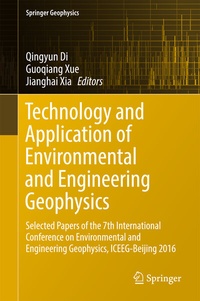
Technology and Application of Environmental and Engineering Geophysics
Description

This book focuses on essential theories, methods and techniques in the field of environmental and engineering geophysics that can contribute to resource detection and environmental protection. Geophysics has been playing an important role in exploring the earth, locating vital resources and promoting the development of society. This book covers a range of topics including the exploration of modern resources, such as ore deposits, coal mines, shale gas and geothermal power, and the monitoring of geological disasters, including the rock-soil body, ground deformation, mines, specific rock-soil engineering disasters, desertification of land and environmental abnormalities.
This book not only offers a valuable resource for geophysical researchers; it also demonstrates how geophysics theories and methods can be practically implemented to protect our environment and promote the development of human society.
More details
Other editions
Additional editions
Persons
Qingyun Di is now a professor of geophysics at the Key Laboratory of Shale Gas and Geoengineering, Institute of Geology and Geophysics, Chinese Academy of Sciences (IGGCAS). She is also the current associate director of IGGCAS. She was a senior visiting scholar at the University of Alberta (2002-2003) and University of Utah (2007-2008). Professor Qingyun Di is a prominent figure in EM method in China. She has received a number of awards from the Chinese government and IGGCAS, including "Zhao Jiuzhang" award for outstanding young scientist and technologist. Her research activities are mainly devoted to research and development of EM method instruments, forward modeling and inversion of CSAMT, ERT, and GPR methods. She is currently conducting a research on the propagation characteristics of controlled source EM wave, putting into consideration the ionosphere, atmosphere, and the earth.
Guoqiang Xue is now a professor at the Key Laboratory of Mineral Resources, Institute of Geology and Geophysics, Chinese Academy of Sciences (IGGCAS). He is director of Science and Technology Promotion Center, Chinese Geophysical Society (CGS). He has promoted the development of EM exploration method and the application of geophysical science and technology in China. His research activities are mainly devoted to time-domain electromagnetic (TEM) method, including infinitesimal point charge theory, short-offset TEM, multi-channel TEM, 1D inversion, and pseudo-seismic interpretation. He is also editorial board of several international journals, such as Journal of Geophysics & Remote Sensing , Journal of Geology & Geoscience Sensing , Applied Geophysics, and Journal of Environmental and Engineering Geophysics .
