

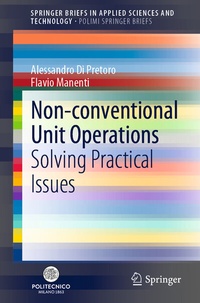
Non-conventional Unit Operations
Description

This volume presents both methodologies and numerical applications for the design of non-conventional unit operations in chemical processes and plants, which are rarely studied in depth at an academic level but have wide applications in the industrial sector. The first part discusses the design, comparison and optimization of heating and cooling operations that are different from simple heat exchange. The second and larger part offers a brief but effective overview of non-conventional separation processes, mainly focusing on the heterogeneous phases. Based on sample case studies, it extrapolates the process model equations and includes the numerical solution in order to provide a straightforward application example. The end of each chapter features a C++ code implementation to solve the ODE or nonlinear equations system using the BzzMath library.
More details
Other editions
Additional editions
Content
- Intro
- Preface
- Contents
- Nomenclature
- Part I Heating and Cooling Operations
- 1 Pinch Technology
- 1.1 Optimization of a Heat Exchanger Network
- 1.2 Conclusions
- 2 Heat Pumps
- 2.1 Heat Pump Design
- 2.2 Conclusions
- 3 Cooling Towers
- 3.1 Cooling Tower Packing Design
- 3.2 Additional Remarks
- 3.3 Conclusions
- 3.4 C++ Code
- Part II Non-conventional Separation Units
- 4 Multiple-Effect Evaporation
- 4.1 Multiple-Effect Evaporator Design
- 4.2 Countercurrent Configuration Comparison
- 4.3 Additional Remarks
- 4.4 Conclusions
- 4.5 C++ Code
- 5 Filtration
- 5.1 Filtration Time Optimization
- 5.2 Centrifugal Filtration
- 5.3 Conclusions
- 6 Drying
- 6.1 Bread Drying Example
- 6.2 Conclusions
- 7 Spray Drying
- 7.1 Spray Dryer Design for Powdered Milk Production
- 7.2 Conclusions
- 7.3 C++ Code
- 8 Lyophilization
- 8.1 Apples Lyophilization
- 8.2 Optimal Plate Temperature Trend
- 8.3 Conclusions
- 8.4 C++ Code
- 9 Gas-Solid Separation
- 9.1 Cyclone Separation Effectiveness Calculation
- 9.2 Abatement Chamber
- 9.3 Conclusions
- 10 Centrifugal Sedimentation
- 10.1 Minimum Collected Particles Diameter Assessment
- 10.2 Conclusions
- 11 Centrifugal Decantation
- 11.1 Design of a Centrifugal Liquid-Liquid Decantation
- 11.2 Conclusions
- 12 Membrane Separation
- 12.1 Design of a Tubular Membrane
- 12.2 Conclusions
- 12.3 C++ Code
- 13 Crystallization
- 13.1 Growth Ratio Estimation
- 13.2 Conclusions
- Appendix Recommended Bibliography
