

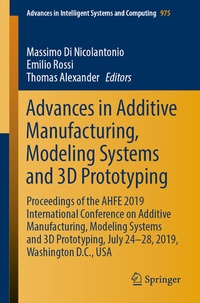
Advances in Additive Manufacturing, Modeling Systems and 3D Prototyping
Description

This book discusses the latest advances in digital modeling systems (DMSs) and additive manufacturing (AM) technologies. It covers applications of networked technologies, ubiquitous computing, new materials and hybrid production systems, discussing how they are changing the processes of conception, modeling and production of products and systems of product. The book emphasizes ergonomic and sustainability issues, as well as timely topics such as DMSs and AM in Industry 4.0, DMSs and AM in developing countries, DMSs and AM in extreme environments, thus highlighting future trends and promising scenarios for further developing those technologies. Based on the AHFE 2019 International Conference on Additive Manufacturing, Modeling Systems and 3D Prototyping, held on July 24-28, 2019, in Washington D.C., USA, the book is intended as source of inspiration for researchers, engineers and stakeholders, and to foster interdisciplinary and international collaborations between them.
More details
Other editions
Additional editions
Content
- Intro
- Advances in Human Factors and Ergonomics 2019
- Preface
- Additive Manufacturing, Modeling Systems and 3D Prototyping
- Digital Human Modeling and Applied Optimization
- Contents
- Design and Innovation for 3D Printing
- Sustainable 3D Printing: Design Opportunities and Research Perspectives
- Abstract
- 1 Introduction
- 2 Aims
- 3 Methodology
- 3.1 3D Printing's Literature Review
- 3.2 Design for Sustainability's Literature Review
- 3.3 Cross-Fertilization Scenario
- 4 Results
- 4.1 Design Opportunities
- 4.2 Research Perspectives
- 5 Conclusions
- Acknowledgements
- References
- 3D Printing to Innovate the Guitar Design
- Abstract
- 1 Introduction
- 2 Guitar Design Process and Technical Specifications
- 2.1 Design Process
- 2.2 Sound and Technical Specifications
- 3 Guitar Design Innovation
- 3.1 Organic Aesthetics
- 3.2 The Reticular Structures of the Body
- 3.3 The Ribbon Body and the Unstructured Concept
- 3.4 The Monocoque Body
- 4 Other 3D Printing Musical Instruments
- 5 Conclusion
- References
- Italian Manufacture Between Technological and Social Innovation
- Abstract
- 1 Introduction
- 2 Experiences
- 2.1 Capsules of Digital Technology
- 2.2 Production Districts and Design Research
- 3 Between Digital and Social Innovation
- 4 Innovator Networks
- 5 Conclusions
- References
- Evaluation of Early-Age Concrete Structural Build-Up for 3D Concrete Printing by Oscillatory Rheometry
- Abstract
- 1 Introduction
- 1.1 Context and Motivation
- 1.2 Scope
- 2 Experimental Setup
- 2.1 Materials and Mix Design
- 2.2 Oscillatory Rheometry
- 2.3 3D Concrete Printing Setup
- 3 Case Study - Freeform Concrete Column
- 3.1 Freeform Parametric Concrete Column
- 3.2 Early-Age Structural Build-up
- 3.3 3D Concrete Printing
- 4 Conclusion
- References
- Artisan as a Maker or Artisan as a not Recognized Co-designer?
- Abstract
- 1 Introduction
- 2 Made in Italy: Design Thinking and Product Development
- 3 Tuscany Manufacturing as a Model
- 3.1 Emerging Interest for Manufacturing Values
- 3.2 Advanced Craftsmanship and Innovation Processes
- 4 State-of-the-Art of Made in Italy Manufacturing and a Possible Development Scenarios
- 4.1 Traceability System with RFID e NFC (IT4Fashion)
- 4.2 Laser Visual Effects as a Performance
- 5 Conclusions
- References
- Ma(r)kers: Digital Fabrication as Opportunity for Enhancing Territories Through Hacking, Personalization, Traces
- Abstract
- 1 From Pre to Post: An Economic Evolution Overview
- 2 Local Micronetworks
- 3 Sharing Economy
- 4 Ma(r)kers' Stories
- 5 Conclusions
- References
- Induction Heating Based 3D Metal Printing of Eutectic Alloy Using Vibrating Nozzle
- Abstract
- 1 Introduction
- 2 Experimental Setup
- 3 Results and Discussions
- 4 Conclusion
- References
- 3D Printing Technology
- 3D Printed Hybrid Flexible Electronics with Direct Light Synthesis
- Abstract
- 1 Introduction
- 2 Materials and Methods
- 2.1 Overmolding Considerations
- 2.2 Overmolding Process
- 3 Results and Applications
- 3.1 Overmolding Butt Joint Investigation
- 3.2 Mechanical Connector - A 3D Printed Coaxial Connector Housing
- 3.3 Optimized Wearable Shock Absorbing Lattice with Capacitive Sensing
- 4 Conclusions
- Acknowledgments
- References
- EZ-Print: Transparent String-Like Pottery Design System
- Abstract
- 1 Introduction
- 2 Problem and Objective
- 3 EZ-Print System
- 4 Application
- 5 Conclusion
- Acknowledgements
- References
- Automatic Design of 3D Lightweight Structures Based on Finite Element Mesh
- Abstract
- 1 Introduction
- 2 Automatic Design of Porous Shell Structure
- 2.1 Design of Porous Shell Structure Using 3D Triangular Mesh
- 2.2 Determination of Adaptive Hole Size
- 3 Automatic Design of Lightweight Cellular Structures
- 3.1 Automatic Design of Lightweight Cellular Structures
- 3.2 Structural Evaluation of Lightweight Structure
- 3.3 Development of Lightweight Shoe Heels
- 4 Conclusions
- Acknowledgements
- References
- Kinematic Optimization of the Robot Head Movements for the Evaluation of Human-Robot Interaction in Social Robotics
- Abstract
- 1 Introduction
- 2 The Robot Human Interaction
- 3 The Design Concept
- 3.1 Head Biomechanics
- 3.2 Design of the Neck-Head Mechanism
- 3.3 Additive 3D Printing
- 3.4 Mathematic Model and Control Mechanism
- 4 Evaluation of the Design: Comparison with the Human Neck
- 5 Results
- 6 Discussion
- 7 Conclusions
- Acknowledgements
- References
- Personalized Human Factor and Ergonomics: Usability Design of 3D Printed Patient-Specific Fracture External Fixator
- Abstract
- 1 Introduction
- 2 Medical Additive Manufacture Personalisation: Design of the Patient-Specific Fixator
- 2.1 A Novel Method of Reduction and Fixation of Fracture
- 2.2 Usability in External Fixator
- 2.3 Efficacy Evaluation in Satisfying Surgical Requirements by Experts
- 2.4 Summative Evaluation for User Experience by Patients
- 3 Technology-Pushed Personalization
- 4 Patient-Specific Usability Design Process
- 5 Interdisciplinary User-Designer-Doctor Co-design
- 6 Conclusion and Future Research
- Acknowledgements
- References
- Research on 3D Printing, Design and Digital Modeling
- Parametric Design of Applied Origami with a Synthetic Computational Approach
- Abstract
- 1 Introduction
- 2 Selection of Tools and Methods
- 2.1 The Synthetic Method
- 2.2 The Synthetic Method in the Digital Age
- 3 Applying Synthetic and Analytical Methods for Solving the Kinematics of the Degree-4 Vertex
- 3.1 Symmetric Degree-4 Vertex, Synthetic Method
- 3.2 Symmetric Degree-4 Vertex, Analytical Method
- 3.3 Asymmetric Degree-4 Vertex, Synthetic Method
- 3.4 Asymmetric Degree-4 Vertex, Analytical Method
- 3.5 Solving Self-Intersection Problem of a Generic Degree-4 Vertex - Synthetic Method
- 3.6 Solving Self-Intersection Problem of a Generic Degree-4 Vertex - Analytical Method
- 4 Conclusions
- Acknowledgments
- References
- Generative Design for Printable Mass Customization Jewelry Products
- Abstract
- 1 Introduction
- 2 Idea Generation and Algorithmic Design
- 3 The 'CORALLO' Case Study
- 4 Design Process
- 5 3D Printing Process
- 6 High Mass Customization
- 7 Conclusions
- Acknowledgments.
- References
- Application of Robust Design Techniques for 3D Printing on Textiles
- Abstract
- 1 Introduction
- 2 Background
- 2.1 Robust Design
- 2.2 Case Study A: Adhesion Strength of Textiles and 3D Printing
- 2.3 Case Study A: Adhesion Strength of Textiles and 3D Printing
- 3 Approach
- 3.1 Parameters Case Study A
- 3.2 Parameters Case Study B
- 4 Experiment Design
- 4.1 Experiment Case Study A
- 4.2 Experiment Case Study B
- 5 Results
- 5.1 Results Case Study A
- 5.2 Results Case Study B
- 6 Conclusions
- Acknowledgments.
- References
- Algorithmic Design and Rapid Prototyping for Cultural Heritage
- An Algorithmic Approach to Viewsheds Analysis for Cultural Landscape: Manziana and the Bracciano Lake Area
- Abstract
- 1 Introduction
- 2 Intervisibility and Land
- 2.1 Models for Intervisibility Analysis
- 2.2 Basic Algorithmic Condition
- 3 An Algorithmic Viewsheds Analysis
- 3.1 The Construction of Topography
- 3.2 Viewsheds Analysis
- 3.3 Results Representation
- 4 Results
- 5 Conclusions and Future Developments
- Acknowledgments
- References
- Design and Digital Fabrication of a Parametric Joint for Bamboo Sustainable Structures
- Abstract
- 1 Introduction
- 2 Algorithmic Joint Modeling
- 3 Joints Digital Fabrication of a Spatial Structure Prototype
- Acknowledgements
- References
- Visionaria. An Open Design Approach for the Regeneration of Historical Urban Heritage
- Abstract
- 1 Introduction. Open/Open Design/Open Design Furniture
- 2 Case Study: Visionaria Project
- 3 Applied Methodology. Automated Procedures and Parameters
- 4 The Workshop for Learning the Method
- 4.1 Coding and Parameterization of the Typological Model
- 4.2 Configurator Tool Set-Up to Designing Customized Furniture
- 4.3 From the Virtual Model to the Real Model
- 5 Conclusions
- Acknowledgments
- References
- Three Renaissance Vaults in Milan. Cultural Heritage and Digital Workflows for BIM Modelling
- Abstract
- 1 Introduction
- 1.1 The Case Study
- 1.2 Related Works
- 1.3 3D Digital Survey and Elaboration
- 2 From Point Cloud to 3D Model
- 2.1 From the Surveyed Vaults to a BIM Environment
- 3 Conclusion
- Acknowledgments
- References
- Four Projects of Pier Luigi Nervi. A Methodology for the Construction and 3D Print of Architectural Models
- Abstract
- 1 Introduction
- 2 First Phase: The Construction of 2D Digital Drawings
- 3 Second Phase: The Construction of the Mathematical Model
- 4 Third Phase: The Construction of the Physical Model
- 5 Conclusions
- References
- Rapid Prototyping for Dissemination of Perspective Treatises
- Abstract
- 1 Introduction
- 2 Exploration Models of Projective Space
- 3 Transformations of the Projective Space: The Renaissance Theatrical Scenography
- 4 Limit Configurations of Projective Space: The Horizontal Architectural Perspectives
- 5 Conclusions
- Acknowledgments
- References
- Semantic and Procedural Approaches in Generative Modeling for the Representation of Cultural Heritage
- Abstract
- 1 The Architecture Survey Between Knowledge and Measurement
- 2 Survey Models for Architecture
- 3 Hierarchies and Semantic Quality in the Digital Model
- 4 A Generative Parametric Model for the Arch of Titus
- 5 Generative Modeling as an Aid for the Identification of the Ideal Model
- 6 Generative Modeling as an Aid to Define the Semantic Structure of the Model
- 7 Application Results, Evaluation of Methodology and Future Work
- Acknowledgments
- References
- Procedural Modelling as a Tool for Morphological Analysis of the Design Idea
- Abstract
- 1 Introduction
- 2 Case Studies
- 2.1 X600 Stool by Alvar Aalto
- 2.2 Paimio Chair by Alvar Aalto
- 3 Conclusions
- References
- Resolution Analysis of Image-Based 3D Models
- Abstract
- 1 Interest in Resolution Computation
- 2 Experimental Design Criteria
- 3 Experimental Solution and Prototype Model
- 4 Testing Procedure
- 5 Developments and Conclusions
- Acknowledgments
- References
- Generative Models for Experimentation and Knowledge of Perspective Principles
- Abstract
- 1 Introduction
- 2 The Model as Icon of Representation
- 3 The Interactive, Parametric, Generative Model
- 4 Examples
- 5 Conclusions and Developments
- Acknowledgments
- References
- Recent Developments in Rapid Prototyping for Assistive Technologies
- Using Virtual Reality and Rapid Prototyping to Co-create Together with Hospitalized Children
- Abstract
- 1 Introduction
- 2 Methods
- 2.1 Participants
- 2.2 Procedures
- 3 Results and Discussion
- 4 Conclusion
- Acknowledgments
- References
- Avoiding Product Abandonment Through User Centered Design: A Case Study Involving the Development of a 3D Printed Customized Upper Limb Prosthesis
- Abstract
- 1 Introduction
- 2 Methods
- 2.1 Informational Project
- 2.2 3D Scanning, Modelling and Printing
- 2.3 Evaluation by the User
- 3 Results
- 4 Conclusion
- Acknowledgments
- References
- Evaluation of Orthosis Rapid Prototyping During the Design Process: Analysis of Verification Models
- Abstract
- 1 Introduction
- 2 Methods
- 3 Results and Discussion
- 4 Conclusion
- Acknowledgments
- References
- 3D Printing as Tool for Guiding Product Design: A Teaching Experience in the Ergonomics Course
- Abstract
- 1 Introduction
- 2 Methods
- 2.1 3D Printer Design and Development
- 2.2 Ergonomic Design Course
- 3 Results
- 4 Conclusion
- Acknowledgments
- References
- Design and Development of a Myoelectric Upper Limb Prosthesis with 3D Printing: A Low-Cost Alternative
- Abstract
- 1 Introduction
- 2 Development Process
- 2.1 Concept Design and 3D Modelling
- 2.2 3D Printing
- 2.3 Electronic Components
- 2.4 Aesthetical Finishing
- 3 Results
- 4 Conclusion
- Acknowledgments
- References
- Manufacturing Technology in Rehabilitation Practice: Implications for Its Implementation in Assistive Technology Production
- Abstract
- 1 Introduction
- 2 Methods
- 3 Results
- 4 Discussion
- 5 Conclusion
- Acknowledgements
- References
- Smart Additive Manufacturing: Sensing, Data Analytics and Process Control
- Modeling In-Plane Deviations of Shapes to Come Based on Prior Deviation Features in Additive Manufacturing
- Abstract
- 1 The Challenge of Deviation Modeling for New Shape Classes
- 2 In-Plane Geometric Shape Deviations and Their Models
- 3 Framework for In-Plane Deviation Modeling of New Shapes to Come in Additive Manufacturing Systems
- 3.1 Overview of the Framework
- 3.2 Blocking the Nominal Radius Function for a New Shape to Come
- 3.3 Specifying and Updating Prescriptive Deviation Models
- 4 Case Study of Prescriptive Modeling Framework
- 4.1 Description of Shapes and the Stereolithography Process
- 4.2 Blocking of Freeform Shape
- 4.3 Prescriptive Deviation Model for Freeform Shape
- 5 Concluding Remarks
- Acknowledgments
- References
- Toward Defect-Free Additive Fabricating of Flexible and Hybrid Electronics: Physics-Based Computational Modeling and Control of Aerosol Jet Printing
- Abstract
- 1 Introduction
- 1.1 Objectives and Motivation
- 1.2 Literature Review
- 1.3 AJP Process
- 1.4 Sensor-Instrumented Setup
- 2 Process Control
- 2.1 Digital Image Processing
- 2.2 Closed-Loop Control
- 3 Computational Fluid Dynamics (CFD) Modeling
- 4 Results and Discussion
- 4.1 CFD Modeling and Simulation
- 4.2 Closed-Loop Control
- 5 Conclusions
- Acknowledgments
- References
- New Materials and Industrial Processes for Additive Manufacturing
- Investigation of Bioplastics for Additive Manufacturing
- Abstract
- 1 Introduction
- 2 Materials and Methods
- 2.1 Materials
- 2.2 Equipment
- 2.3 Methods
- 3 Results
- 3.1 Filament Extrusion
- 3.2 Tensile Strength
- 3.3 Differential Scanning Calorimetry
- 3.4 Print Quality
- 4 Conclusions
- References
- Experimental Evaluation of Mechanical Properties and Machine Process in Fused Deposition Modelling Printed Polymeric Elements
- Abstract
- 1 Introduction
- 2 Specimens Production and Printing Parameters
- 3 Tensile Test Set-Up
- 3.1 Test Set-Up
- 4 Compression Test Set-Up
- 4.1 Test Set-Up
- 5 The Flexural Test
- 5.1 Test Set-Up
- 6 Results
- 6.1 Tensile Test
- 6.2 Compression Test
- 6.3 Flexural Test
- 7 Conclusions and Further Developments
- References
- Human Performance Differences Between Drawing-Based and Model-Based Reference Materials
- Abstract
- 1 Introduction
- 2 Methods
- 2.1 Study Design
- 2.2 Participants
- 2.3 Measurement Tools and Materials
- 2.4 Experimental Procedure
- 2.5 Data Analysis
- 3 Findings and Results
- 3.1 Descriptive Statistics
- 3.2 T-Test Results
- 4 Limitations and Future Work
- 4.1 Limitations
- 4.2 Future Work
- 5 Conclusions
- Acknowledgments
- References
- Additive Manufacturing and Industrial Production
- Visions, Concepts, and Applications in Additive Manufacturing for Yacht Design
- Abstract
- 1 A Brief History of Boat Design and Manufacturing
- 2 The Twenty-First Century Yacht Market
- 3 Emerging Technologies in Yacht Design
- 4 From Prototypes to Industrial Products
- 5 Future Applications for Additive Manufacturing in Yacht Design
- 6 Conclusion
- References
- A Holistic Approach to Additive Manufacture
- From Design for AM to Part Verification in Product Development
- Abstract
- 1 Summary
- 2 Stages
- 2.1 Design
- 2.2 Machine Selection
- 2.3 Metal 3D Printing
- 2.4 Designing for Metals
- 3 Build Removal
- 3.1 Part Qualification
- Acknowledgements
- Design for Additive Manufacturing of Mechanical Connections Toward Hybrid Products
- Abstract
- 1 Introduction
- 2 Hybrid Products
- 3 Ceramic AM Products
- 4 Methodology for Improving AM Ceramic Parts
- 4.1 Planning
- 4.2 Development
- 4.3 Manufacturing
- 5 Conclusions
- Acknowledgments
- References
- Design of a Set of Geometries and Templates for the Analysis of Surface in the Process of Fused Filament Fabrication
- Abstract
- 1 Introduction
- 2 Method
- 3 Results
- 4 Conclusion
- References
- Case Study Analysis for Development Strategies of Construction 3D Printing
- Abstract
- 1 Introduction
- 2 Critical Review
- 3 Case Study
- 4 Factor Analysis
- 4.1 External Factors
- 4.2 Internal Factors
- 4.3 Evaluation of Factor Matrix
- 5 SWOT Analysis
- 5.1 S-O Strategy
- 5.2 S-T Strategy
- 5.3 W-O Strategy
- 5.4 W-T Strategy
- Acknowledgments
- References
- Digital Human Modeling and Applied Optimization
- Chicken or Egg Problem? New Challenges and Proposals of Digital Human Modeling and Interior Development of Automated Vehicles
- Abstract
- 1 Introduction
- 2 (Non-)driving Postures
- 3 Digital Human Modeling
- 4 Interior Development
- 4.1 State of the Art
- 4.2 Challenges
- 4.3 Opportunities
- 5 Iterative User-Centered Development Framework
- 6 Summary
- References
- A Comparative Study Between Three Measurement Methods to Predict 3D Body Dimensions Using Shape Modelling
- Abstract
- 1 Introduction
- 2 Materials and Methods
- 3 Results
- 4 Discussion
- 5 Conclusion
- References
- Quantification of Buttock Deformation on a Rigid Seat
- Abstract
- 1 Introduction
- 2 Methods
- 2.1 Participants
- 2.2 Anthropometric Measurement Procedure
- 2.3 The Experiment Protocol
- 2.4 Data Analysis
- 3 Results
- 4 Discussion
- 5 Conclusion
- References
- Virtual Human Hand: Grasps and Fingertip Deformation
- Abstract
- 1 Introduction
- 2 Design
- 3 Results
- 4 Discussion
- 5 Conclusions
- Acknowledgments
- References
- Prediction of Human Maximum Forces - A Comparison of Four Approaches to Calculate Muscle-Torque
- Abstract
- 1 Introduction
- 2 Modelling Human Action Forces
- 3 Methods
- 3.1 Modelling Maximum-Torque-Bodies
- 3.2 Comparing the Maximum-Torque-Bodies
- 4 Results
- 4.1 Comparison of the Independent, the Linear and the Spherical Approaches
- 4.2 Comparison of the Spherical and the Fluid Approaches
- 5 Summary
- Acknowledgements
- References
- From Design Sketch to Immersive Product Experience: Exploration of a New Competence Portfolio
- Abstract
- 1 Introduction
- 2 Use Case
- 3 The Challenge
- 3.1 Workflow
- 3.2 Time Plan
- 4 Results
- 4.1 Drone Concept 1
- 4.2 Drone Concept 2
- 4.3 Drone Concept 3
- 4.4 Drone Concept 4
- 5 Summary
- 6 Outlook
- References
- Digital Human Updated: Merging the Thermal Layers with the 3D Anthropometric Model
- Abstract
- 1 Introduction
- 2 Methods
- 2.1 Experimentation and Data Processing
- 2.2 Equipment
- 2.3 Procedures and Study Design
- 2.4 Data Analysis and Statistics
- 2.5 Image Processing and 3D Reconstruction
- 2.6 Relational Objective - Subjective Model
- 3 Result and Discussion
- 4 Conclusion and Further Work
- Conflict of Interest
- References
- Rigging and Re-posing a Human Model from Standing to Cycling Configuration
- Abstract
- 1 Introduction
- 2 Aim
- 3 Methods
- 4 Results
- 5 Discussion
- 6 Conclusion
- References
- Anthropometric Analyses of Head and Face Shape to Design Protective Headgear for U.S. Army Personnel
- Abstract
- 1 Introduction
- 2 Target Population
- 2.1 2012 U.S. Army Anthropometric Survey (ANSUR II)
- 2.2 Population Subgroups
- 2.3 Anthropometric Dimensions
- 3 Data Analysis
- 4 Results
- 4.1 Head Dimensions
- 4.2 Face Dimensions
- 4.3 Multivariate Analysis (PCA)
- 5 Discussion
- 5.1 Differences by Sex and Population Subgroups
- 5.2 PCA
- 6 Conclusion
- Acknowledgments
- References
- Digital Human Modelling by Women in Human Factors
- A New Quantitative Kinesiophobia Assessment
- Abstract
- 1 Introduction
- 2 Methods
- 2.1 Design and Outline
- 3 Results
- 4 Discussion
- 5 Conclusions
- Acknowledgments
- References
- Predicting Anthropometric Measurements from 3D Body Scans: Methods and Evaluation
- Abstract
- 1 Introduction
- 2 Method
- 2.1 Dataset
- 2.2 Approach
- 2.3 Regression Methods
- 3 Results
- 3.1 Performance Among Different Regression Methods
- 3.2 Comparison of the Prediction Errors to ANSUR Allowable Errors
- 3.3 Comparison of the Predicted Errors to Software Measurement Errors
- 4 The Conclusions and Future Work
- References
- Effects of Body Armor Fit on Area of 3D Surface Coverage
- Abstract
- 1 Introduction
- 2 Method
- 2.1 Test Item
- 2.2 Test Participants (TPs)
- 2.3 Initial Fit Size Prediction
- 2.4 Experimental Design
- 2.5 Overall Test Procedure
- 2.6 3D Area of Surface Coverage
- 2.7 Data Editing
- 2.8 Analysis
- 3 Results and Discussion
- 3.1 Area of Surface Coverage, AoSC (in2 & cm2)
- 3.2 Effect of Body Armor Fit on Area of Surface Coverage
- 3.3 Mobility Degradation and Area of Surface Coverage
- 4 Conclusion
- Acknowledgments
- References
- Application of Multi-objective Optimization on Ergonomics in Production - A Case Study
- Abstract
- 1 Introduction
- 2 Approach for Illustration of Typical Use and Tool Development
- 2.1 Use Scenario
- 2.2 Development of the Optimization Tool
- 3 Results of the Simulation-Based Multi-optimization
- 4 Discussion
- Acknowledgments
- References
- A Co-model for Research Through Co-design
- Abstract
- 1 Introduction
- 1.1 Research Through Design
- 1.2 Co-design in Research Through Co-design
- 1.3 Control System Theory for Research Through Co-design
- 1.4 A Collaborative Model
- 2 Methodological Approach
- 2.1 A Closed-Loop Control Theory for the RTC System
- 3 Research Through Co-design Theory
- 4 Conclusions
- References
- Towards Occupant Protections for Both Men and Women
- Abstract
- 1 Introduction
- 2 Methods
- 2.1 Spinal Alignment
- 2.2 Rear Impact Reconstruction Simulations
- 2.3 Facet Joint Kinematics
- 2.4 Elongation of the Cervical Ligaments
- 3 Results
- 3.1 Facet Joint Kinematics
- 3.2 Elongation of the Cervical Ligaments
- 4 Discussion
- 5 Conclusions
- Acknowledgments
- References
- Determination of Electrical Resistance for Conductive Textiles Under Simulated Wearing Environment Using Modified Sweating Guarded Hotplate
- Abstract
- 1 Introduction
- 2 Development of New Test Device
- 2.1 Sweating Guarded-Hotplate
- 2.2 Device Including Temperature and Humidity Sensor with Set-Up of Four Electrode-Four Wire Method
- 3 Experimental
- 3.1 Samples
- 3.2 Measurement Method of Electrical Resistance under Simulated Microclimate
- 4 Results and Discussion
- 5 Conclusion
- References
- Toward a Co-logical Aid for Research Through Co-design
- Abstract
- 1 Introduction
- 1.1 Research Through Co-design
- 1.2 Research Through Co-design: A Co-model
- 2 Methodological Approach
- 2.1 The Logical Framework
- 2.2 Toward a Logical Aid
- 3 Results
- 4 Conclusions and Limits
- References
- How to Turn Yourself into a Virtual Travel Companion in Someone Else's Car: Drawing Design Approaches from the Philosophy of Mind
- Abstract
- 1 Introduction
- 2 The Co-drive Concept
- 2.1 The Co-drive Scenario
- 3 Immersive Experience
- 3.1 Communication and Immersive Extent
- 4 Philosophy of Mind and Virtual Self-representation
- 5 Design Approaches for the Co-drive Scenario
- 5.1 Embodiment as a Tool to Demystify Ageing Stereotypes and to Unfold the "Other-Minds Problem"
- 5.2 Two Ways-Minimal UI to Gain Reciprocal Eye Contact
- 6 Conclusion
- References
- Monitoring Older People: An Overview of Devices Responding to Significant Needs of Elderly Affected by Parkinson's Disease
- Abstract
- 1 Global Ageing
- 2 Ageing, Dementia and Parkinson's Disease
- 3 Design Research
- 4 PD and Smart Devices
- 4.1 Personal KinetiGraph
- 4.2 Path Finder
- 4.3 Emma
- 4.4 Liftware Steady
- 4.5 Gyroglove
- 5 Conclusions
- References
- Estimation of Facial Contact Pressure Based on Finite Element Analysis
- Abstract
- 1 Introduction
- 2 Methods
- 2.1 3D Face Scans
- 2.2 3D Face Scans
- 2.3 Facial Wearable Products
- 2.4 Contact Pressure Estimation
- 3 Results
- 4 Discussion
- Acknowledgments
- References
- Author Index
