

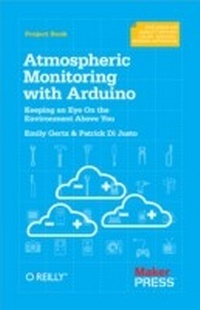
Atmospheric Monitoring with Arduino
Building Simple Devices to Collect Data About the Environment
1st Edition
Published on 20. November 2012
90 pages
978-1-4493-3812-1 (ISBN)
Description

Makers around the globe are building low-cost devices to monitor the environment, and with this hands-on guide, so can you. Through succinct tutorials, illustrations, and clear step-by-step instructions, youll learn how to create gadgets for examining the quality of our atmosphere, using Arduino and several inexpensive sensors.Detect harmful gases, dust particles such as smoke and smog, and upper atmospheric hazesubstances and conditions that are often invisible to your senses. Youll also discover how to use the scientific method to help you learn even more from your atmospheric tests.Get up to speed on Arduino with a quick electronics primerBuild a tropospheric gas sensor to detect carbon monoxide, LPG, butane, methane, benzene, and many other gasesCreate an LED Photometer to measure how much of the suns blue, green, and red light waves are penetrating the atmosphereBuild an LED sensitivity detectorand discover which light wavelengths each LED in your Photometer is receptive toLearn how measuring light wavelengths lets you determine the amount of water vapor, ozone, and other substances in the atmosphereUpload your data to Cosm and share it with others via the Internet"e;The future will rely on citizen scientists collecting and analyzing their own data. The easy and fun gadgets in this book show everyone from Arduino beginners to experienced Makers how best to do that."e;--Chris Anderson, Editor in Chief of Wired magazine, author of Makers: The New Industrial Revolution (Crown Business)
More details
Other editions
Additional editions
Patrick Di Justo | Emily Gertz
Atmospheric Monitoring with Arduino
Building Simple Devices to Collect Data About the Environment
Book
01/2013
1st Edition
Make Community, LLC
€6.50
Shipment within 10-20 days
Content
- Intro
- Copyright
- Table of Contents
- Preface
- Conventions Used in This Book
- Using Code Examples
- Safari® Books Online
- How to Contact Us
- Chapter 1. The World's Shortest Electronics Primer
- What Is Arduino?
- Electronic Circuits and Components
- Programming Arduino
- First Sketch: Make an LED Blink
- Parts
- Install the IDE
- Breadboard the Circuit
- Write the Code
- Things to Try
- Chapter 2. Gadget: Tropospheric Gas Detector
- How Gas Sensors Work
- Which Gases Can We Monitor?
- How This Gadget Works
- Transistorized!
- Build the Gadget
- Load the Sketch
- Displaying and Storing Your Data
- Liquid Crystal Displays
- Reading Data Off EEPROM
- Reading Data from an SD Card
- Things to Try
- Other Sensors
- Solar Powered
- GSM
- Do Not Deploy Your Gadget in Public Without Official Permission
- Get Official Permission
- Get Your Community Involved
- Chapter 3. A Brief Introduction to LEDs
- What Is a Diode?
- What Is a Light Emitting Diode?
- How Are We Using LEDs in the LED Photometer?
- Chapter 4. Gadget: LED Sensitivity Tester
- Mission: Inputtable
- Build the Gadget
- Chapter 5. Gadget: LED Photometer
- Build the Gadget
- Load the Sketch
- Calibrate the Gadget: Air Mass, Atmospheric Optical Thickness, and Extraterrestrial Constant
- Calculating Atmospheric Optical Thickness
- Things to Try
- Detecting "Ozone Holes": Measuring the Ozone Layer
- Add an Accelerometer
- Chapter 6. Using the LED Photometer
- Atmospheric Aerosols
- Photosynthetically Active Radiation (PAR)
- Water Vapor (WV)
- Extracting Data from the LED Photometer
- Graphing Data in a Spreadsheet
- Sending Data to COSM
- Chapter 7. Doing Science: How to Learn More from Your Atmospheric Data
- The Scientific Method
- Steps in the Scientific Method
- Observe Something in the World
- Ask an Answerable Question
- Formulate a Hypothesis
- Compare the Predicted to Actual Results, Considering the Results
- Ask Another Question
- About the Authors
