

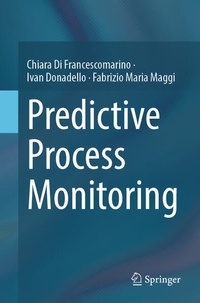
Predictive Process Monitoring
Description

This book provides a comprehensive, structured, and accessible resource that covers both foundational aspects and advanced topics of predictive process monitoring (PPM). It introduces the key building blocks of PPM from preliminary notions and core libraries to bucketing and encoding strategies, learning methods, and validation techniques. At the same time, the book extends its reach to advanced themes such as neuro-symbolic PPM, explainability, multi-modal predictive monitoring, and prescriptive approaches. This dual scope makes it both an introductory text and a reference work for advanced study.
The presentation is organized in seven chapters. Chapter 1 introduces the reader to the field, including its preliminaries and a helicopter view of PPM. Next, chapter 2 presents the tools and libraries that support implementation. Chapters 3 and 4 then delve into core data preparation aspects: prefix generation, bucketing, and encoding techniques. Chapter 5 discusses learning approaches, while Chapter 6 focuses on validation and testing. Finally, Chapter 7 highlights advanced topics that represent the current frontier of the field. Each chapter is enriched with exercises to facilitate learning and with notes to provide further reading.
This book mainly aims at graduate students and researchers in computer science, information systems, and data science who wish to gain a deep understanding of PPM. It is also designed for educators, who will find the structured exposition, exercises, and references suitable for designing and teaching courses on process mining and predictive analytics. Eventually, practitioners and professionals in industry will benefit from the guidance on applying PPM techniques to optimize and innovate their organizational processes.
More details
Other editions
Additional editions
Persons
Chiara Di Francescomarino is an Associate Professor at the Information Engineering and Computer Science Department of the University of Trento. Her main research interests are in the field of Business Process Management, with a particular focus on Process Mining. She has worked extensively on Predictive and Prescriptive Process Monitoring based on historical execution traces, as well as on techniques for explaining process predictions and supporting simulation-based decision making.
Ivan Donadello is an Assistant Professor at the Faculty of Engineering of the Free University of Bozen-Bolzano. His research focuses on Predictive Process Monitoring within the framework of Neuro-Symbolic Artificial Intelligence. He is the main architect of Declare4Py, an open-source Python library for declarative process mining and serves as associate editor for the Logic and Reasoning in Artificial Intelligence section of Frontiers in Artificial Intelligence. He also heads the Machine Learning course at the Free University of Bozen-Bolzano and regularly supervises theses on Neuro-Symbolic techniques applied to Predictive Process Monitoring.
Fabrizio Maria Maggi is a Full Professor at the Faculty of Engineering of the Free University of Bozen-Bolzano. He has a strong background in the fields of Business Process Management and Artificial Intelligence. He is a pioneer in developing techniques that integrate Machine Learning to extract hidden insights from execution logs, having initiated the Predictive Process Monitoring research line that later has become one of the pillars of process analysis in Business Process Management. He has also contributed to some of the first works on explainable Predictive Process Monitoring and Prescriptive Process Monitoring. Recently, his research has focused on developing techniques that combine Predictive Process Monitoring with Neuro-Symbolic Artificial Intelligence.
Content
1. Introduction.- 2. Tools and libraries.- 3. Prefix generation and bucketing.- 4. Encodings.- 5. Learning.- 6. Validating and Testing.- 7. Advanced Topics.
