

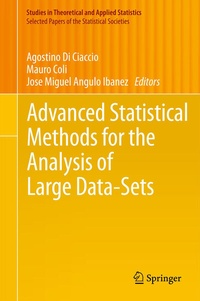
Advanced Statistical Methods for the Analysis of Large Data-Sets
Description

The theme of the meeting was "Statistical Methods for the Analysis of Large Data-Sets". In recent years there has been increasing interest in this subject; in fact a huge quantity of information is often available but standard statistical techniques are usually not well suited to managing this kind of data. The conference serves as an important meeting point for European researchers working on this topic and a number of European statistical societies participated in the organization of the event.
The book includes 45 papers from a selection of the 156 papers accepted for presentation and discussed at the conference on "Advanced Statistical Methods for the Analysis of Large Data-sets."
More details
Other editions
Additional editions
Persons
Content
Part I Clustering Large Data-Sets: Clustering Large Data Set: An Applied Comparative Study (Bocci L., Mingo I.).- Clustering in Feature Space for Interesting Pattern Identification of Categorical Data (Marino M., Palumbo F., Tortora C.).- Clustering geostatistical functional data (Romano E., Verde R.).-Joint Clustering and Alignment of Functional Data: An Application to Vascu-lar Geometries (Sangalli L.M., Secchi P., Vantini S., Vitelli V.).- Part II Statistics in Medicine: Bayesian Methods for Time Course Microarray Analysis: From Genes' Detection to Clustering (Angelini C., De Canditiis D., Pensky M.).- Longitudinal Analysis of Gene Expression Profiles Using Functional Mixed-effects Models (Berk M., Montana G., Levin M., Hemingway C.).- A Permutation Solution to Compare two Hepatocellular Carcinoma Markers (Zirilli A., Alibrandi A.).- Part III Integrating Administrative Data: Statistical Perspective on Blocking Methods when Linking Large Data-Sets (Cibella N., Tuoto T.).- Integrating Households Income Microdata in the Estimate of the Italian GDP (Coli A., Tartamella F.).- The Employment Consequences of Globalization: Linking Data on Employers and Employees in the Netherlands (Fortanier F., Korvorst M., Luppes M.).- Applications of Bayesian networks in Official Statistics (Vicard P., Scanu M.).- Part IV Outliers and Missing Data: A Correlated Random Effects Model for Longitudinal Data with Non-ignorable Drop-out: An Application to University Student Performance (Belloc F., Maruotti A., Petrella L.).- Risk Analysis Approaches to rank Outliers in Trade Data (Kopustinskas V., Arsenis S.).- Problems and Challenges in the Analysis of Complex Data: Static and Dynamic Approaches (Riani M., Atkinson A., Cerioli A.).- Ensemble Support Vector Regression: A New Non-parametric Approach for Multiple Imputation (Scacciatelli D.).- Part V Time Series Analysis: On the Use of PLS Regression for Forecasting Large Sets ofCointegrated Time Series (Cubadda G., Guardabascio B.).- Large-Scale Portfolio Optimisation with Heuristics (Gilli M., Schumann E.).- Detecting Short-Term Cycles in Complex Time Series Databases (Giordano F., Parrella M.L., Restaino M.).- Assessing the Beneficial Effects of Economic Growth: The Harmonic Growth Index (Mendola D., Scuderi R.).- Time Series Convergence within I(2) Models: The Case of Weekly Long Term Bond Yields in the four Largest Euro Area Countries (Passamani G.).- Part VI Environmental Statistics: Anthropogenic CO2 Emissions and Global Warming: Evidence from Granger Causality Analysis (Bilancia M., Vitale D.).- Temporal and Spatial Statistical Methods to Remove External Effects on Groundwater Levels (Imparato D., Carena A., Gasparini M.).- Reduced Rank Covariances for the Analysis of Environmental Data (Nicolis O., Nychka D.).- Radon Level in Dwellings and Uranium Content in Soil in the Abruzzo Region: A Preliminary Investigation by Geographically Weighted Regression (Nissi E., Sarra A., Palermi S.).- Part VII Probability and Density Estimation.- Applications of Large Deviations to Hidden Markov Chains Estimations (Del Greco M.).- Multivariate Tail Dependence Coefficients for Archimedean Copulae (De Luca G., Rivieccio G.).- A Note on Density Estimation for Circular Data (Di Marzio M., Panzera A., Taylor C.C.).- Markov Bases for Sudoku Grids (Fontana R., Rapallo F., Rogantin M.P.).- Part VIII Application in Economics: Estimating the Probability of Moonlighting in Italian Building Industry (Arezzo M.F., Alleva G.).- Use of Interactive Plots and Tables for Robust Analysis of International Trade Data (Perrotta D., Torti F.) Generational Determinants on the Employment Choice in Italy (Quintano C., Castellano R., Punzo G.).- Route-based Performance Evaluation Using Data Envelopment Analysis Combined with Principal Component Analysis (Rapposelli A.).- Part IX WEB and Text Mining: Web Surveys: MethodologicalProblems and Research Perspectives (Biffignandi S., Bethlehem J.).- Semantic Based DCM Models for Text Classification (Cerchiello P.).- Probabilistic Relational Models for Operational Risk - A new Application Area and an Implementation Using Domain Ontologies (Spies M.).- Part X Advances on Surveys.- Efficient Statistical Sample Designs in a GIS for Monitoring the Landscape Changes (Carfagna E., Tassinari P., Zagoraiou M., Benni S., Torreggiani D.).- Studying Foreigners' Migration Flows Through a Network Analysis Approach (Conti C., Gabrielli D., Guarneri A., Tucci E.).- Estimation of Income Quantiles at the Small Area Level in Tuscany (Giusti C., Marchetti S., Pratesi M.).- The Effects of Socioeconomic Background and Test-taking Motivation on Italian Students' Achievement (Quintano C., Castellano L., Longobardi R.).- Part XI Multivariate Analysis: Firm Size Dynamics in an Industrial District: The Mover-Stayer Model in Action (Cipollini F. , Ferretti C., Ganugi P.).- Multiple Correspondence Analysis for the Quantification and Visualization of Large Categorical Data Sets (Iodice D'Enza A., Greenacre M.).- Multivariate Ranks-based Concordance Indexes (Raffinetti E., Giudici P.).- Methods for Reconciling the Micro and the Macro in Family Demography Research: A Systematization (Matysiak A., Vignoli D.).
