

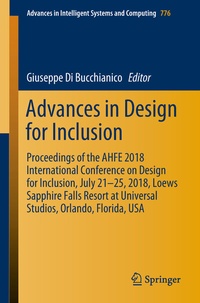
Advances in Design for Inclusion
Description

This book addresses a range of topics in design, such as universal design, design for all, digital inclusion, universal usability, and accessibility of technologies for people regardless of their age, financial situation, education, geographic location, culture and language. It especially focuses on accessibility for people with auditory, cognitive, neurological, and visual impairments, ageing populations, and mobility for those with special physical needs.
The book explores some of the overlaps between inclusive design and web accessibility to help managers, designers, developers, policy makers, and researchers optimize their efforts in these areas. Based on the AHFE 2018 International Conference on Design for Inclusion, held on July 21-25, 2018, in Orlando, Florida, USA, it discusses new design technologies and highlights the disparate needs of the individuals within a community. Thanks to its multidisciplinary approach, it is a valuable resource for readers from various backgrounds, providing them a timely, practice-oriented guide to design for inclusion.
More details
Other editions
Additional editions
Content
- Intro
- Advances in Human Factors and Ergonomics 2018
- Preface
- Contents
- Design for Inclusive Daily Life and Human Diversity
- Providing Context-Sensitive Mobile Assistance for People with Disabilities in the Workplace
- Abstract
- 1 Introduction
- 2 Related Work
- 3 Materials and Methods
- 3.1 Prototype System
- 3.2 Evaluation Study
- 3.3 Procedure
- 3.4 Participants
- 4 Results
- 5 Discussion
- Acknowledgments
- References
- User Perceptions of Haptic Fidgets on Mobile Devices for Attention and Task Performance
- Abstract
- 1 Introduction
- 1.1 Motivation
- 1.2 Related Work
- 2 Materials and Method
- 2.1 Materials
- 2.2 Method
- 3 Results
- 4 Discussion
- 5 Conclusion
- Acknowledgments
- References
- Evaluation of Design Recommendations for the Development of Wheelchair Rugby Sports-Wear
- Abstract
- 1 Introduction
- 2 Methodology
- 3 Results and Discussion
- 3.1 Gloves
- 3.2 Tops
- 3.3 Bottoms
- 4 Conclusion
- Acknowledgments
- References
- Emotional and Stress Responses to Cyberbullying
- Abstract
- 1 Introduction
- 2 Cyberbullying Definition
- 3 Types of Cyberbullying
- 4 Theoretical Perspectives
- 4.1 Emotional Responses
- 4.2 Cyberbullying and Stress
- 4.3 Coping with Cyberbullying
- 5 Cyberbullying Factors
- 5.1 Publicity
- 5.2 Anonymity
- 6 Conclusion
- References
- Wellness for All: Novel Design Scenarios and Concepts of Products-Systems for an Inclusive User Experience in Indoor Physical Activity
- Abstract
- 1 Introduction
- 1.1 Physical Activity and Wellness for Contemporary User
- 1.2 Inclusive Design Approach for the Sport Innovation
- 2 Wellness for All: "Smart Running" Workshop
- 3 Methodology
- 3.1 Personas and Task Analysis
- 3.2 Brainstorming
- 4 Results
- 5 Conclusion
- References
- Evaluating a Proposed Design for All (DfA) Manual for Architecture
- Abstract
- 1 Introduction
- 2 Methodology
- 2.1 Proposed DfA Manual
- 2.2 The Assessment of the Manual
- 3 Findings
- 3.1 Strengths
- 3.2 Weaknesses
- 3.3 Design for All Knowledge Transfer Criteria
- 4 Conclusions
- Appendix
- References
- Design for Enabling Technologies. A Framework to Empower Multi-level User Engagement
- Abstract
- 1 Introduction
- 2 State of Art: Activities of Daily Living and Cognitive Abilities
- 2.1 A Tool for Measuring Activities and Abilities: The ICF
- 2.2 Hierarchical Task Analysis: A Methodology for Employing ICF Tools in Activities of Daily Living
- 3 Developing an IoT-Based Media Assistive Controller
- 4 ARCS - Adaptive Remote Control System
- 4.1 The Multi-level Learning System
- 4.2 Design Details of Adaptive Remote Control
- 5 Conclusion
- References
- Anthropometric Data Collection of Portuguese Overweight and Obese Children Using a Kinect Body Image System: Preliminary Results
- Abstract
- 1 Introduction
- 2 Methodology
- 2.1 Anthropometric Data Collection
- 2.2 Anthropometric Data Treatment and Analysis
- 3 Results and Discussion
- 3.1 Sample Characterization
- 3.2 Overweight and Obese Rate
- 3.3 Gender Difference
- 3.4 Age Difference
- 3.5 School Comparison
- 4 Final Considerations
- Acknowledgements
- References
- Assessment of How Inclusive Are Shopping Centers for Blind People
- Abstract
- 1 Introduction
- 2 Method
- 2.1 Subjects
- 2.2 Experimental Procedure
- 3 Results
- 3.1 Social Environmental Factors
- 3.2 Physical Environmental Factors
- 3.3 Personal Factors
- 4 Conclusion
- Acknowledgments
- Appendix: Sample of the Semi-structured Interview Questions
- References
- Game for the Digital Inclusion of the Physically Disabled with Reduced Mobility
- Abstract
- 1 Introduction
- 2 Methodology
- 3 Results and Discussion
- 3.1 The Game
- 3.2 History
- 3.3 Characters
- 3.4 Entertainment
- 3.5 Interface
- 3.6 Inclusive Strategies
- 3.7 Gameplay
- 3.8 Conclusion
- References
- Playgrounds for All: Practical Strategies and Guidelines for Designing Inclusive Play Areas for Children
- Abstract
- 1 Introduction
- 2 Research Stages
- 2.1 Definition of Research Objectives
- 2.2 User Needs Analysis
- 2.3 Estimating User Exclusion
- 3 Results and Discussion
- 4 Conclusions
- Acknowledgments
- References
- Preprocessing the Structural Optimization of the SPELTRA Robotic Assistant by Numerical Simulation Based on Finite Elements
- Abstract
- 1 Introduction
- 2 Pre-processing
- 2.1 Compilation of Technical Information
- 2.2 Studies of Possible Materials and Forms
- 2.3 Definition of the Geometry, Material, Charges, Restrictions of the Robotic Assistant and Their Discretization
- 3 Results
- 4 Conclusions
- References
- Device Design for the Learning Processes of Children with Cerebral Palsy
- Abstract
- 1 Introduction
- 1.1 LÚ Project
- 2 Methodology
- 3 Results
- 3.1 System's Composing Elements
- 4 Conclusion
- References
- Design for Inclusive Environments, Materials and Multisensory
- Design for the Sensitive Experience: Inclusive Design in Historical-Archaeological Contexts
- Abstract
- 1 Introduction
- 2 Community Involvement
- 3 Case Study
- 3.1 Rome
- 3.2 Parameters
- 4 Research Process and Method
- 4.1 Questionnaires
- 4.2 Interviews
- 4.3 Surveys and Cultural Promenade
- 4.4 Workshop
- 5 Output Expected and Research Products
- 5.1 The Walkable Map
- 5.2 Guidelines
- 5.3 Open Source Platforms
- References
- Inclusive, Active and Adaptive Design as Approaches to User-Centered Design
- Abstract
- 1 User-Centered Design
- 2 Anthropometric Approach
- 3 Anthropocentric Approach
- 4 Architecture as a Prosthetic Space for Health
- 5 Conclusions
- References
- The Influence of Adding Vibrations on the Impression of Messaging on Smartphones
- Abstract
- 1 Background and Study Aims
- 2 The Flow of This Research
- 3 Pre-investigation
- 3.1 The Investigation's Outline
- 3.2 Survey Results
- 4 The Main Experiments I and II
- 4.1 The Investigation's Outline
- 4.2 Evaluation Method
- 4.3 Results
- 4.4 Conclusion
- 5 Main Experiment III
- 5.1 The Investigation's Outline
- 6 Conclusion
- 7 Discussion
- References
- Inclusive Design of Open Spaces for Visually Impaired Persons: A Comparative Study of Beijing and Hong Kong
- Abstract
- 1 Introduction
- 2 Methods
- 2.1 Case Studies in Beijing and Hong Kong
- 2.2 Procedures
- 3 Results
- 3.1 Policies Related to Inclusive Open Space
- 3.2 Implementation and Management Issues in Inclusive Design
- 4 Discussion
- 4.1 Inclusive Design Factors
- 4.2 Implications for Policy, Implementation and Management
- 5 Conclusions
- Acknowledgments
- References
- Lighting in the Workplace: Recommended Illuminance (lux) at Workplace Environs
- Abstract
- 1 Introduction
- 1.1 Daylight Versus Artificial Light
- 1.2 Visual and Non-visual Systems
- 1.3 Workplace
- 1.4 International and European Recommendations (Iluminance Levels)
- 2 Conclusions
- 2.1 Discussion
- References
- The Inclusion of Children with Total Visual Impairment in Learning Activities of Daily Living, Especially the Act of Eating Independently
- Abstract
- 1 Introduction
- 2 Methodology
- 2.1 Phase 1. Bibliographic Collection
- 2.2 Phase 2. Field Work
- 2.3 Phase 3. Design Process
- 3 Results
- 3.1 The Product
- 3.2 The User Manual for the Product
- 3.3 The Strategy
- 4 Conclusions
- 5 Recommendation
- Acknowledgments
- References
- Design for Inclusive Transportation, Information and Communication Technologies
- Inclusive Responsiveness - Why Responsive Web Design Is Not Enough and What We Can Do About This
- Abstract
- 1 Introduction
- 2 Responsive Web Design: Adapting to the Equipment Context
- 3 Personalization: Adapting to the User Context
- 4 Context Queries: Adapting to the Environment Context
- 5 Adapting to the Task Context
- 6 Inclusive Responsiveness: A Vision
- Acknowledgment
- References
- Evaluating Accessibility and Usability of an Experimental Situational Awareness Room
- Abstract
- 1 Introduction
- 2 Literature Review
- 3 Evaluation Methodology
- 3.1 User Testing Setup
- 3.2 Heuristic Evaluation of Selected User Interfaces
- 4 Results
- 4.1 User Testing
- 4.2 Heuristic Testing
- 4.3 Recommendations
- 5 Discussions
- 6 Conclusions and Future Works
- References
- Design Guidelines for Adaptable Videos and Video Players on the Web
- Abstract
- 1 Motivation
- 2 Related Work: Video Usability and Accessibility
- 3 Examination of Existing Video Adaptation Concepts
- 4 Consideration of Other Existing Preference Settings Dialogs
- 5 Study: Requirements Analysis in the Context of Online Videos
- 5.1 Goals
- 5.2 Online Survey Addressing Deaf People
- 5.3 Interviews with Older Adults
- 5.4 Parameters for a Video Preference Dialog
- 6 Conclusion
- References
- Social Inclusion and Territorial Enhancement: A Project of Tourism Interactive Information System for Bike Users
- Abstract
- 1 Introduction
- 2 Objectives
- 3 Method
- 3.1 Scenario Analysis
- 3.2 Service Design
- 3.3 Product Design: The Bikiosk
- 4 Principal Results
- 5 Conclusions
- 6 Credits
- References
- Understanding the Experience of Teenagers as Bus Passengers for the Design of a More Inclusive Bus Service
- Abstract
- 1 Introduction
- 1.1 Context
- 1.2 Approach
- 2 Methods and Materials
- 2.1 Overview
- 2.2 Participants
- 2.3 Procedure
- 3 Results
- 3.1 Focus Group
- 3.2 Comparing Difficulty Levels Among Teenagers, Younger and Older Adults
- 4 Discussion
- 5 Conclusion
- Acknowledgments
- References
- Inclusive Smart Parking: Usability Analysis of Digital Parking Meter for Younger and Older Users
- Abstract
- 1 Introduction
- 1.1 Parking Meters in Guadalajara
- 2 Method
- 2.1 Apparatus and Materials
- 2.2 Procedure
- 3 Results
- 4 Discussion
- 5 Conclusions
- Acknowledgements
- References
- Design of a Low-Cost Wheelchair for Open-Source Platform: First Phase
- Abstract
- 1 Introduction
- 2 Project Goals
- 2.1 Wheelchair Design Selection Process [7]
- 3 Analysis of Existing Products
- 4 Project Development
- 5 Results
- 5.1 Future Works
- Acknowledgements
- References
- Inclusive Service Design for Education and Learning
- An Eye-Tracking Study on Usability and Efficiency of Blackboard Platform
- Abstract
- 1 Introduction
- 2 Objectives and Research Questions
- 3 Methods
- 3.1 Apparatus
- 3.2 Tasks
- 3.3 Procedures
- 4 Results and Discussion
- 5 Conclusion and Future Work
- References
- Supporting Inclusive Approaches in Service Design with Netnography
- Abstract
- 1 Introduction
- 1.1 The Background
- 2 Methodological Approach
- 2.1 The Research Field: Selecting Platforms
- 2.2 The Data Collection and Insights
- 2.2.1 Filtering Threads
- 2.2.2 Collecting Relevant Threads
- 2.2.3 Summarising Insights and Detecting Design Domains
- 3 Results
- 3.1 Design Domains for Inclusive SBS
- 4 Conclusions
- References
- Braille Cursor: An Innovative and Affordable Refreshable Braille Display Designed for Inclusion
- Abstract
- 1 Introduction
- 2 Design of the Refreshable Braille Display Based on Simple Passive Pins
- 2.1 Actuation Method Using Three Solenoids
- 2.2 Actuation Method Using a Single Solenoid
- 3 Experimental Results and Discussions
- 3.1 Implementation of the Prototype
- 3.2 Experimental Results
- 4 Discussion and Conclusions
- Acknowledgments
- References
- Case Studies of Inclusive Higher Education in Norway, Sweden and Slovakia
- Abstract
- 1 Introduction
- 2 Methodology
- 3 Case Study of Inclusive Higher Education in Norway
- 3.1 National Legislative Framework in Norway
- 3.2 Methods and Tools for Monitoring Accessibility in Norway
- 3.3 Training Activities on Accessibility Issues in Norway
- 3.4 Norwegian University of Science and Technology
- 4 Case Study of Inclusive Higher Education in Sweden
- 4.1 National Legislative Framework in Sweden
- 4.2 Methods and Tools for Monitoring Accessibility in Sweden
- 4.3 Training Activities on Accessibility Issues in Sweden
- 4.4 Mid Sweden University
- 5 Case Study of Inclusive Higher Education in Slovakia
- 5.1 National Legislative Framework in Slovakia
- 5.2 Methods and Tools for Monitoring Accessibility in Slovakia
- 5.3 Training Activities on Accessibility Issues in Slovakia
- 5.4 Slovak University of Technology
- 6 Conclusions
- Acknowledgements
- References
- Inclusive Design of Wearable Smart Objects for Older Users: Design Principles for Combining Technical Constraints and Human Factors
- Abstract
- 1 Introduction
- 2 Case Study
- 3 Supported Thesis
- 3.1 Wearable 1
- 3.2 Wearable 2
- 4 Methodological Process
- 4.1 Definition of Primary Users, Secondary Users and Stakeholders, and Analysis of the Relative Needs Concerning the Design of the Two Wearable Devices Within the Project HABITAT
- 4.2 Definition of Constrains Deriving from the Technologies Developed by the Partners of the Habitat Project, and Individuation of the Features of Smart Wearables to Be Designed
- 4.3 Application of the Quality Function Deployment, for the Definition of Project Priorities and Hierarchy of Most Important Needs to Be Met, and Interpretation of Its Results
- 4.4 Design and Construction of the First Rough Prototypes
- 4.5 Testing of Prototypes with the Same Users that Were Involved in the Initial Analysis and Development of Test Results for the Improvement of Wearables' Design
- 5 Results
- 6 Conclusions
- References
- Internet of Things and Elderly: Quantitative and Qualitative Benchmarking of Smart Objects
- Abstract
- 1 Introduction
- 2 Methodology
- 2.1 Analysis of Needs
- 2.2 Smart Objects for Home Care
- 3 Benchmarking
- 4 Results
- 5 Conclusion
- References
- Social Footprint. An Exploratory Analysis of Existing Evidence and Opportunities
- Abstract
- 1 Social Footprint: From CSR to Shared Value
- 1.1 Defining Social Impact Through Externalities, Processes and Philanthropy
- 1.2 Towards Social Impact as a Core Business
- 2 Human Diversity for a Sustainable and Innovative Social Impact
- 3 Designing for Human Diversity as a Competitive Advantage and Winning Business Factor
- 3.1 Self-image Business: The Development of the Fashion Industry's Perfect Package
- 3.2 Design for All: When Excellence in Design for H.D. Transforms a Feature for Disability in Performance and Trend for All
- 4 Designing the Next Step: Data and Methods
- 5 Conclusions
- References
- Graphic Design of Interactive Tools for People with Autistic Spectrum Disorders
- Abstract
- 1 Introduction
- 2 Objective
- 3 Methodology
- 4 Results
- 4.1 Characters
- 4.2 Initial Interface
- 4.3 The Game - Association
- 4.4 The Game - Creation of Facial Expressions
- 5 Discussion
- 6 Conclusion
- References
- Use of the Functional State Simulator of the Elderly Adult to Identify Requirements for the Design of Food Containers
- Abstract
- 1 Introduction
- 2 Background
- 3 Methodology
- 3.1 Fine Motor Skills Simulator Design
- 3.2 Simulator Reliability Tests
- 4 Results
- 4.1 Containers Testing: Elderly People
- 4.2 Detail Design
- 5 Conclusions
- Acknowledgements
- References
- Author Index
