

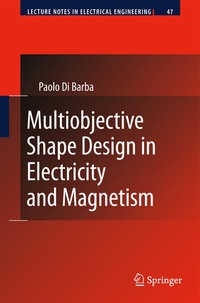
Multiobjective Shape Design in Electricity and Magnetism
Description

Multiobjective Shape Design in Electricity and Magnetism is entirely focused on electric and magnetic field synthesis, with special emphasis on the optimal shape design of devices when conflicting objectives are to be fulfilled. Direct problems are solved by means of finite-element analysis, while evolutionary computing is used to solve multiobjective inverse problems. This approach, which is original, is coherently developed throughout the whole manuscript. The use of game theory, dynamic optimisation, and Bayesian imaging strengthens the originality of the book. Covering the development of multiobjective optimisation in the past ten years, Multiobjective Shape Design in Electricity and Magnetism is a concise, comprehensive and up-to-date introduction to this research field, which is growing in the community of electricity and magnetism. Theoretical issues are illustrated by practical examples. In particular, a test problem is solved by different methods so that, by comparison of results, advantages and limitations of the various methods are made clear.
Reviews / Votes
"The intention of this book is to try to dispel some of the myths surrounding computer-based optimisation. Professor Di Barba provides an up-to-date and comprehensive overview of optimisation techniques related to electromagnetic devices and systems in a logical and consistent way. An understanding of the contents of this book can help a designer to use the computational resources that are now available in a much more effective manner."
David A. Lowther Ph.D., AKC, FCAE, FIET
James McGill Professor
Department of Electrical and Computer Engineering
McGill University, Montreal
More details
Other editions
Additional editions
Person
Paolo DI BARBA graduated in Electronic Engineering (MSc) in the year 1987-1988 at the University of Pavia, Italy. He obtained the PhD degree in Electrical Engineering from the Technical University of Lodz, Poland, in the year 2001-2002. At the time being, he is a full professor of electrical engineering (tenure position) at the University of Pavia, Faculty of Engineering. He is a member of the steering committees of some international symposia in the area of computational electromagnetism, in particular: Intl Symposium on Electromagnetic Fields in Electrical Engineering (ISEF), Workshop on Optimization and Inverse Problems in Electromagnetism (OIPE).
The scientific interests of the author include the computer-aided design of electric, magnetic and electromechanical devices with special emphasis on the methodologies for multi-objective optimisation in electromagnetism. He is author of more than 100 papers, either presented to international conferences or published in international journals; relevant applications concern electrical power engineering as well as biomedical engineering.