

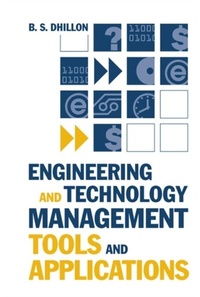
Engineering and Technology Management Tools and Applications
1st Edition
Published on 1. January 2001
402 pages
978-1-58053-568-7 (ISBN)
Description

Career success for engineers who wish to move up the management ladder, requires more than an understanding of engineering and technological principles - it demands a profound understanding of today's business management issues and principles. In this unique book, the author provides you with a valuable understanding of contemporary management concepts and their applications in a technical organization. You get in-depth coverage of product selection and management, engineering design and product costing, concurrent engineering, value management, configuration management, risk management, reengineering strategies and benefits, managing creativity and innovation, information technology management, and software management. The large number of solved examples highlighted throughout the text underscore the value of this book as an indispensable "e;How To"e; manual, and library reference piece.
More details
Other editions
Additional editions
Book
07/2002
Artech House Publishers
€108.50
Shipment within 10-20 days
Content
- Intro
- TOC
- Preface
- 1. Introduction
- 1.1 History of Management
- 1.2 Terms and Definitions
- 1.3 Management Characteristics and Functions and Traditional Management Versus Modern Management
- 1.4 Engineering and Technology Management Challenges and Skill Requirements
- 1.5 Useful Information on Engineering and Technology Management
- 1.5.1 Books
- 1.5.2 Professional Organizations
- 1.5.3 Journals
- 1.6 Scope of the Text
- 1.7 Problems
- References
- 2. Organizing and the Human Element
- 2.1 Introduction
- 2.2 The Components of Organizing and Guidelines for Planning an Organization
- 2.3 Organizational Charts and Basic Relationships in Organizational Structures
- 2.4 Centralization and Decentralization of Organizations, Span of Control, and Delegation
- 2.5 Methods of Organization
- 2.5.1 Organization by Product
- 2.5.2 Organization by Function
- 2.5.3 Organization by Product
- 2.5.4 Organization by Territory
- 2.5.5 Matrix Organization
- 2.6 Functions of an Engineering Department and Guidelines for Organizing a New Engineering Department
- 2.7 Characteristics and Needs of an Engineer, Routes for an Engineer to Obtain Management Positions, and Transition of an Engine
- 2.8 An Engineering Manager's Qualities and Activities
- 2.9 Motivating Others and Analyzing Team Characteristics
- 2.10 Committees and Staff Meetings
- 2.11 Displacing Managers and an Organization Size-Efficiency Model
- 2.11.1 An Organization Size-Efficiency Model
- 2.12 Problems
- References
- 3. Tools for Making Effective Engineering and Technology Management Decisions
- 3.1 Introduction
- 3.2 Discounted Cash Flow Analysis
- 3.2.1 Compound Interest and Present Value
- 3.2.2 Uniform Periodic Payment Amount and Present Value
- 3.3 Depreciation Analysis
- 3.3.1 Method I
- 3.3.2 Method II
- 3.3.3 Method III
- 3.4 Decision Trees
- 3.5 Optimization Techniques
- 3.5.1 Lagrangian Multiplier Method
- 3.5.2 Linear Program Method
- 3.6 Learning Curve Analysis
- 3.7 Fault Tree Analysis
- 3.8 Forecasting
- 3.8.1 Forecasting Types and Time Horizons
- 3.8.2 Forecasting Steps, Methods, and Technique Selection Factors
- 3.8.3 Simple Average
- 3.8.4 Exponential Smoothing
- 3.9 Problems
- References
- 4. Project Selection and Management
- 4.1 Introduction
- 4.2 Terms and Definitions
- 4.3 Types of Information Required for Evaluating a Project
- 4.4 Project Selection Models
- 4.4.1 Benifit-Cost Ratio Model
- 4.4.2 Disman Model
- 4.4.3 Pacifico Model
- 4.4.4 Mottley and Newton Model
- 4.4.5 Calculated-Risk Model
- 4.4.6 Sobelman Model
- 4.4.7 Manley Model
- 4.4.8 Profitability Index Model
- 4.4.9 Relative Worth Index Model
- 4.4.10 Dean-Sengupta Model
- 4.4.11 Net Income Present Value Model
- 4.5 Need for Project Management, Project Organization Life Cycle Phases, and Project Management Functions and Procedure Characte
- 4.6 Project Manager Responsibilities, Qualifications, Selection and Reporting
- 4.7 Project Management Methods
- 4.7.1 PERT Steps
- 4.7.2 CPM Steps
- 4.7.3 CPM/PERT Symbols
- 4.7.4 Essential Formulas and Network Critical Path Determination
- 4.7.5 CPM Advantages and Disadvantages
- 4.8 Project Management Benifits, Obstacles to Achieve Benifits, and Project Management
- 4.9 Problems
- References
- 5. Management of Engineering Design and Product Costing
- 5.1 Introduction
- 5.2 Design Types and Approach
- 5.3 Expectations from a Design Department and Product Design-Related Area Requiring Decisions
- 5.4 Engineering Design Manpower and Tasks and Qualities of a Design Engineer
- 5.5 Design Reviews and Design Review Team, Team Chairperson, and Questions
- 5.6 Engineering Drawing Types, Uses, and Guidelines for Drafting Managers When Producing Original Drawings with Computer-Aided D
- 5.7 Reasons and a Procedure for Product Costing
- 5.8 Product Life Cycle Costing
- 5.8.1 Cost Estimation Models
- 5.9 New Product Pricing
- 5.9.1 Product Pricing Model
- 5.10 Problems
- References
- 6. Management of Proposals and Contract
- 6.1 Introduction
- 6.2 Technical Proposal Types, Higher-Level Management Considerations in Proposal Development, and a Proposal Development Procedu
- 6.3 Proposal Components and Format and RFP
- 6.4 Classifications, Layout, and Benifits and Drawbacks of Engineering Specifications
- 6.5 Contact Provisions, Contract Type Determining Factors, and Contract Types
- 6.6 Engineering Contract Documents and Contractor Selection Factors
- 6.7 Contract Negotiation Approach and Negotiator's Characteristics
- 6.8 Mathematical Models for Contracting
- 6.9 Problems
- References
- 7. Creativity and Innovation
- 7.1 Introduction
- 7.2 Creativity and Invention Definitions, Classifications of Inventions, and Factors in Creativity
- 7.3 Creativity Climate, Ways and Guidelines to Develop Creativity, and Creative Problem-Solving Processes
- 7.4 Types of Barriers to Creative Thinking, Management Barriers to Creativity, and Innovation Prevention Reasons
- 7.5 Individual Creative Person, Engineer, and Manager Characteristics
- Attributes of a Manager of Creative People
- and a Noncrea
- 7.6 New Idea Generation, Presentation, Evaluation, and Elimination
- 7.6.1 New Idea Generation
- 7.6.2 New Idea Presentation
- 7.6.3 New Idea Evaluation
- 7.6.4 New Idea Elimination
- 7.7 Creativity Methods
- 7.7.1 Group Brainstorming Method
- 7.7.2 Checklist Method
- 7.7.3 CNB Method
- 7.7.4 Gordon Method
- 7.7.5 Forced-Relationships Method
- 7.7.6 Single-Person Method
- 7.7.7 Attribute-Listing Method
- 7.7.8 And-Also Method
- 7.7.9 Tear-Down Approach
- 7.8 Problems
- References
- 8. Concurrent Engineering
- 8.1 Introduction
- 8.2 Concurrent Engineering Objectives and Basic Principles
- 8.3 Applying the Concurrent Engineering Concept
- 8.3.1 Concurrent Engineering Concept Introduction-
- 8.4 Concurrent Engineering Team and Associated Areas
- 8.4.1 Concurrent Engineering Team Formation
- 8.4.2 Concurrent Engineering Team Plan
- 8.4.3 Concurrent Engineering Team Charter
- 8.4.4 Concurrent Engineering Team Leadership and Mento's Role
- 8.4.5 Team Management and Limitations
- 8.4.6 Good Concurrent Engineering Team Characteristics
- 8.5 Concurrent Engineering Process-Related Methodologies and Techniques
- 8.6 Useful Concurrent Engineering Guidelines and Guidelines for Handling Conflicts in the Concurrent Engineering Environment
- 8.7 Concurrent Engineering Advantages, Savings Due to Concurrent Engineering, and Its Risks
- 8.8 Problems
- References
- 9. Value Engineering
- 9.1 Introduction
- 9.2 Value Engineering Terms and Definitions
- 9.3 Value Engineering Objectives and Reasons for the Unnecessary Cost and for Not Having a Value Engineering Program
- 9.4 Determining the Need for a Value Engineering Program
- 9.5 Value Engineering Phases
- 9.5.1 Team Selection Phase
- 9.5.2 Information Collection Phase
- 9.5.3 Brainstorming Phase
- 9.5.4 Alternative Evaluation Phase
- 9.5.5 Alternative Development Phase
- 9.5.6 Recommendation Phase
- 9.5.7 Implementation Phase
- 9.6 Application of Value Engineering to New Products-Related Factors and Value Engineering Techniques
- 9.7 Management Responsibilities to the Value Engineering Program, Test for Value Questions, and Poor Value Factors
- 9.8 Value Engineer's Functions and Characteristics and Value Engineering-Related Savings and Benefits
- 9.9 Problems
- References
- 10. Reverse Engineering
- 10.1 Introduction
- 10.2 Reverse Engineering Terms and Definitions
- 10.3 Reverse Engineering Objectives, Clone-Surrogate Reverse Engineering, and Basic Considerations
- 10.4 Reverse Engineering Method
- 10.5 Reverse Engineering Documentation
- 10.6 Software Reversing Engineering
- 10.6.1 Software Reverse Engineering Tasks and Tools
- 10.6.2 Software Reverse Engineering Application Areas and Project Selection
- 10.6.3 Software Reverse Engineering Benefits, Difficulties, and Related Pointers
- 10.7 Reverse Engineering-Related Court Cases and Laws
- 10.8 Reverse Engineering Team and Tips for Success
- 10.9 Tradional and Reverse Engineering Design Processes and Future Reverse Engineering Challenges
- 10.10 Problems
- References
- 11. Configuration Management
- 11.1 Introduction
- 11.2 Configuration Management Terms and Definitions
- 11.3 Types of Product Changes and Their Reasons During Design and Production
- 11.4 Reasons for and Objectives of Having a Configuration Management System
- 11.5 Configuration Management Plan and Disciplines
- 11.5.1 Identification
- 11.5.2 Control
- 11.5.3 Configuration Status Accounting
- 11.6 Configuration Management Organization
- 11.6.1 Configuration Control Board
- 11.7 Configuration Manager Responsibilities and Qualities
- 11.8 Successful Configuration Management Characteristics and Guidelines for Controlling Products' Configuration and Documentatio
- 11.9 Symptoms of Ineffective Application of Configuration Management
- 11.10 Software Configuration Management
- 11.11 Problems
- References
- 12. Total Quality Management
- 12.1 Introduction
- 12.2 TQM-Related Terms and Definitions
- 12.3 TQM and Traditional Quality Assurance Program Versus TQM
- 12.4 TQM Principles and Components
- 12.5 Deming's Approach to TQM
- 12.6 TQM Methods and Techniques
- 12.6.1 Cause-and-Effect Diagram
- 12.6.2 Pareto Diagram
- 12.6.3 Quality Function Deployment (QFD)
- 12.6.4 Hoshin Kanri (Quality Policy Deployment)
- 12.6.5 Check Sheets
- 12.7 Facts About TQM-Related Organizational Changes and Barriers to TQM Success
- 12.8 Problems
- References
- 13. Maintenance Management
- 13.1 Introduction
- 13.2 Maintenance Management Term and Definitions
- 13.3 Maintenance and Maintenance Engineering Objectives and Good Maintenance Advantages
- 13.4 Maintenance Department Functions and Organization
- 13.5 An Effective Maintenance Management Approace, Maintenance Program Effectiveness Evaluation Questions for Managers, and Main
- 13.6 Effective Maintenance Management Elements
- 13.6.1 Maintenance Policy
- 13.6.2 Data-Recording System
- 13.6.3 Work Order
- 13.6.4 Job Planning
- 13.6.5 Preventive Maintenance
- 13.6.6 Material Control
- 13.7 Performance Measurement Indexes
- 13.7.1 Index I
- 13.7.2 Index II
- 13.7.3 Index III
- 13.7.4 Index IV
- 13.7.5 Index V
- 13.7.6 Index VI
- 13.7.7 Index VII
- 13.7.8 Index VIII
- 13.7.9 Index IX
- 13.7.10 Index X
- 13.7.11 Index XI
- 13.7.12 Index XII
- 13.7.13 Index XIII
- 13.8 Problems
- References
- 14. Warranties, Ethics, and Legal Factors
- 14.1 Introduction
- 14.2 Reasons for the Warranty Needs and Basic Options to Meet Warranty Obligations
- 14.3 Government, Commerial, and Consumer Warranties
- 14.3.1 Consumer and Government Warranties' Comparison
- 14.3.2 Consumer and Commerical Warranties' Comparison
- 14.4 Warranty Components and Management
- 14.5 Reasons for the Growth in Warranty Claims, Predictions for Warranty Problems in the Futire, and Warranty Cost Estimation Mo
- 14.5.1 Warranty Cost-Estimation Models
- 14.6 Need for Ethics, Ethical Concerns, and an Example of Unethical Behavior
- 14.7 General Guidelines for Wthical Behavior and Etchis Code for Engineers
- 14.7.1 Basic Canons
- 14.7.2 Rules of Practice
- 14.7.3 Obligations
- 14.8 Limitations of Ethics Codes
- 14.9 Product Liability and Patents
- 14.10 Copyrights and Trademarks
- 14.11 Problems
- References
- 15. Reenigineering
- 15.1 Introduction
- 15.2 Reengineering Terms and Definitions
- 15.3 Reengineering Fact and Figures
- 15.4 Reasons for Reengineering and When to Reengineer
- 15.5 Product, Process, and Systems Management Level Reengineering
- 15.6 Reengineering Process
- 15.7 Reengineering Tools and Methodology
- 15.7.1 Reengineering Tools
- 15.7.2 A Business Process-Reengineering Methodology
- 15.8 Reengineering Team and Manpower
- 15.9 Reengineering Guidelines and Product-Reengineering Risks
- 15.10 Reengineering Assumption, Success and Failure Factors, Top Management Reengineering-Related Mistakes, and Reengineering So
- 15.11 Problems
- References
- 16. Information-Technology Management
- 16.1 Introduction
- 16.2 IT Management-Related Facts and Figures
- 16.3 IT Manpower and Its Associated Stress, Sources of Conflict Between Corporate Management and IT Professionals, and IT Produc
- 16.3.1 IT Manpower-Associated Stress
- 16.3.2 Sources of Conflict Between Corporate Management and IT Professionals
- 16.3.3 IT Manpower Productive-Time Estimation
- 16.4 Network Management
- 16.4.1 Software and Resources for Network Management
- 16.5 Client-Server System
- 16.6 Development-Information Engineering Approaches, Program Language Selection, and Benefits and Drawbacks of Software Packages
- 16.7 Human Factors in Information Systems
- 16.8 Problems
- References
- 17. Software Engineering Management
- 17.1 Introduction
- 17.2 Software Facts and Figures
- 17.3 Software Engineering Tasks and Reasons for Software Management to Be Different
- 17.4 Software Engineering Project Management
- 17.4.1 Software Engineering Project Planning
- 17.4.2 Software Engineering Project Organizing
- 17.4.3 Software Engineering Project Staffing
- 17.4.4 Software Engineering Project Directing
- 17.4.5 Software Engineering Project Controlling
- 17.5 Useful Models for Software Engineering Management
- 17.5.1 Basic Effort Estimation Model
- 17.5.2 Basic Development Time Estimation Model I
- 17.5.3 Full-Time-Equivalent Software Maintenance Personal Estimation Model
- 17.5.4 Software Product Development Time Estimation Model II
- 17.5.5 Software Maintenance Cost-Estimation Model
- 17.5.6 Source-Code Readability Index
- 17.5.7 Software Size-Estimation Model
- 17.5.8 Fog Index
- 17.6 Software Engineer's Functions and Skills
- 17.7 Software Engineering Management Standards
- 17.8 Problems
- References
- About the Author
- Index
