

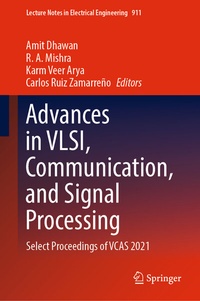
Advances in VLSI, Communication, and Signal Processing
Description

This book comprises select peer-reviewed proceedings of the International Conference on VLSI, Communication and Signal processing (VCAS 2021). The contents focus on the latest research in different domains of electronics and communication engineering, in particular microelectronics and VLSI design, communication systems and networks, and signal and image processing. The book discusses the emerging applications of novel tools and techniques in image, video, and multimedia signal processing. This book will be useful to students, researchers, and professionals working in electronics and communication.
More details
Other editions
Additional editions
Persons
Amit Dhawan is a Professor and Head of the Department of Electronics and Communication Engineering, MNNIT, India. He received his Bachelors in Electronics and Communication Engineering from Birla Institute of Technology, Mesra, Ranchi, India, and Masters (Control & Instrumentation) and Ph. D. (Electronics and Communication Engineering) from Motilal Nehru National Institute of Technology (MNNIT), Allahabad, Prayagraj, India. His research interest areas are digital signal processing, robust stability, guaranteed cost control, delayed systems, and multidimensional systems. He has published several papers in indexed journals and conference proceedings. He has also served as a reviewer for many international journals and conferences. His biography was listed in Marquis´s Who´s Who in the World, USA.
R. A. Mishra passed B. Tech. in Electronics Engg. from K.N.I.T Sultanpur, Avadh University, Faizabad (U.P), in 1989, M.S. degree in Electronic & Control from B.I.T.S Pilani, Rajasthan, in1996, a Ph.D. degree in Electronics & Telecommunication Engg. from Jadavpur University, Kolkata, in 2006. Currently, he is a Professor in the Department of Electronics and Communication Engineering at Motilal Nehru National Institute of Technology Allahabad, India. His area of research is on the topic of device modeling, residue number system-based signal processing, and low power VLSI design. He has published many research papers in reputed journals and conferences. He has guided 8 Ph.D. students, many M. Tech and B. Tech students in their thesis and projects.Karm Veer Arya has received his B.Sc. from Rohilkhand University, Bareilly, India, in 1986. He did his M.E. and Ph.D. from the Indian Institute of Science Bangalore, India, and the Indian Institute of Technology Kanpur, Kanpur, India, in 1991 and 2007, respectively. He is currently working as Professor at ABV-Indian Institute of Information Technology and Management, Gwalior, India. He has published over 150 research papers in international journals and conferences. He has supervised 11 Ph.D. scholars and 92 Master's students. He has completed several funded R&D projects and his research interest areas are image processing, biometrics, and information security.
Carlos Ruiz Zamarreno is a Professor in the Electrical, Electronic, and Communications Engineering Department at the Public University of Navarra (UPNA), Pamplona-Iruña, Spain. He received an MS. degree in Electrical and Electronic Engineering and his Ph.D. in Communications from UPNA, in 2005 and 2009, respectively. He obtained in 2012 a permanent position as Associate Professor at the Electrical, Electronic, and Communications Engineering Department at UPNA. In 2008, he was a visiting scientist at the Massachusetts Institute of Technology (Boston, MA, USA) under the guidance of Prof. Henry I. Smith. He also performed a post-doctoral research stay at Siemens AG (Munich, Germany) in the group of Prof. Maximilian Fleischer. He is the author of more than 200 scientific journal and conference publications and has participated in 20 different research projects with public and private entities.
