

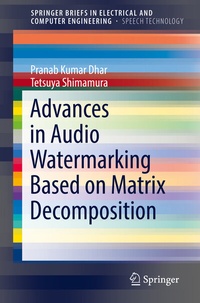
Advances in Audio Watermarking Based on Matrix Decomposition
Description

-
Introduces audio watermarking methods for copyright protection and ownership protection;
-
Describes watermarking methods with encryption and decryption that provide excellent performance in terms of imperceptibility, robustness, and data payload;
-
Discusses in details on the challenges and future research direction of audio watermarking in various application areas.
More details
Other editions
Additional editions
Persons
Pranab Kumar Dhar received B. Sc., M. Sc., and Ph.D. degrees from Chittagong University of Engineering and Technology (CUET), Bangladesh, University of Ulsan, Republic of Korea and Saitama University, Japan in 2004, 2010, and 2014, respectively. In 2005, he joined as a Lecturer in the Department of Computer Science and Engineering, Chittagong University of Engineering and Technology (CUET), Chittagong, Bangladesh where he is currently serving as a Professor. His research interest includes Multimedia Security, Digital Watermarking, Multimedia Data Compression, Sound Synthesis, Digital Image Processing, and Digital Signal Processing. He has published over 25 referred journal articles, 30 conference papers. He is an author of one book and one book chapter, and one patent. He is a member of technical committee of several international conferences. He serves as a reviewer of various reputed journals including of IEEE, IEICE, Elsevier, and Springer. He received 'Best Paper Award' of the International Conference on Intelligent Computing (ICIC-2009) in 2009, 'Excellent Paper Award' of the Engineering and Arts Society Conference in Korea (EASKO-2009) in 2009, and 'Best Paper Award' of the 9th International Forum on Strategic Technologies (IFOST-2014) in 2014. He is also a recipient of 'Best Paper Award' of the Journal of Signal Processing in 2015.
Tetsuya Shimamura received the B.E., M.E., and Ph.D. degrees in Electrical Engineering from Keio University, Yokohama, Japan in 1986, 1988, and 1991, respectively. In 1991, he joined Saitama University, Saitama, Japan, where he is currently a Professor. He was a visiting researcher at Longhborough University, U.K. in 1995 and at Queen's University of Belfast, U.K. in 1996, respectively. His research interests are in digital signal processing and its applications to speech, audio, image and communication systems. He has published over 90 refereed journal articles and 220 international conference papers. He is an author and co-author of eight books, and a member of the organizing committee of several international conferences. He has received IEEE Pacific Rim Conference on Communications, Computers and Signal Processing 'Gold Paper Award' in 2012, WSEAS International Conference on Multimedia Systems and Signal Processing 'Best Paper Award' in 2013, and IEEE IFOST 'Best Paper Award' in 2014. Also, he is a recipient of Journal of Signal Processing 'Best Paper Award' in 2013, 2015, and 2016.
