

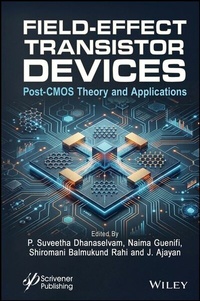
Field-Effect Transistor Devices
Description

Master the More-Moore paradigm and the cutting-edge material innovations redefining the limits of semiconductor miniaturization with this essential roadmap to the future of global microelectronics fabrication.
In today's rapidly evolving electronics landscape, the relentless pursuit of miniaturization stands as a fundamental objective. This drive fuels substantial investments in semiconductor fabrication facilities worldwide. This book serves as a concise, comprehensive guide to semiconductor device miniaturization. It delves into a wide spectrum of topics, including characteristics, innovative materials, structural modifications, and advancements in semiconductor devices. It meticulously traces the evolution of semiconductor devices, shedding light on both existing and proposed technologies, while emphasizing the significance of Moore's Law and the More-Moore paradigm. This compendium provides a holistic view of recent developments, incorporating discussions on cutting-edge research and innovative concepts in the field of miniaturized semiconductor devices and their practical applications.
More details
Other editions
Additional editions
Persons
P. Suveetha Dhanaselvam, PhD is a Professor in the Department of Electronics and Communication at the Velammal College of Engineering and Technology with 22 years of teaching experience. She has authored two books, published papers in 24 reputed journals and 53 international conferences, and holds one patent. Her research interests include analytical modeling, simulation, and oxides.
Naima Guenifi is an Assistant Professor at the University of Batna 2. She has more than 25 publications in international journals of repute. Her research focuses on characterization techniques for Tunnel FETs and optimization techniques involving genetic algorithms and neural networks.
Shiromani Balmukund Rahi, PhD is an Assistant Professor in the School of Information and Communication Technology at Gautam Buddha University. He has published 26 research papers, three conference proceedings, 30 book chapters, and seven books. His research interests include nanofabrication, quantum mechanics, and material characterization.
J. Ajayan, PhD is a Professor in the Department of Electronics and Communication Engineering at Sri Rajeshwara University. He has published more than 150 research articles in various journals and international conferences, six books, more than 20 book chapters, and three patents. His areas of interest include microelectronics, semiconductor devices, nanotechnology, RF-integrated circuits, and photovoltaics.
