

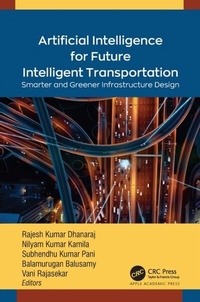
Artificial Intelligence for Future Intelligent Transportation
Smarter and Greener Infrastructure Design
1st Edition
Published on 9. January 2024
336 pages
978-1-000-90683-7 (ISBN)
Description

Emphasizing a sustainable and green approach, this new book presents an overview of state-of-the-art AI strategies for solving transportation challenges around the world, with a focus on traffic management, traffic safety, public transportation, urban mobility, and pollution mitigation. The book examines modern AI technologies such as IoT, cloud computing, machine learning, and neural networking in the context of fully automated transportation that meets current requirements.
The volume provides an informative review of the difficulties and recent developments in smart mobility and transportation, encompassing technical, algorithmic, and social elements. The volume examines innovative service and platform concepts for future mobility. Artificial intelligence principles are examined as well as their implementation in modern hardware architecture. New machine learning issues for autonomous vehicles and fleets are investigated in the framework of artificial intelligence. In addition, the book investigates the human dynamics and social implications of future mobility concepts.
Highlighting the research directions in this field, Artificial Intelligence for Future Intelligent Transportation: Smarter and Greener Infrastructure Design will be of value for researchers in cybersecurity, machine learning, data analysis, and artificial intelligence. Ethical hackers, students, and faculty will find useful information here as well.
The volume provides an informative review of the difficulties and recent developments in smart mobility and transportation, encompassing technical, algorithmic, and social elements. The volume examines innovative service and platform concepts for future mobility. Artificial intelligence principles are examined as well as their implementation in modern hardware architecture. New machine learning issues for autonomous vehicles and fleets are investigated in the framework of artificial intelligence. In addition, the book investigates the human dynamics and social implications of future mobility concepts.
Highlighting the research directions in this field, Artificial Intelligence for Future Intelligent Transportation: Smarter and Greener Infrastructure Design will be of value for researchers in cybersecurity, machine learning, data analysis, and artificial intelligence. Ethical hackers, students, and faculty will find useful information here as well.
More details
Edition
1. Auflage
Language
English
Place of publication
London
United Kingdom
Publishing group
Taylor & Francis Ltd
Target group
College/higher education
Illustrations
5 Tables, black and white; 6 Line drawings, color; 113 Line drawings, black and white; 9 Halftones, black and white; 6 Illustrations, color; 122 Illustrations, black and white
ISBN-13
978-1-000-90683-7 (9781000906837)
Copyright in bibliographic data and cover images is held by Nielsen Book Services Limited or by the publishers or by their respective licensors: all rights reserved.
Schweitzer Classification
Other editions
Additional editions
Rajesh Kumar Dhanaraj | Nilayam Kumar Kamila | Subhendu Kumar Pani
Artificial Intelligence for Future Intelligent Transportation
Smarter and Greener Infrastructure Design
Book
01/2024
1st Edition
Apple Academic Press Inc.
€204.50
Shipment within 3-4 weeks
Persons
Rajesh Kumar Dhanaraj, PhD, is a Professor at Symbiosis International (Deemed University), Pune, India. Prior to this assignment, he was Professor at the School of Computing Sciences & Engineering, Galgotias University, Greater Noida, India. He received the BE degree in Computer Science and Engineering from Anna University Chennai, India, in 2007, his MTech from Anna University Coimbatore, India in 2010, and his PhD degree in Computer Science from Anna University, Chennai, India, in 2017. He has contributed 45+ authored and edited books on various technologies, 21 patents, and 100+ articles and papers in various refereed journals and international conferences and contributed chapters to the books. He has collaborated with eminent professors across the world from top QS ranked universities. His research interests include machine learning, cyber-physical systems and wireless sensor networks. He has delivered many research talks on applied AI and cyber-physical systems at various institutes. He is a Senior Member of the Institute of Electrical and Electronics Engineers (IEEE), member of the Computer Science Teacher Association (CSTA), and International Association of Engineers (IAENG). He is serving as an associate editor and guest editor for reputed journals Computers and Electrical Engineering (Elsevier), Human-centric Computing and Information Sciences, International Journal of Pervasive Computing and Communications (Emerald Insight), Mobile Information Systems (Hindawi), and others. He is an Expert Advisory Panel Member of Texas Instruments Inc., USA.
Nilayam Kumar Kamila, PhD
, is an experienced technical architect and lead, currently working as a Manager in Platform and Data Architecture Engineering Stream under Retail and Direct Technology in Capital One, USA. He received prestigious professional certifications in machine learning, neural networks, and deep learning from Stanford University, USA.
Subhendu Kumar Pani, PhD
, is Professor in the Department of Computer Science and Engineering and Research Coordinator at Krupajal Engineering College, India. He has over 15 years of teaching and research experience, for which he has received awards. He has more than 150 publications, including journal papers, authored and edited books, and book chapters to his credit. He has also acted as associate editor, editorial board member, and reviewer of international journals.
Balamurugan Balusamy, PhD
, is Associate Dean of Student Engagement at Shiv Nadar Institute of Eminence, Delhi, India. He has over 200 papers published in journals from Springer, Elsevier, and IEEE. He has edited and authored more than 50 books and has collaborated with eminent professors across the world at top QS-ranked universities.
Vani Rajasekar, PhD
, is Assistant Professor in the Department of Computer Science and Engineering at Kongu Engineering College, India. She has authored around 25 research papers and book chapters published in international journals and conferences. Her areas of interest include cryptography, biometrics, network security, and wireless networks.
Nilayam Kumar Kamila, PhD
, is an experienced technical architect and lead, currently working as a Manager in Platform and Data Architecture Engineering Stream under Retail and Direct Technology in Capital One, USA. He received prestigious professional certifications in machine learning, neural networks, and deep learning from Stanford University, USA.
Subhendu Kumar Pani, PhD
, is Professor in the Department of Computer Science and Engineering and Research Coordinator at Krupajal Engineering College, India. He has over 15 years of teaching and research experience, for which he has received awards. He has more than 150 publications, including journal papers, authored and edited books, and book chapters to his credit. He has also acted as associate editor, editorial board member, and reviewer of international journals.
Balamurugan Balusamy, PhD
, is Associate Dean of Student Engagement at Shiv Nadar Institute of Eminence, Delhi, India. He has over 200 papers published in journals from Springer, Elsevier, and IEEE. He has edited and authored more than 50 books and has collaborated with eminent professors across the world at top QS-ranked universities.
Vani Rajasekar, PhD
, is Assistant Professor in the Department of Computer Science and Engineering at Kongu Engineering College, India. She has authored around 25 research papers and book chapters published in international journals and conferences. Her areas of interest include cryptography, biometrics, network security, and wireless networks.
Content
1. Introduction to Artificial Intelligence in Smart Transportation 2. AI Approaches in Intelligent Transportation Systems 3. Smart Air Pollution Monitoring and Prediction System Using Deep Learning Enabled IoT Technology 4. Various AI Models to Mitigate Transport Pollution 5. Neural Network Approaches for Transportation 6. Statistical AI Model in Intelligent Transportation System 7. Reinforcement Learning in Smart Transportation 8. Role of AI and IoT in Intelligent Transportation 9. Potential Applications of AI in Transportation 10. AI Techniques for Future Smart Transportation 11. AI-Based Green Transportation: A Sustainable Approach
