

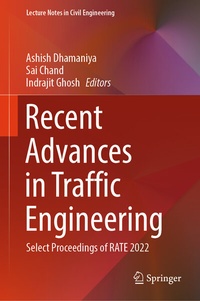
Recent Advances in Traffic Engineering
Description

More details
Other editions
Additional editions
Persons
Dr. Ashish Dhamaniya is Associate Professor of Transportation Engineering in the Department of Civil Engineering at SVNIT, Surat. He completed his Ph.D. in Traffic Engineering from Indian Institute of Technology (IIT) Roorkee. He has wide area of research interests in dynamic traffic flow modelling, highway capacity and level of service, GIS and GPS applications in transportation engineering, pedestrian flow modelling and facility design, road safety, pedestrians and motorists and drone data analysis. He is one of the pioneers in the study of toll plaza operation studies in India and abroad. He has guided number of Ph.D. and M.Tech. students. He has also been awarded with international collaborative research project with Technical University of Munich, Germany under DST-DAAD scheme. He has published more than 100 papers in reputed SCI and Scopus indexed journals and reputed conferences.
Dr. Sai Chand is an Assistant Professor at the Transportation Research and Injury Prevention Centre (TRIPC), Indian Institute of Technology (IIT) Delhi. Prior to that, he worked as a Postdoctoral Research Associate at Research Centre for Integrated Transport Innovation (rCITI), University of New South Wales (UNSW) Sydney, Australia, where he also obtained his Ph.D. in 2019. His research focuses on statistical modelling of traffic safety, applications of crowdsourced pervasive traffic data, traffic flow fluctuations, building strategic regional transport network planning models, and simulation modelling of the network-wide impacts of autonomous vehicles. Dr. Chand has managed several research and consultancy projects. He has helped develop traffic and safety management strategies for several global cities. He has authored more than 40 journals and conference papers with international presentations. He also taught courses on transport modelling and the fundamentals of traffic engineering.
Dr. Indrajit Ghosh is Associate professor in the Department of Civil Engineering at the Indian Institute of Technology (IIT) Roorkee. He has completed his Ph.D. in Transportation Engineering area from Wayne State University, U.S.A. He has a wide area of research interests including road traffic safety using traffic conflict technique, ITS applications, traffic control devices, traffic operations, level-of-service analysis, adoption of electric vehicle and e-mobility. He has more than 40 research papers published in peer reviewed journals and more than 60 papers in national and international conferences. He has supervised 7 Ph.D. scholars. He has been awarded with DUO-India fellowship, Thomac C. Rumble Fellowship, and Young Scientist Award by different national and international agencies.
