

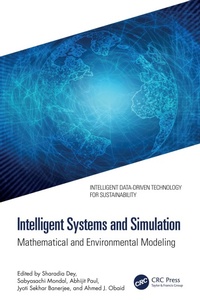
Intelligent Systems and Simulation
Mathematical and Environmental Modeling
Published on 27. June 2025
310 pages
978-1-040-38238-7 (ISBN)
Description

This book covers a wide range of topics such as mathematical modeling, computational methods, simulation techniques in engineering, and their applications in environmental sciences. It begins with an introduction to the fundamental concepts and principles of mathematical modeling with subsequent sections delving into various simulation techniques, including numerical methods, statistical modeling, and bio-mathematical modeling. It also explores the application of these techniques in addressing complex environmental problems.
Features:
Covers mathematical and computational modeling techniques for simulation in engineering, mathematical, and environmental domains
Explores intelligent techniques and simulation methods to enhance accuracy and efficiency in modeling and simulation
Includes practical applications and studies that demonstrate the effectiveness of techniques in real-world scenarios
Incorporates pertinent newly developed methodologies and applications
Discusses CFD software tools like Fortran, MATLAB (R), and Mathematics
This book is aimed at researchers and graduate students in computer engineering, applied mathematics, and applied ecology.
Features:
Covers mathematical and computational modeling techniques for simulation in engineering, mathematical, and environmental domains
Explores intelligent techniques and simulation methods to enhance accuracy and efficiency in modeling and simulation
Includes practical applications and studies that demonstrate the effectiveness of techniques in real-world scenarios
Incorporates pertinent newly developed methodologies and applications
Discusses CFD software tools like Fortran, MATLAB (R), and Mathematics
This book is aimed at researchers and graduate students in computer engineering, applied mathematics, and applied ecology.
More details
Series
Language
English
Place of publication
London
United Kingdom
Publishing group
Taylor & Francis Ltd
Target group
College/higher education
Professional and scholarly
Illustrations
32 Tables, black and white; 110 Line drawings, black and white; 21 Halftones, black and white; 131 Illustrations, black and white
File size
14,05 MB
ISBN-13
978-1-040-38238-7 (9781040382387)
Copyright in bibliographic data and cover images is held by Nielsen Book Services Limited or by the publishers or by their respective licensors: all rights reserved.
Schweitzer Classification
Other editions
Additional editions
Sharadia Dey | Sabyasachi Mondal | Abhijit Paul
Intelligent Systems and Simulation
Mathematical and Environmental Modeling
Book
06/2025
1st Edition
CRC Press
€177.50
Shipment within 10-20 days
Persons
Sharadia Dey is working as an Assistant Professor in the Department of Environmental Studies at St. Xavier's College (Autonomous), Kolkata, West Bengal, India. She completed B.Sc. (Honours) in Chemistry from St. Xavier's College, Kolkata, University of Calcutta, West Bengal, India, and M.Sc. in Atmospheric Science from Ballygunge Science College, University of Calcutta, West Bengal, India. She obtained her Ph.D. from the Department of Environmental Science, University of Burdwan, West Bengal, India, and she completed her postdoctoral research at the University of KwaZulu-Natal, South Africa.
Her research interests include air quality, health, and environmental modeling. Along with 12 years of teaching experience, she is also actively engaged in research. She has published her research work in reputed international journals, conferences, and book chapters. Additionally, she has been successfully working on three national and international research projects. She has research collaborations with scientists in India and abroad.
Sabyasachi Mondal is an Associate Professor in the Department of Mathematics at North-Eastern Hill University, Shillong, Meghalaya, India. He earned his B.Sc. (H) in Mathematics, M.Sc. in Applied Mathematics, and Ph.D. in Computational Fluid Dynamics from Visva-Bharati Santiniketan, West Bengal, India. He worked as a Postdoctoral Research Fellow at the University of KwaZulu-Natal, South Africa.
His areas of research interest include computational fluid dynamics, heat and mass transport, nanofluid flow, etc. Along with his 13 years of teaching experience, he has more than 90 international publications in different reputed journals, books, and conferences in his credit. Also, he published one Indian patent. He delivered invite talks at different Universities and colleges. He is an editorial board member in different international journals and a reviewer of various reputed journals.
Dr. Mondal has received various prestigious funds and fellowships like the UKZN PDF fellowship, Claude Leone Postdoctoral fellowship, NRF travel grants, etc. He is a lifetime member of the Calcutta Mathematical Society and the International Association of Engineers (IAENG). He has research collaborations with various eminent scientists in India and abroad, like South Africa, Botswana, Malaysia, Iran, etc. His research has led to him being selected on the 'Top 2% Most Influential Scientists List' published by Stanford University for the year 2022-2023.
Abhijit Paul is an Associate Professor in the Department of Computer Science at Swami Vivekananda University, Kolkata, India. Prior to this role, he served at Assam Down Town University, Guwahati, and Amity University, Kolkata. He holds a B.Sc. (Hons) in Mathematics from Assam University, Silchar; an M.C.A. from the West Bengal University of Technology; and a Ph.D. in Computer Science from Assam University, Silchar.
His research interests encompass IoT, sensor networks, ad hoc networks, and machine learning. With 8 years of teaching experience, Dr. Paul has contributed to over 11 international publications in reputed journals, books, and conferences. He is also the inventor of one Indian patent and serves as a reviewer for prestigious journals. He actively collaborates with prominent researchers both in India and internationally.
Jyoti Sekhar Banerjee is currently serving as the Head of the Department of Computer Science and Engineering (AI & ML) at the Bengal Institute of Technology (BIT), Kolkata, India. He is also the Professor-in-Charge, R & D and Consultancy Cell & Nodal Officer of the IPR Cell of BIT. Since 2024, he also works as a Remote Researcher in the Internet of THings & AppliCAtions (ITHACA) Lab at the Department of Electrical and Computer Engineering, University of Western Macedonia, Greece. He is the former Remote Research Fellow of the Cognitive Computing and Brain Informatics Research Group (CCBI) at Nottingham Trent University (NTU), UK. He did his Postdoctoral Fellowship at Nottingham Trent University, UK, in the Department of Computer Science. He also completed the Postgraduate Diploma in IPR & TBM from MAKAUT, West Bengal. He has teaching and research experience spanning 20 years and completed one IEI-funded project. He is a member of the CSI, IEEE, ISTE, IEI, ISOC, and IAENG and a fellow of IETE. He is the present Secretary-cum-Treasurer of the ISTE WB Section and Secretary of the IETE, Kolkata Centre. He is the Immediate Past Secretary of the Computer Society of India, Kolkata Chapter. He is also elected as the Vice Chairman Cum Chairman Elect in Computer Society of India, Kolkata Chapter for the year 2025-2027. He has published over 80 papers in various international journals, conference proceedings, and book chapters. So far, he has published 15 edited books and four text books. He is serving as the Series Editor for Advances in Disruptive Technologies and Generative Artificial Intelligence", published by CRC Press, USA. He is also the Series Editor for the Conference Proceedings Series on Futuristic Intelligent and Smart Technologies (FIST), CRC Press, USA. Currently, he is serving as the General Chair of ICHCSC 2022, 2023, 2024, and 2025; and General Co-Chair of GCAIA 2021. He is the Program Chair of the Human 2023, 2024, and 2025 and AAIDS 2024. He is also the General Chair of the AIEST-2024, NEIAIS-2025, WIN 6.0 2025, and ICADAC 2025. He is the Organizing Chair of the EAIT 2024, ICNSBT 2023. 2024, and ICACA 2024. His areas of research interests include computational intelligence, cognitive radio, sensor networks, AI/ML, network security, different computing techniques, IoT, WBAN (e-healthcare), and expert systems.
Ahmed J. Obaid is an Assistant Professor in the Department of Computer Science, Faculty of Computer Science and Mathematics, University of Kufa, Iraq. He holds a bachelor's degree in Computer Science and a degree in Information Systems from the College of Computers, University of Anbar, Iraq (2001-2005); a master's degree (M. TECH) in Computer Science Engineering (CSE) from the School of Information Technology, Jawaharlal Nehru Technological University, Hyderabad, India (2010-2013); and a Ph.D. in Web Mining from the College of Information Technology, University of Babylon, Iraq (2013-2017). He is a Certified Web Mining Consultant with over 14 years of experience working as a Faculty Member at the University of Kufa, Iraq. He has taught courses in web designing, web scripting, JavaScript, VB.Net, MATLAB Toolbox, and other courses on PHP, CMC, and DHTML from more than 10 international organizations and institutes in the USA and India. He is a member of the Statistical and Information Consultation Center (SICC), University of Kufa, Iraq. His main line of research is web mining techniques and applications, image processing in web platforms, image processing, genetic algorithm, information theory, and medical health applications. He has supervised several final year projects for bachelor's and master's degrees in his main line of work. He authored and co-authored several scientific publications in journals, books, and conferences with more than 75+ journal research articles, 5+ book chapters, 15+ conference papers, 10+ conference proceedings, 8+ books editing, and 2+ patents. He attended and participated as Keynote Speakers (60+ Conferences), Webinars (10+), and Session Chairs (10+) in many international events in the following countries: India, Turkey, Nepal, Philippines, Vietnam, Thailand, Indonesia, and other countries.
Her research interests include air quality, health, and environmental modeling. Along with 12 years of teaching experience, she is also actively engaged in research. She has published her research work in reputed international journals, conferences, and book chapters. Additionally, she has been successfully working on three national and international research projects. She has research collaborations with scientists in India and abroad.
Sabyasachi Mondal is an Associate Professor in the Department of Mathematics at North-Eastern Hill University, Shillong, Meghalaya, India. He earned his B.Sc. (H) in Mathematics, M.Sc. in Applied Mathematics, and Ph.D. in Computational Fluid Dynamics from Visva-Bharati Santiniketan, West Bengal, India. He worked as a Postdoctoral Research Fellow at the University of KwaZulu-Natal, South Africa.
His areas of research interest include computational fluid dynamics, heat and mass transport, nanofluid flow, etc. Along with his 13 years of teaching experience, he has more than 90 international publications in different reputed journals, books, and conferences in his credit. Also, he published one Indian patent. He delivered invite talks at different Universities and colleges. He is an editorial board member in different international journals and a reviewer of various reputed journals.
Dr. Mondal has received various prestigious funds and fellowships like the UKZN PDF fellowship, Claude Leone Postdoctoral fellowship, NRF travel grants, etc. He is a lifetime member of the Calcutta Mathematical Society and the International Association of Engineers (IAENG). He has research collaborations with various eminent scientists in India and abroad, like South Africa, Botswana, Malaysia, Iran, etc. His research has led to him being selected on the 'Top 2% Most Influential Scientists List' published by Stanford University for the year 2022-2023.
Abhijit Paul is an Associate Professor in the Department of Computer Science at Swami Vivekananda University, Kolkata, India. Prior to this role, he served at Assam Down Town University, Guwahati, and Amity University, Kolkata. He holds a B.Sc. (Hons) in Mathematics from Assam University, Silchar; an M.C.A. from the West Bengal University of Technology; and a Ph.D. in Computer Science from Assam University, Silchar.
His research interests encompass IoT, sensor networks, ad hoc networks, and machine learning. With 8 years of teaching experience, Dr. Paul has contributed to over 11 international publications in reputed journals, books, and conferences. He is also the inventor of one Indian patent and serves as a reviewer for prestigious journals. He actively collaborates with prominent researchers both in India and internationally.
Jyoti Sekhar Banerjee is currently serving as the Head of the Department of Computer Science and Engineering (AI & ML) at the Bengal Institute of Technology (BIT), Kolkata, India. He is also the Professor-in-Charge, R & D and Consultancy Cell & Nodal Officer of the IPR Cell of BIT. Since 2024, he also works as a Remote Researcher in the Internet of THings & AppliCAtions (ITHACA) Lab at the Department of Electrical and Computer Engineering, University of Western Macedonia, Greece. He is the former Remote Research Fellow of the Cognitive Computing and Brain Informatics Research Group (CCBI) at Nottingham Trent University (NTU), UK. He did his Postdoctoral Fellowship at Nottingham Trent University, UK, in the Department of Computer Science. He also completed the Postgraduate Diploma in IPR & TBM from MAKAUT, West Bengal. He has teaching and research experience spanning 20 years and completed one IEI-funded project. He is a member of the CSI, IEEE, ISTE, IEI, ISOC, and IAENG and a fellow of IETE. He is the present Secretary-cum-Treasurer of the ISTE WB Section and Secretary of the IETE, Kolkata Centre. He is the Immediate Past Secretary of the Computer Society of India, Kolkata Chapter. He is also elected as the Vice Chairman Cum Chairman Elect in Computer Society of India, Kolkata Chapter for the year 2025-2027. He has published over 80 papers in various international journals, conference proceedings, and book chapters. So far, he has published 15 edited books and four text books. He is serving as the Series Editor for Advances in Disruptive Technologies and Generative Artificial Intelligence", published by CRC Press, USA. He is also the Series Editor for the Conference Proceedings Series on Futuristic Intelligent and Smart Technologies (FIST), CRC Press, USA. Currently, he is serving as the General Chair of ICHCSC 2022, 2023, 2024, and 2025; and General Co-Chair of GCAIA 2021. He is the Program Chair of the Human 2023, 2024, and 2025 and AAIDS 2024. He is also the General Chair of the AIEST-2024, NEIAIS-2025, WIN 6.0 2025, and ICADAC 2025. He is the Organizing Chair of the EAIT 2024, ICNSBT 2023. 2024, and ICACA 2024. His areas of research interests include computational intelligence, cognitive radio, sensor networks, AI/ML, network security, different computing techniques, IoT, WBAN (e-healthcare), and expert systems.
Ahmed J. Obaid is an Assistant Professor in the Department of Computer Science, Faculty of Computer Science and Mathematics, University of Kufa, Iraq. He holds a bachelor's degree in Computer Science and a degree in Information Systems from the College of Computers, University of Anbar, Iraq (2001-2005); a master's degree (M. TECH) in Computer Science Engineering (CSE) from the School of Information Technology, Jawaharlal Nehru Technological University, Hyderabad, India (2010-2013); and a Ph.D. in Web Mining from the College of Information Technology, University of Babylon, Iraq (2013-2017). He is a Certified Web Mining Consultant with over 14 years of experience working as a Faculty Member at the University of Kufa, Iraq. He has taught courses in web designing, web scripting, JavaScript, VB.Net, MATLAB Toolbox, and other courses on PHP, CMC, and DHTML from more than 10 international organizations and institutes in the USA and India. He is a member of the Statistical and Information Consultation Center (SICC), University of Kufa, Iraq. His main line of research is web mining techniques and applications, image processing in web platforms, image processing, genetic algorithm, information theory, and medical health applications. He has supervised several final year projects for bachelor's and master's degrees in his main line of work. He authored and co-authored several scientific publications in journals, books, and conferences with more than 75+ journal research articles, 5+ book chapters, 15+ conference papers, 10+ conference proceedings, 8+ books editing, and 2+ patents. He attended and participated as Keynote Speakers (60+ Conferences), Webinars (10+), and Session Chairs (10+) in many international events in the following countries: India, Turkey, Nepal, Philippines, Vietnam, Thailand, Indonesia, and other countries.
Content
1. Establishment of FLP model applying triangular membership functions. 2. Fixed point model for expansion on interval-valued fuzzy metric space. 3. Stability and modified new results for the iterative approximations. 4. QSPR Modelling with Topological Indices. 5. First order phase transition and heat capacity calculation of a transuranic compound at room temperature. 6. Introduction of Modal Analysis to Study the Hydroelatic Response of a Submerged Elastic Structure. 7. Binary interaction with multiple fluid type cosmology under modified gravity frame. 8. Multi soliton, multi singular soliton and lumps in plasma: The Hirota bilinear method. 9. Numerical simulation of Indian ocean dipole and its impact on the Bay of Bengal. 10. Role of stent embedment and release kinetics on two-phase binding of drug in a three-layered arterial tissue. 11. Impact of rumor credibility and user-maturity on rumor propagation. 12. Heat Transfer Analysis of buoyancy-driven MHD Flow with Heat Generation/Absorption in a Nanofluid-Filled Inclined Enclosure. 13. Application of a new multi-domain local linearization method in investigating the soret and dufour effects on natural convection over the vertical frustum of a cone in a nanofluid. 14. An Improved Multi-Derivative Hybrid Block Method for Chaotic and Nonlinear Initial Value Problems. 15. Water Quality Predictive Analysis and Forecasting Dissolved Oxygen (DO) Using Neural Network Model. 16. Understanding the photochemical formation of tropospheric Ozone in Gauteng, South Africa by using Tropospheric Ultraviolet and Visible (TUV) radiation model. 17. A comprehensive analysis of the mismatch between satellite and ground-based particulate matter concentration over Gangetic West Bengal, India. 18. Variation of ambient PM2.5 and associated deposition in the respiratory tract of children during the festive season over Kolkata, India. 19. Book recommender system using collaborative filtering.
