

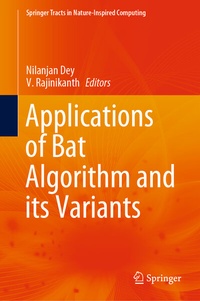
Applications of Bat Algorithm and its Variants
Description

This book highlights essential concepts in connection with the traditional bat algorithm and its recent variants, as well as its application to find optimal solutions for a variety of real-world engineering and medical problems. Today, swarm intelligence-based meta-heuristic algorithms are extensively being used to address a wide range of real-world optimization problems due to their adaptability and robustness. Developed in 2009, the bat algorithm (BA) is one of the most successful swarm intelligence procedures, and has been used to tackle optimization tasks for more than a decade. The BA's mathematical model is quite straightforward and easy to understand and enhance, compared to other swarm approaches. Hence, it has attracted the attention of researchers who are working to find optimal solutions in a diverse range of domains, such as N-dimensional numerical optimization, constrained/unconstrained optimization and linear/nonlinear optimization problems. Along with the traditional BA, its enhanced versions are now also being used to solve optimization problems in science, engineering and medical applications around the globe.
More details
Other editions
Additional editions
Persons
Nilanjan Dey is an Assistant Professor at the Department of Information Technology, Techno International New Town (formerly Techno India College of Technology), Kolkata, India. He is also a Visiting Fellow of the University of Reading, UK and a Visiting Professor at Duy Tan University, Vietnam. He was an honorary Visiting Scientist at Global Biomedical Technologies Inc., CA, USA (2012-2015). Holding a Ph.D. from Jadavpur University (2015), he is the Editor-in-Chief of the International Journal of Ambient Computing and Intelligence, IGI Global. He is also the Series Co-Editor of Springer Tracts in Nature-Inspired Computing (Springer Nature); Series Co-Editor of Advances in Ubiquitous Sensing Applications for Healthcare (Elsevier); and Series Editor of Computational Intelligence in Engineering Problem Solving and Intelligent Signal processing and Data Analysis (CRC). He has authored/edited more than 50 books with Springer, Elsevier, Wiley and CRC Press and published more than 300 peer-reviewed research papers. His main research interests include medical imaging, machine learning, computer-aided diagnosis, and data mining. He is the Indian Ambassador of the International Federation for Information Processing (IFIP) - Young ICT Group.
Venkatesan Rajinikanth is a Professor at the Department of Electronics and Instrumentation Engineering, St. Joseph's College of Engineering, Chennai, India. Recently, he edited a book titled Advances in Artificial Intelligence Systems with Nova Science Publisher, USA. He is an Associate Editor for the International Journal of Rough Sets and Data Analysis. Having published more than 75 papers, his main research interests include medical imaging, machine learning and computer-aided diagnosis, as well as data mining.
Content
