

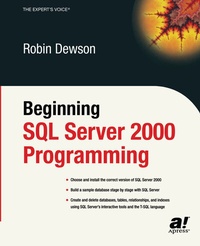
Beginning SQL Server 2000 Programming
Published on 1. January 2008
XIV, 792 pages
978-1-4302-0804-4 (ISBN)
Description

Microsoft SQL Server 2000 provides enterprise-class database solutions, offering interactive development tools and complete management of your relational database applications.
In this book, you'll build a sample database with SQL Server and in the process learn how to design with solutions in mind. If you are migrating from a desktop solution such as Access to SQL Server, this book will provide you with clear and practical demonstrations of the relevant tasks at every stage in the process. Once you've mastered the basics of SQL Server, you'll move on to learn more advanced techniques. By the end of this book, you'll have a firm grasp of the most important SQL Server features and be able to develop your own effective database solutions.
More details
Other editions
Additional editions
Robin Dewson
Beginning SQL Server 2000 Programming
Book
09/2003
Apress
€41.72
Article exhausted; check for reprint
Person
Robin Dewson has been hooked on programming ever since he bought his first computer, a Sinclair ZX80, in 1980. He has been working with SQL Server since version 6.5 and Visual Basic since version 5. Robin is a consultant mainly in the city of London, where he has been for nearly eight years. He also has been developing a rugby-related website as well as maintaining his own site at Fat-Belly.com.
Content
SQL Server 2000 Installation.- Managing SQL Server.- Query Analyzer.- Database Analysis and Design.- Creating the Sample Database.- Defining Tables.- Creating Indexes.- Building Relationships.- Diagramming the Database.- Database Backups and Recovery.- Maintaining Your Database.- Inserting Data.- Retrieving Data.- Updating Data and Transactions.- Deleting Data.- Building a View.- Stored Procedures.- Advanced Stored Procedures.- XML and Data Retrieval.- Triggers.
