

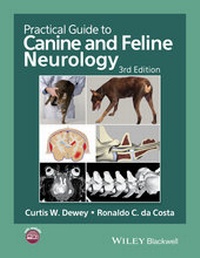
Practical Guide to Canine and Feline Neurology
Description

Reviews / Votes
"There is also an impressive list of references at the end of each chapter should the reader need more details. A great tool for those of us who are serious about their neurology." (Vet Nurses Today, 1 January 2016) "The third updated edition of Practical Guide to Canine and Feline Neurology appears in full color and is a powerful 'must have' veterinary reference, representing a complete update to a reference on managing neurology cases in small animal practice." (Midwest Book Review 2016) "I believe this book should be part of every veterinarian's library. It is an easy reference for readers who need to look something up quickly. The text is written in a manner that is easy to read for veterinary students and veterinarians who are still uncomfortable with neurology, yet it is comprehensive for residents who are studying for board (medical and surgical) certification as well as specialists who are already certified." (Journal of the American Veterinary Medical Association 15 June 2016) The Practical Guide to Canine and FelineNeurology, though being a textbook with atarget audience of veterinarians, is writtenusing clear language and medical terminologythat would make it a useful additionto any veterinary clinic library. "The Practical Guide to Canine and Feline Neurology, though being a textbook with a target audience of veterinarians, is written using clear language and medical terminology that would make it a useful addition to any veterinary clinic library." (New Zealand Veterinary Nurse. 2016) "This book is a must-have for those dealing with neurology on a daily basis." Zoran Loncar (EJCAP 2016)More details
Other editions
Additional editions
Persons
Content
CHAPTER 1
Signalment and History: The First Considerations
Curtis W. Dewey & Ronaldo C. da Costa
Introduction
When presented with a patient that is suspected of having a neurologic disorder, the signalment (i.e. breed, age, and sex) and history are often helpful in guiding the clinician toward the most likely diagnosis. It is important to recognize, however, that this information is adjunctive to the neurologic examination. Properly weighting the importance of signalment and history will help avoid "tunnel vision" when devising diagnostic plans and implementing treatment strategies.
Signalment1-3, 5
The information in Table 1.1 and Table 1.2 provides a summary of suspected and confirmed breed predilections for various neurologic disorders. Knowledge of breed predilections can be very helpful when considering differential diagnoses, especially for uncommon presentations (e.g. neuropathies in juvenile patients). The clinician should be aware of the limitations of breed predilection tables, however. Newly discovered breed predilections or undiscovered breed predilections will not necessarily be represented in a table. In other words, breed predilection tables tend to increase in size with successive textbook editions. Also, breeds other than those reportedly predisposed to a particular disorder may occasionally be affected by that disorder. Finally, certain rare disorders may have only one or a few members of a certain breed reported in the literature. Since some of these disorders are inherited (e.g. lysosomal storage diseases), it may be assumed that the breed is at risk, despite low numbers of actually confirmed cases.
Table 1.1 Breed-associated neurologic abnormalities of dogs.
Afghan Hound Acquired (idiopathic) laryngeal paralysisHereditary myelopathy (leukodystrophy)
Narcolepsy/cataplexy
Retinal degeneration Airedale Terrier Cerebellar abiotrophy
Cerebellar hypoplasia
Congenital myasthenia gravis
Degenerative lumbosacral stenosis Akita Acquired myasthenia gravis
Congenital deafness
Congenital vestibular disease (bilateral)
Glycogenolysis (type III) Alaskan Husky Gangliosidosis (GM1)
Mitochondrial encephalopathy (Leigh's disease, subacute necrotizing encephalopathy) Alaskan Malamute Hereditary polyneuropathy
Myelodysplasia
Muscular dystrophy
Osteochondromatosis of the vertebrae American Bulldog Ceroid lipofuscinosis American Eskimo dog Congenital deafness Australian Blue Heeler Congenital deafness Australian Cattle dog Ceroid lipofuscinosis
Congenital deafness
Dermatomyositis
Mitochondrial encephalomyelopathy
Myotonia congenita
Polioencephalomyelopathy Australian Kelpie Cerebellar abiotrophy Australian Shepherd Ceroid lipofuscinosis (CLN 6)
Congenital deafness Basset Hound Cervical spondylomyelopathy (bony stenosis)
Degenerative disc disease (type I)
Globoid cell leukodystrophy (Krabbe's disease)
Glycoproteinosis (Lafora's disease) Bavarian Mountain dog Cerebellar abiotrophy Beagle Agenesis vermis cerebellum
Congenital deafness
Congenital vestibular disease
Cerebellar abiotrophy
Globoid cell leukodystrophy (Krabbe's disease)
Glycoproteinosis (Lafora's disease)
Idiopathic epilepsy
Intervertebral disc disease (type I)
Methionine deficiency-related spinal myelinopathy
Narcolepsy
Necrotizing vasculitis (steroid meningitis, Beagle pain syndrome) Beagle mix Gangliosidosis (GM1) Belgian Sheepdog Congenital nystagmus
Muscular dystrophy Belgian Shepherd (Groenendael) Muscular dystrophy Belgian Shepherd (Malinois) Degenerative myelopathy
Degenerative lumbosacral stenosis
Leukodystrophy/spongy degeneration (encephalomyelopathy; Belgian Shepherd (Malinois)/Shepherd mixed-breed dogs) Belgian Shepherd (Tervuren) Idiopathic epilepsy
Muscular dystrophy Bern Running dog Cerebellar degeneration Bernese Mountain dog Aggression
Cerebellar abiotrophy
Degenerative myelopathy
Epilepsy
Hepatocerebellar degeneration
Histiocytic sarcoma
Hypomyelination/dysmyelination (dysmyelinogenesis)
Meningitis/meningomyelitis (necrotizing vasculitis) Bichon Frise Atlantoaxial instability
Caudal occipital malformation syndrome
Congenital deafness
Idiopathic tremor syndrome (steroid responsive) Blue Tick Hound Globoid cell leukodystrophy Boerboel Cervical spondylomyelopathy Border Collie Cerebellar abiotrophy
Ceroid lipofuscinosis
Congenital deafness
Fibrocartilaginous embolic myelopathy
Idiopathic epilepsy
Sensory neuropathy Border Terrier Spongiform leukoencephalopathy Borzoi Cervical spondylomyelopathy
Congenital deafness Boston Terrier Brain tumor (gliomas)
Cerebellar abiotrophy
Congenital deafness
Congenital hydrocephalus
Congenital vertebral malformation (hemivertebrae)
Intracranial arachnoid cyst
Muscular dystrophy
Myelodysplasia
Vermian hypoplasia Bouvier des Flandres Distal sensorimotor polyneuropathy
Hereditary laryngeal paralysis
Muscular dystrophy
Pharyngeal/esophageal myopathy Boxer dog Autoimmune polymyositis (+/- paraneoplastic)
Congenital deafness
Corticosteroid-responsive (aseptic) meningitis
Degenerative myelopathy
Disseminated idiopathic skeletal hyperostosis (DISH)
Head-bobbing (suspected dyskinesia)
Neuroaxonal dystrophy
Neuronal vacuolation
Pilonidal (dermoid) sinus
Primary brain tumor (glioma, meningioma)
Progressive axonopathy
Sensory neuropathy
Spondylosis deformans Briquet Griffon Vendéen Spinal muscular atrophy (motor neuron disease) Brittany Spaniel Cerebellar abiotrophy (late onset)
Muscular dystrophy
Sensory ganglioradiculitis
Spinal muscular atrophy
Spinocerebellar degeneration Brussels Griffon Chiari-like malformation (CLM) Bull Mastiff Cerebellar abiotrophy
Cervical spondylomyelopathy
Extradural synovial cyst
Leukodystrophy/spongiform degeneration Bull Terrier Cerebellar abiotrophy
Congenital deafness
Hereditary laryngeal paralysis
Hyperkinesis
Tail chasing Cairn Terrier Globoid cell leukodystrophy
Hydrocephalus
Portosystemic shunt (hepatic encephalopathy)
Spinal muscular atrophy (motor neuron disease) Cardigan Welsh Corgi Congenital deafness
Sensory ganglioradiculitis Catahoula Leopard dog Congenital deafness Cavalier King Charles Spaniel Chiari-like malformation (CLM)
Cerebellar infarct
Congenital deafness
Dorsolateral vertebral canal stenosis and compression at C2-C3
Episodic muscle hypertonicity ("falling cavaliers"-probable dyskinesia)
Femoral thromboembolism
Fly chasing behavior
Idiopathic epilepsy Primary secretory otitis media Chihuahua Atlantoaxial instability
Ceroid lipofuscinosis
Congenital deafness
Congenital hydrocephalus
Muscular dystrophy
Necrotizing meningoencephalitis
Neuroaxonal dystrophy Chinese Crested Cerebellar abiotrophy Chow Chow Cerebellar hypoplasia
Congenital deafness
Hypomyelination/dysmyelination (dysmyelinogenesis)
Myotonia congenita Clumber Spaniel Cerebellar abiotrophy
Mitochondrial myopathy Cocker Spaniel Cerebellar abiotrophy
Ceroid lipofuscinosis
Congenital deafness
Congenital vestibular disease (English)
Cryptococcosis (American)
Hydrocephalus
Idiopathic facial nerve paralysis
Intervertebral disc disease (type I)
Juvenile epilepsy
Leukodystrophy/spongiform degeneration Multisystem neuronal degeneration (red-haired)
Muscular dystrophy
Myopathy...
