

From Quills to Tweets
Description

International Affairs / Communications
"The American way of communicating war dates back to the 18th century and has matured alongside the development of the latest media technologies. For anyone wanting a comprehensive overview of how domestic and global publics have been informed about America's role in armed conflict, From Quills to Tweets is indispensable."
- Philip Seib, professor of journalism and public diplomacy and professor of international relations, University of Southern California
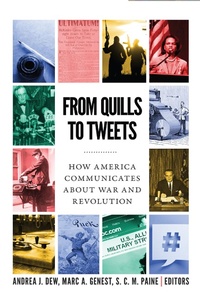
While today's presidential tweets may seem light years away from the scratch of quill pens during the American Revolution, the importance of political communication is eternal. This book investigates the roles that political narratives, media coverage, and evolving communication technologies have played in precipitating, shaping, and concluding or prolonging wars and revolutions over the course of US history.
The case studies begin with the Sons of Liberty in the era of the American Revolution, explore the American wars in the nineteenth and twentieth centuries, and conclude with a look at the conflict against ISIS in the Trump era. Special chapters also examine how propagandists shaped American perceptions of two earthshaking revolutions: the Russian Revolution and the Chinese Revolution. Each chapter analyzes its subject through the lens of the messengers, messages, and communications media to reveal the effects on public opinion and the trajectory and conduct of the conflict. This book is a unique overview of the history of American strategic communications about wars and revolutions that is essential reading for scholars, students, and communications strategists.
Andrea J. Dew is the Maritime Irregular Warfare Forces Chair and Codirector of the Center on Irregular Warfare and Armed Groups at the US Naval War College.
Marc A. Genest is the Forrest Sherman Professor of Public Diplomacy in the Strategy and Policy Department at the US Naval War College.
S. C. M. Paine is the William S. Sims University Professor of History and Grand Strategy at the US Naval War College.
Contributors: Judith Baroody, Troy Bickham, Michael G. Carew, Steven Casey, Andrea J. Dew, Matthew C. DuPée, Bruce A. Elleman, Marc A. Genest, Michelle D Getchell, Haroro J. Ingram, Thomas H. Johnson, David Kaiser, Martin J. Manning, S. C. M. Paine, David J. Silbey, J. Lee Thompson, Craig A. Whiteside
More details
Other editions
Additional editions
Persons
Andrea J. Dew is the Maritime Irregular Warfare Forces Chair and Co-Director of the Center on Irregular Warfare and Armed Groups at the US Naval War College.
Marc A. Genest is the Forrest Sherman Professor of Public Diplomacy in the Strategy and Policy Department at the US Naval War College.
S. C. M. Paine is the William S. Sims University Professor of History and Grand Strategy at the US Naval War College.
Content
Introduction: Message, Messenger, Medium, and Political Environment
Andrea J. Dew, Marc A. Genest, and S. C. M. Paine
Part I. Introduction
Committees of Correspondence and Early Newspapers
Marc A. Genest
1. The Message Heard "Round the World" and the First American Political Campaign
Marc A. Genest
2. Why Communications Mattered in the War of 1812
Troy Bickham
Part II. Introduction
Mass Circulation Newspapers, Magazines, and the Telegraph
Marc A. Genest
3. The Communications Revolution during the US Civil War
Martin J. Manning
4. The Cuban Junta in Exile and the Origins of the Spanish-American War
Michelle D. Getchell
5. Narrating the War in the Philippines, 1899-1902
David J. Silbey
6. John Reed and US Perceptions of the Russian Revolution
Bruce A. Elleman
7. Theodore Roosevelt's Verbal Insurgency against Woodrow Wilson in World War I
J. Lee Thompson
Part III. Introduction
Early Mass Media: Print and Radio
Marc A. Genest
8. Edgar Snow and Shaping US Perceptions of the Chinese Civil War
S. C. M. Paine
9. Franklin D. Roosevelt and World War II
Michael G. Carew
10. Selling a Limited War in Korea, 1950-53
Steven Casey
Part IV. Introduction
Mass Media: Print, Radio, Television, and Cable
Marc A. Genest
11. How Presidents Explained Vietnam, 1954-75
David Kaiser
12. American Wartime Communication Strategies during the Gulf War
Judith Baroody
Part V. Introduction
The Twenty-First Century Information Age: Print, Radio, Cable TV, Internet, and Social Media
Andrea J. Dew and Marc A. Genest
13. Struggling to Overcome the Afghan Taliban's Master Narratives
Thomas H. Johnson and Matthew C. DuPée
14. The Challenge of Outcommunicating the Islamic State
Haroro J. Ingram and Craig A. Whiteside
15. Communicating the Global War on Terror from Speeches to Tweets
Andrea J. Dew
Conclusion: Tweaking the Tweets
Andrea J. Dew, Marc A. Genest, S. C. M. Paine
List of Contributors
Index
