

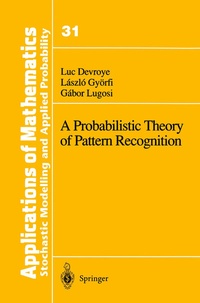
A Probabilistic Theory of Pattern Recognition
Published on 27. November 2013
XV, 638 pages
978-1-4612-0711-5 (ISBN)
Description

Pattern recognition presents one of the most significant challenges for scientists and engineers, and many different approaches have been proposed. The aim of this book is to provide a self-contained account of probabilistic analysis of these approaches. The book includes a discussion of distance measures, nonparametric methods based on kernels or nearest neighbors, Vapnik-Chervonenkis theory, epsilon entropy, parametric classification, error estimation, free classifiers, and neural networks. Wherever possible, distribution-free properties and inequalities are derived. A substantial portion of the results or the analysis is new. Over 430 problems and exercises complement the material.
More details
Other editions
Additional editions
Luc Devroye | László Györfi | Gabor Lugosi
A Probabilistic Theory of Pattern Recognition
Book
11/2013
Springer
€106.99
Shipment within 15-20 days
Luc Devroye | László Györfi | Gabor Lugosi
A Probabilistic Theory of Pattern Recognition
Book
02/1997
1st Edition
Springer
€149.79
Shipment within 5-7 days
Content
Preface * Introduction * The Bayes Error * Inequalities and alternate
distance measures * Linear discrimination * Nearest neighbor rules *
Consistency * Slow rates of convergence Error estimation * The regular
histogram rule * Kernel rules Consistency of the k-nearest neighbor
rule * Vapnik-Chervonenkis theory * Combinatorial aspects of Vapnik-
Chervonenkis theory * Lower bounds for empirical classifier selection
* The maximum likelihood principle * Parametric classification *
Generalized linear discrimination * Complexity regularization *
Condensed and edited nearest neighbor rules * Tree classifiers * Data-
dependent partitioning * Splitting the data * The resubstitution
estimate * Deleted estimates of the error probability * Automatic
kernel rules * Automatic nearest neighbor rules * Hypercubes and
discrete spaces * Epsilon entropy and totally bounded sets * Uniform
laws of large numbers * Neural networks * Other error estimates *
Feature extraction * Appendix * Notation * References * Index
distance measures * Linear discrimination * Nearest neighbor rules *
Consistency * Slow rates of convergence Error estimation * The regular
histogram rule * Kernel rules Consistency of the k-nearest neighbor
rule * Vapnik-Chervonenkis theory * Combinatorial aspects of Vapnik-
Chervonenkis theory * Lower bounds for empirical classifier selection
* The maximum likelihood principle * Parametric classification *
Generalized linear discrimination * Complexity regularization *
Condensed and edited nearest neighbor rules * Tree classifiers * Data-
dependent partitioning * Splitting the data * The resubstitution
estimate * Deleted estimates of the error probability * Automatic
kernel rules * Automatic nearest neighbor rules * Hypercubes and
discrete spaces * Epsilon entropy and totally bounded sets * Uniform
laws of large numbers * Neural networks * Other error estimates *
Feature extraction * Appendix * Notation * References * Index
