

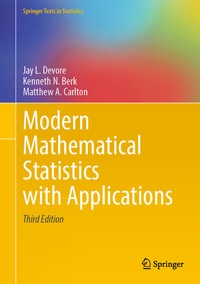
Modern Mathematical Statistics with Applications
Description

- Use of the "Big Mac index" by the publication The Economist as a humorous way to compare product costs across nations
- Visualizing how the concentration of lead levels in cartridges varies for each of five brands of e-cigarettes
- Describing the distribution of grip size among surgeons and how it impacts their ability to use a particular brand of surgical stapler
- Estimating the true average odometer reading of used Porsche Boxsters listed for sale on www.cars.com
- Comparing head acceleration after impact when wearing a football helmet with acceleration without a helmet
- Investigating the relationship between body mass index and foot load while running
Reviews / Votes
"The textbook Modern Mathematical Statistics with Applications can be recommended for applied mathematics and statistics majors as well as prospective scientists, business, social and medical science majors interested in the applying modern statistical methods for their disciplines." (Maria Ivanchuk, ISCB News, iscb.info, June, 2022)More details
Other editions
Additional editions
Persons
Jay L. Devore received a B.S. in Engineering Science from the University of California, Berkeley, and a Ph.D. in Statistics from Stanford University. He previously taught at the University of Florida and Oberlin College, and has had visiting positions at Stanford, Harvard, the University of Washington, New York University, and Columbia. He has been at California Polytechnic State University, San Luis Obispo, since 1977, where he was chair of the Department of Statistics for seven years and recently achieved the exalted status of Professor Emeritus.
Jay has previously authored or coauthored ?ve other books, including Probability and Statistics for Engineering and the Sciences , which won a McGuffey Longevity Award from the Text and Academic Authors Association for demonstrated excellence over time. He is a Fellow of the American Statistical Association, has been an associate editor for both the Journal of the American Statistical Association and The American Statistician , and received the Distinguished Teaching Award from Cal Poly in 1991. His recreational interests include reading, playing tennis, traveling, and cooking and eating good food.
Kenneth N. Berk has a B.S. in Physics from Carnegie Tech (now Carnegie Mellon) and a Ph.D. in Mathematics from the University of Minnesota. He is Professor Emeritus of Mathematics at Illinois State University and a Fellow of the American Statistical Association. He founded the Software Reviews section of The American Statistician and edited it for six years. He served as secretary/treasurer, program chair, and chair of the Statistical Computing Section of the American Statistical Association, and he twice co-chaired the Interface Symposium, the main annual meeting in statistical computing. His published work includes papers on time series, statistical computing, regression analysis, and statistical graphics, as well as the book Data Analysis with Microsoft Excel (with Patrick Carey).
Matthew A. Carlton
is Professor of Statistics at California Polytechnic State University, San Luis Obispo, where he joined the faculty in 1999. He received a B.A. in Mathematics from the University of California, Berkeley and a Ph.D. in Mathematics from the University of California, Los Angeles, with an emphasis on pure and applied probability; his thesis research involved applications of the Poisson-Dirichlet random process. Matt has published papers in the
Journal of Applied Probability
,
Human Biology
,
Journal of Statistics Education
, and
The American Statistician
. He was also the lead content adviser for the "Statistically Speaking" video series, designed for community college statistics courses, and he has published a variety of educational materials for high school statistics teachers. Matt was responsible for developing both the applied probability course and the probability and random processes course at Cal Poly, which in turn inspired him to get involved in writing this text. His professional research focus involves applications of probability to genetics and engineering. Personal interests include travel, good wine, and college sports.
