

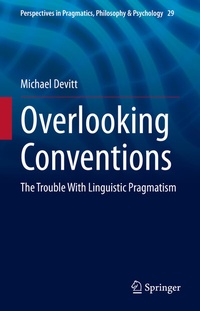
Overlooking Conventions
Description

This book criticizes the methodology of the recent semantics-pragmatics debate in the theory of language and proposes an alternative. It applies this methodology to argue for a traditional view against a group of "contextualists" and "pragmatists", including Sperber and Wilson, Bach, Carston, Recanati, Neale, and many others. The author disagrees with these theorists who hold that the meaning of the sentence in an utterance never, or hardly ever, yields its literal truth-conditional content, even after disambiguation and reference fixing; it needs to be pragmatically supplemented in context.
The standard methodology of this debate is to consult intuitions. The book argues that theories should be tested against linguistic usage. Theoretical distinctions, however intuitive, need to be scientifically motivated. Also we should not be guided by Grice's "Modified Occam's Razor", Ruhl's "Monosemantic Bias", or other such strategies for "meaning denialism". From this novel perspective, the striking examples of context relativity that motivate contextualists and pragmatists typically exemplify semantic rather than pragmatic properties. In particular, polysemous phenomena should typically be treated as semantic ambiguity. The author argues that conventions have been overlooked, that there's no extensive "semantic underdetermination" and that the new theoretical framework of "truth-conditional pragmatics" is a mistake.
More details
Other editions
Additional editions
Person
Michael Devitt is a Distinguished Professor of Philosophy at the Graduate Center of CUNY. He is the author of the following books: Designation (1981); Realism and Truth (1984/1991/1997); Language and Reality (with Kim Sterelny, 1987/1999); Coming to Our Senses (1996); Ignorance of Language (2006); Putting Metaphysics First (2010); Biological Essentialism (forthcoming). He has co-edited (with Richard Hanley) The Blackwell Guide to the Philosophy of Language (2006)
Content
Preface.- Chapter 1. Introduction.- Chapter 2. Reliance on Intuitions.- Chapter 3. The Semantics-Pragmatics Distinction.- Chapter 4: Speaker Meanings and Intentions.- Chapter 5. Linguistic Conventions and Language.- Chapter 6. Bach and Neale on "What is Said".- Chapter 7. Confusion of the Metaphysics Of Meaning With the Epistemology of Interpretation.- Chapter 8. Modified Occam's Razor and The Denial of Linguistic Meanings.- Chapter 9. Referential Descriptions: A Case Study.- Chapter 10. Saturation and Pragmatism's Challenge.- Chapter 11. Polysemy and Pragmatism's Challenge.- Chapter 12. Sub-Sententials: Pragmatics or Semantics?.- Index.
