

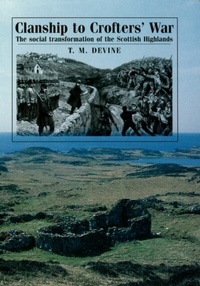
Clanship to Crofters' War
The Social Transformation of the Scottish Highlands
1st Edition
Published on 28. February 2018
276 pages
978-1-5261-3082-2 (ISBN)
Description

Received to wide acclaim when first published in the 1990s, this absorbing book remains one of the most important, influential and widely read histories of the Scottish Highlands from the end of the Jacobite Risings to the great crofters' rebellion of the 1880s.
T. M. Devine argues that the Highlands in the eighteenth and nineteenth centuries saw the wholesale transformation of a society at a pace without parallel anywhere else in western Europe.
This is an important book for all those interested in the history of the Scottish Highlands and Islands, and for students and scholars of Scottish history, social history and rural society. -- .
T. M. Devine argues that the Highlands in the eighteenth and nineteenth centuries saw the wholesale transformation of a society at a pace without parallel anywhere else in western Europe.
This is an important book for all those interested in the history of the Scottish Highlands and Islands, and for students and scholars of Scottish history, social history and rural society. -- .
Reviews / Votes
This is the most pathbreaking book in Highland history since Donald Gregory's appraisal of clanship originally published in the 1840s ... this outstanding work should be prescribed reading for any serious student of Scottish Gaeldom.'Allan I. MacInnes, Innes Review
'Written by Scotland's master historian, this remains the best overview we have of the tumultuous transformation of the Highlands from the collapse of Jacobitism to the great crofting agitation. All of Tom Devine's superb skills are on display: fluent and accessible prose, perceptive arguments, and incisive analysis.'
Angela McCarthy, Professor of Scottish and Irish History, University of Otago, New Zealand
'Professor Devine's book is scrupulously researched and provides the definitive explanation of the Highland crofting system.'
Press and Journal
'A book that any student of Highland history will want to read.'
The Herald
'A powerful story, written with great passion, of defeat, social destruction, emigration, rebellion and cultural revival ... a masterful book ... by the leading authority on the subject.'
Teaching History
Widely considered the definitive work since its original publication in 1994, this study of the Highlands in the 18th and 19th Centuries by Scotland's premier historian receives a welcome reissue. It's a book densely packed with information, following the Highlands from the collapse of Jacobitism to the Crofters' War of the 1880s, and explains how the clan system was supplanted by a new orthodoxy much more in line with the priorities of an urbanising and industrialising Britain. Devine is part of the tendency which believes that the clan system was already in decline before 1745 and that the Duke of Cumberland, while making a useful symbol, did much less harm to the Highlands than the inevitable march of progress which was already transforming the Lowlands. Delving into the language and culture of the region, as well as the pain that eviction, famine and emigration exacted on the people, this is a comprehensive account of the period that is still to be bettered. -- .
All prices
More details
Language
English
Place of publication
Manchester
United Kingdom
Target group
College/higher education
Edition type
Digital original
Illustrations
Illustrations, black & white|Maps, 2 s/w Abbildungen
2 Maps
ISBN-13
978-1-5261-3082-2 (9781526130822)
Copyright in bibliographic data and cover images is held by Nielsen Book Services Limited or by the publishers or by their respective licensors: all rights reserved.
Schweitzer Classification
Other editions
Additional editions
Book
09/2013
Manchester University Press
€29.90
Shipment within 15-20 days
Person
T. M. Devine is Personal Senior Research Professor of History and Director of the Scottish Centre for Diaspora Studies at the University of Edinburgh -- .
Content
1. Clanship
2. Jacobitism and the '45
3. The transformation of Gaeldom
4. The final phase of clearance
5. Revolution in landownership
6. The making of Highlandism, 1746-1822
7. The social impact of protestant evangelicalism
8. The language of the Gael
9. Peasant enterprise: illicit whisky-making, 1760-1840
10. The migrant tradition
11. The great hunger
12. A century of emigration
13. After the famine
14. Patterns of popular resistance and the Crofter's War, 1790-1886
15. The intervention of the state
16. Diaspora: Highland migrants in the Scottish city
Index -- .
2. Jacobitism and the '45
3. The transformation of Gaeldom
4. The final phase of clearance
5. Revolution in landownership
6. The making of Highlandism, 1746-1822
7. The social impact of protestant evangelicalism
8. The language of the Gael
9. Peasant enterprise: illicit whisky-making, 1760-1840
10. The migrant tradition
11. The great hunger
12. A century of emigration
13. After the famine
14. Patterns of popular resistance and the Crofter's War, 1790-1886
15. The intervention of the state
16. Diaspora: Highland migrants in the Scottish city
Index -- .
