

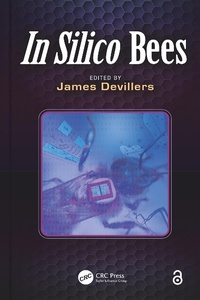
In Silico Bees
Published on 27. January 2014
314 pages
978-1-000-21901-2 (ISBN)
Description

Bees are critically important for ecosystem function and biodiversity maintenance through their pollinating activity. This book provides a collection of computational methods to those primarily interested in the study of the ecology, ethology, and ecotoxicology of bees. It presents numerous case studies to enable readers to understand the appropriateness but also the limitations of models in theoretical and applied bee research. Written by an international team of experts, this book covers the main types of modeling approaches that can be used in terrestrial ecology and applied ecotoxicology.
More details
Language
English
Place of publication
London
United Kingdom
Publishing group
Taylor & Francis Ltd
Target group
Professional and scholarly
Product notice
Reflowable
File size
33,32 MB
ISBN-13
978-1-000-21901-2 (9781000219012)
Copyright in bibliographic data and cover images is held by Nielsen Book Services Limited or by the publishers or by their respective licensors: all rights reserved.
Schweitzer Classification
Other editions
Additional editions
James Devillers
In Silico Bees
Book
01/2014
1st Edition
CRC Press
€260.41
Article not available at the moment
Person
James Devillers has authored/edited 15 books and published more than 200 peer-reviewed papers and book chapters in QSAR and (eco)toxicology modeling. He is editor-in-chief of the journal SAR and QSAR in Environmental Research (Taylor & Francis) and editor of the series of books QSAR in Environmental and Health Sciences (CRC Press). James Devillers is also a member of the editorial boards of Ecological Modelling (Elsevier), Xenobiotica (Taylor & Francis), Current Bioactive Compounds (Bentham Science), and Toxics (MDPI AG).
Content
Automatic Systems for Capturing the Normal and Abnormal Behaviors of Honey Bees. Computational Modeling of Organization in Honey Bee Societies Based on Adaptive Role Allocation. Illustrating the Contrasting Roles of Self-Organization in Biological Systems with Two Case Histories of Collective Decision Making in the Honey Bee. Models for the Recruitment and Allocation of Honey Bee Foragers. Infectious Disease Modeling for Honey Bee Colonies. Honey Bee Ecology from an Urban Landscape Perspective: The Spatial Ecology of Feral Honey Bees. QSAR Modeling of Pesticide Toxicity to Bees. Mathematical Models for the Comprehension of Chemical Contamination into the Hive. Agent-Based Modeling of the Long-Term Effects of Pyriproxyfen on Honey Bee Population. Simulation of Solitary (non-Apis) Bees Competing for Pollen. Estimating the Potential Range Expansion and Environmental Impact of the Invasive Bee-Hawking Hornet, Vespa velutina nigrithorax. Index.
