

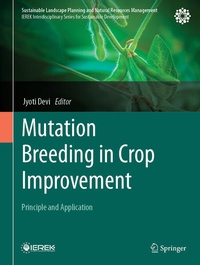
Mutation Breeding in Crop Improvement
Description

This book is useful for post-graduate students, teachers, and researchers, including those working for seed and biotechnology firms. Mutagenesis has been extensively employed to create variety and uncover crucial regulatory genes or the purpose of improving crops. Among the several techniques now in use, mutagenesis and mutation breeding in conjunction with conventional breeding programs can result in mutant varieties with fresh and appealing agronomical trait qualities. This environment is highly suited for induced mutations and its related technologies, and the whole approach helps to track crop genetic variation and maintain biodiversity. Mutagenesis is an important technique for increasing genetic variation, which is necessary for breeders to develop new varieties. Novel allelic variation can be created by random or targeted mutagenesis. Apparently, random mutagenesis seems to be out of date because clustered regularly interspaced short palindromic repeats (CRISPR)-Cas technology has the potential to be faster and far more precise. Targeted mutagenesis offers advantages like targeting one gene (family) only, inducing multiple mutations simultaneously, and avoiding background mutations.
Regretfully, due to legal restrictions, breeders cannot access genome editing in many countries. Therefore, random mutagenesis continues to be an essential technique for generating novel allelic variation. However, the application of mutant offspring in polyploid crops is limited, as multiple mutations are usually needed, and they suffer from a high mutation load. Recent technological developments, such as sequence-based mutant screening and genomic background selection, have made it more effective to take advantage of random mutations. The book discusses both fundamental and practical elements of random and targeted mutagenesis. All of the noteworthy and pertinent literature in the area is included in this book.
More details
Other editions
Additional editions
Person
Dr. Jyoti Devi is an Department of Agriculture, Amity University, Lucknow, Uttar Pradesh, India. Dr. Devi completed her doctoral degree in Plant Biology from Patiala University, Punjab, India. Her specialization is bioactive compounds characterization, molecular and mutation breeding, plant physiology, and biotechnology. She has published more than 11 research articles in leading international and journals having high impact factors. She has received many awards and fellowships from different government organizations. She is involved in teaching and research and her area of research is plant biotechnology. She is an active reviewer for journals Plant Gene, Plant Biotech Reports, 3 Biotech, Industrial Crops and Products, Gene, Current Science, Biologia, etc.
Content
Role of Mutagenesis in Genetic Improvement of Crop Plants.- In-vivo and in-vitro random mutagenesis methods in crop plants.- CRISPR/Cas9 and TALEN mediated genome engineering for crop improvement.- Induced Mutations for Enhancing Nutrition Quality and Production of Food.- Enhancing crop resilience to combined abiotic and biotic stress through induced mutation.- Mutation Breeding for Crop Adaptation to Climate Change.- Mutation breeding for yield and quality improvement: A case study for Wheat and Barley.- Mutation breeding for yield and quality traits in pulses.- Application of Gamma Radiation for the Genetic Improvement of crop plants in Democratic Republic of the Congo.- Advancing rice cultivation through mutation breeding for sustainable agriculture.- Mutagenesis for Crop Breeding and Functional Genomics.- Role of Site-directed mutagenesis in genetic improvement of Crop Plant.- Mutation breeding for yield and quality improvement: A case study of Rice.- Mutation breeding for yield and quality improvement: A case study for millets.- Advancing Sugarcane Breeding through Induced Mutagenesis and Somaclonal Variation -Prospects, Challenges and Opportunities.
