

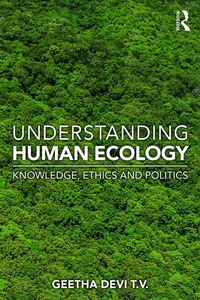
Understanding Human Ecology
Knowledge, Ethics and Politics
1st Edition
Published on 15. January 2019
240 pages
978-0-429-64419-1 (ISBN)
Description

This book examines the domain of human agency-environment interaction from a multidimensional point of view. It explores the human-environment interface by analysing its ethical, political and epistemic aspects - the value aspects that humans attribute to their environment, the relations of power in which the actions and their consequences are implicated and the meaning of human actions in relation to the environment. The volume delineates the character of this domain and works out a theoretical framework for the field of human ecology.
This book will be a must-read for students, scholars and researchers of environmental studies, human ecology, development studies, environmental history, literature, politics and sociology. It will also be useful to practitioners, government bodies, environmentalists, policy makers and NGOs.
This book will be a must-read for students, scholars and researchers of environmental studies, human ecology, development studies, environmental history, literature, politics and sociology. It will also be useful to practitioners, government bodies, environmentalists, policy makers and NGOs.
Reviews / Votes
'This is an epistemologically sound and methodologically unassailable study of the domain and dimensions of Human Ecology, a fast-growing interdisciplinary field of convergence research with thermodynamic depth and truth of entropy. Delving deep into the meaning of 'value' as raised and deliberated upon across the existing thought systems like reform environmentalism, deep ecology, ecofeminism, and social ecology, the study underscores the homologous processes of techno-economic development and the inevitable consequence of ecological degradation.Unlike eco-philosophical literature bound by questions of human-nature dualism or scientific works confined to causal explanations, the present study focuses on the human agency-environment interface. It entrenches the irreducibility of value, politics and knowledge as three fundamental dimensions of human ecology. Quite convincingly the present study informs that human ecology is best understood by recognising the ontological inseparability of these dimensions, generally treated as independent facets in the extant literature. A brilliant combine of analysis and description, this work has turned up eminently readable and educative.'
Rajan Gurukkal, former Professor and Vice Chairman, Kerala State Higher Education Council, Thiruvananthapuram, India
'Bringing together the ethical, political and epistemic dimensions of human ecology that define a knowledge area, this book challenges the conventional wisdom on environmental challenges that we face today. Suggesting a critical new orientation towards environmental policies in a democratic framework, the author suggests new ways of understanding development that will be ethically justified. This justification finally comes out of a new politics that does not make a binary choice between ecology and development.'
P. Sanal Mohan, Director, School of Social Sciences, Mahatma Gandhi University, Kottayam, India
'The book presents the complex interconnections between human agency and the environment. It is clearly written and well-argued. The critique at the beginning and the new proposals and claims that come at the end of the book are both firm and well-grounded. The interesting aspect of this book lies in its interdisciplinary approach; integrating both theory and case studies and closely analysing both failures and successes in environmental movement.'
A. Raghuramaraju, Professor, Department of Humanities and Social Sciences, Indian Institute of Technology Tirupati, India
'A concise but critical effort to explicate human ecology as a disciplinary practice at the intersection of the natural and social sciences. A careful and sustained attention to the field is the primary approach used - one that the author characterises partly as a 'textual analytic method' - and the effort is to develop the domain of human ecology along the constitutive dimensions of 'value, politics and knowledge'. It is not only a successful academic effort to transpose the terms of the author's own disciplinary location in natural science; it also creatively inserts itself into a pedagogic situation where environmental studies are approached as a cross-disciplinary terrain.'
Sasheej Hegde, Professor of Sociology, University of Hyderabad, India 'This is an epistemologically sound and methodologically unassailable study of the domain and dimensions of Human Ecology, a fast-growing interdisciplinary field of convergence research with thermodynamic depth and truth of entropy. Delving deep into the meaning of "value" as raised and deliberated upon across the existing thought systems like reform environmentalism, deep ecology, ecofeminism, and social ecology, the study underscores the homologous processes of techno-economic development and the inevitable consequence of ecological degradation.
Unlike eco-philosophical literature bound by questions of human-nature dualism or scientific works confined to causal explanations, the present study focuses on the human agency-environment interface. It entrenches the irreducibility of value, politics and knowledge as three fundamental dimensions of human ecology. Quite convincingly the present study informs that human ecology is best understood by recognising the ontological inseparability of these dimensions, generally treated as independent facets in the extant literature. A brilliant combination of analysis and description, this work is eminently readable and educative.'
Rajan Gurukkal, former Professor and Vice Chairman, Kerala State Higher Education Council, Thiruvananthapuram, India
'Bringing together the ethical, political and epistemic dimensions of human ecology that define a knowledge area, this book challenges the conventional wisdom on environmental challenges that we face today. Suggesting a critical new orientation towards environmental policies in a democratic framework, the author suggests new ways of understanding development that will be ethically justified. This justification finally comes out of a new politics that does not make a binary choice between ecology and development.'
P. Sanal Mohan, Director, School of Social Sciences, Mahatma Gandhi University, Kottayam, India
'The book presents the complex interconnections between human agency and the environment. It is clearly written and well-argued. The critique at the beginning and the new proposals and claims that come at the end of the book are both firm and well-grounded. The interesting aspect of this book lies in its interdisciplinary approach; integrating both theory and case studies and closely analysing both failures and successes in environmental movement.'
A. Raghuramaraju, Professor, Department of Humanities and Social Sciences, Indian Institute of Technology Tirupati, India
'A concise but critical effort to explicate human ecology as a disciplinary practice at the intersection of the natural and social sciences. A careful and sustained attention to the field is the primary approach used - one that the author characterises partly as a "textual analytic method" - and the effort is to develop the domain of human ecology along the constitutive dimensions of "value, politics and knowledge". It is not only a successful academic effort to transpose the terms of the author's own disciplinary location in natural science; it also creatively inserts itself into a pedagogic situation where environmental studies are approached as a cross-disciplinary terrain.'
Sasheej Hegde, Professor of Sociology, University of Hyderabad, India
More details
Edition
1. Auflage
Language
English
Place of publication
London
United Kingdom
Publishing group
Taylor & Francis Ltd
Target group
College/higher education
Professional and scholarly
File size
1,31 MB
ISBN-13
978-0-429-64419-1 (9780429644191)
Copyright in bibliographic data and cover images is held by Nielsen Book Services Limited or by the publishers or by their respective licensors: all rights reserved.
Schweitzer Classification
Other editions
New editions
E-Book
06/2023
2nd Edition
Routledge
€49.99
Available for download
Additional editions

Book
01/2019
1st Edition
Routledge India
€207.60
Shipment within 10-20 days
Book
01/2019
1st Edition
Routledge India
€63.30
Shipment within 15-20 days
Person
Geetha Devi T. V. is Project Coordinator (Honorary), Institute for Social and Ecological Studies (ISES), an NGO based in Kozhikode, Kerala, India, and an independent researcher. She began her academic career in the sciences and completed her postgraduate degree in botany. Subsequently, she moved into the field of human ecology and completed both her MPhil and PhD degrees from the School of Social Sciences, Mahatma Gandhi University, Kottayam, Kerala. She was Lecturer (temporary) of Human Ecology in the Social Sciences department for postgraduate and MPhil programmes. She became an affiliated scholar at the Interuniversity Centre for Social Science Research and Extension (IUCSSRE), M. G. University for one and half years and submitted a working paper titled Sustainable Development and Environmental Policy Making: A Review. She gained insights in Geo-spatial technology from the Dr. R. Satheesh Centre for Remote Sensing and GIS at the School of Environmental Sciences, M. G. University and continued research to examine the role of GIS tools in environmental studies and completed training programmes at the National Remote Sensing Centre, Hyderabad. Her research interests include natural resource management, environmental studies, human ecology, environment-development interface, sustainable development and political ecology. Her other interests include music and Indian philosophy.
Content
Part I Human ecology: the domain and its dimensionsIntroduction
Part II Ethics.1 Environmental scenario of the twentieth century: a historical sketch2 'Value' dynamics in the environmental thought systems
Part III Politics
3 'Environment' in the 'development' context: a historical inquiry
4 The question of 'political' in environmental thought systems, movements and as a political process
Part IV Knowledge
5 The making of human ecology: a historical perspective6 'Human ecology' as a discipline: methodological reflections
Part V Ethics, politics, knowledge: a multidimensional approach
Conclusion
Bibliography
Index
Part II Ethics.1 Environmental scenario of the twentieth century: a historical sketch2 'Value' dynamics in the environmental thought systems
Part III Politics
3 'Environment' in the 'development' context: a historical inquiry
4 The question of 'political' in environmental thought systems, movements and as a political process
Part IV Knowledge
5 The making of human ecology: a historical perspective6 'Human ecology' as a discipline: methodological reflections
Part V Ethics, politics, knowledge: a multidimensional approach
Conclusion
Bibliography
Index
