

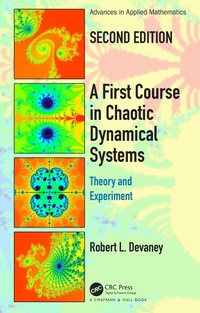
A First Course In Chaotic Dynamical Systems
Theory And Experiment
2nd Edition
Published on 21. April 2020
328 pages
978-1-000-06565-7 (ISBN)
Description

A First Course in Chaotic Dynamical Systems: Theory and Experiment, Second Edition
The long-anticipated revision of this well-liked textbook offers many new additions. In the twenty-five years since the original version of this book was published, much has happened in dynamical systems. Mandelbrot and Julia sets were barely ten years old when the first edition appeared, and most of the research involving these objects then centered around iterations of quadratic functions. This research has expanded to include all sorts of different types of functions, including higher-degree polynomials, rational maps, exponential and trigonometric functions, and many others. Several new sections in this edition are devoted to these topics.
The area of dynamical systems covered in A First Course in Chaotic Dynamical Systems: Theory and Experiment, Second Edition is quite accessible to students and also offers a wide variety of interesting open questions for students at the undergraduate level to pursue. The only prerequisite for students is a one-year calculus course (no differential equations required); students will easily be exposed to many interesting areas of current research. This course can also serve as a bridge between the low-level, often non-rigorous calculus courses, and the more demanding higher-level mathematics courses.
Features
More extensive coverage of fractals, including objects like the Sierpinski carpet and others
that appear as Julia sets in the later sections on complex dynamics, as well as an actual
chaos "game."
More detailed coverage of complex dynamical systems like the quadratic family
and the exponential maps.
New sections on other complex dynamical systems like rational maps.
A number of new and expanded computer experiments for students to perform.
About the Author
Robert L. Devaney is currently professor of mathematics at Boston University. He received his PhD from the University of California at Berkeley under the direction of Stephen Smale. He taught at Northwestern University and Tufts University before coming to Boston University in 1980. His main area of research is dynamical systems, primarily complex analytic dynamics, but also including more general ideas about chaotic dynamical systems. Lately, he has become intrigued with the incredibly rich topological aspects of dynamics, including such things as indecomposable continua, Sierpinski curves, and Cantor bouquets.
The long-anticipated revision of this well-liked textbook offers many new additions. In the twenty-five years since the original version of this book was published, much has happened in dynamical systems. Mandelbrot and Julia sets were barely ten years old when the first edition appeared, and most of the research involving these objects then centered around iterations of quadratic functions. This research has expanded to include all sorts of different types of functions, including higher-degree polynomials, rational maps, exponential and trigonometric functions, and many others. Several new sections in this edition are devoted to these topics.
The area of dynamical systems covered in A First Course in Chaotic Dynamical Systems: Theory and Experiment, Second Edition is quite accessible to students and also offers a wide variety of interesting open questions for students at the undergraduate level to pursue. The only prerequisite for students is a one-year calculus course (no differential equations required); students will easily be exposed to many interesting areas of current research. This course can also serve as a bridge between the low-level, often non-rigorous calculus courses, and the more demanding higher-level mathematics courses.
Features
More extensive coverage of fractals, including objects like the Sierpinski carpet and others
that appear as Julia sets in the later sections on complex dynamics, as well as an actual
chaos "game."
More detailed coverage of complex dynamical systems like the quadratic family
and the exponential maps.
New sections on other complex dynamical systems like rational maps.
A number of new and expanded computer experiments for students to perform.
About the Author
Robert L. Devaney is currently professor of mathematics at Boston University. He received his PhD from the University of California at Berkeley under the direction of Stephen Smale. He taught at Northwestern University and Tufts University before coming to Boston University in 1980. His main area of research is dynamical systems, primarily complex analytic dynamics, but also including more general ideas about chaotic dynamical systems. Lately, he has become intrigued with the incredibly rich topological aspects of dynamics, including such things as indecomposable continua, Sierpinski curves, and Cantor bouquets.
More details
Edition
2nd edition
Language
English
Place of publication
London
United Kingdom
Publishing group
Taylor & Francis Ltd
Target group
College/higher education
Illustrations
16 Illustrations, color
ISBN-13
978-1-000-06565-7 (9781000065657)
Copyright in bibliographic data and cover images is held by Nielsen Book Services Limited or by the publishers or by their respective licensors: all rights reserved.
Schweitzer Classification
Other editions
Additional editions
Book
01/2023
2nd Edition
Chapman & Hall/CRC
€73.40
Shipment within 10-20 days
Book
05/2020
2nd Edition
Chapman & Hall/CRC
€111.41
Shipment within 15-20 days
Person
About the Author
Robert L. Devaney is currently professor of mathematics at Boston University. He received his PhD from the University of California at Berkeley under the direction of Stephen Smale. He taught at Northwestern University and Tufts University before coming to Boston University in 1980. His main area of research is dynamical systems, primarily complex analytic dynamics, but also including more general ideas about chaotic dynamical systems. Lately, he has become intrigued with the incredibly rich topological aspects of dynamics, including such things as indecomposable continua, Sierpinski curves, and Cantor bouquets.
Robert L. Devaney is currently professor of mathematics at Boston University. He received his PhD from the University of California at Berkeley under the direction of Stephen Smale. He taught at Northwestern University and Tufts University before coming to Boston University in 1980. His main area of research is dynamical systems, primarily complex analytic dynamics, but also including more general ideas about chaotic dynamical systems. Lately, he has become intrigued with the incredibly rich topological aspects of dynamics, including such things as indecomposable continua, Sierpinski curves, and Cantor bouquets.
Content
Preface to the Second Edition, 1. A Visual and Historical Tour, 2. Examples of Dynamical Systems, 3. Orbits, 4. Graphical Analysis, 5. Fixed and Periodic Points, 6. Bifurcations, 7. The Quadratic Family, 8. Transition to Chaos, 9. Symbolic Dynamics, 10. Chaos, 11. Sharkovsky's Theorem, 12. Role of the Critical Point, 13. Newton's Method, 14. Fractals, 15. Complex Functions, 16. The Julia Set, 17. The Mandelbrot Set, 18. Other Complex Dynamical Systems, Appendices, Bibliography, Index
