

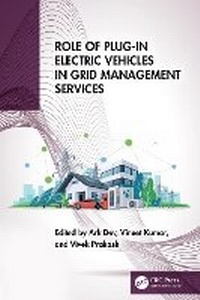
Role of Plug-in Electric Vehicles in Grid Management Services
Published on 5. November 2025
318 pages
978-1-040-44038-4 (ISBN)
Description

The increasing integration of plug-in electric vehicles (PEVs) into power grids has sparked new challenges and opportunities in energy management, grid stability, and sustainable power solutions. Role of Plug-in Electric Vehicles in Grid Management Services provides a comprehensive exploration of how PEVs are transforming modern power networks, offering solutions for demand-side management, vehicle-to-grid (V2G) integration, and energy storage. This book presents in-depth discussions on emerging technologies, smart charging strategies, and optimization methods to ensure a resilient and efficient grid infrastructure.
With contributions from leading researchers and industry experts, this book delves into critical areas such as the impact of EV integration on grid stability, smart charging infrastructure, battery health monitoring using AI, and advanced power electronic converters for seamless EV-grid interactions. Covering both theoretical foundations and practical applications, this book serves as an essential resource for researchers, policymakers, and professionals working at the intersection of electric mobility and power systems.
Key Features
* A detailed review of the impact of EV integration on power grids and energy transition.
* Cutting-edge insights into smart charging infrastructure and multi-criteria decision-making for lithium battery selection.
* AI and machine learning applications for battery health monitoring and key parameter estimation.
* Novel optimization techniques for multi-area microgrids incorporating energy storage and EVs.
* Advanced power electronics designs, including DC-DC converters and resonant converters for efficient EV charging.
* Exploration of future trends and research directions in EV-integrated grids.
This book is an invaluable reference for academics, engineers, and researchers in electrical engineering, renewable energy, and electric vehicle technology. It will also benefit industry professionals involved in power system planning, grid management, and electric mobility solutions.
With contributions from leading researchers and industry experts, this book delves into critical areas such as the impact of EV integration on grid stability, smart charging infrastructure, battery health monitoring using AI, and advanced power electronic converters for seamless EV-grid interactions. Covering both theoretical foundations and practical applications, this book serves as an essential resource for researchers, policymakers, and professionals working at the intersection of electric mobility and power systems.
Key Features
* A detailed review of the impact of EV integration on power grids and energy transition.
* Cutting-edge insights into smart charging infrastructure and multi-criteria decision-making for lithium battery selection.
* AI and machine learning applications for battery health monitoring and key parameter estimation.
* Novel optimization techniques for multi-area microgrids incorporating energy storage and EVs.
* Advanced power electronics designs, including DC-DC converters and resonant converters for efficient EV charging.
* Exploration of future trends and research directions in EV-integrated grids.
This book is an invaluable reference for academics, engineers, and researchers in electrical engineering, renewable energy, and electric vehicle technology. It will also benefit industry professionals involved in power system planning, grid management, and electric mobility solutions.
More details
Language
English
Place of publication
London
United Kingdom
Publishing group
Taylor & Francis Ltd
Target group
Professional and scholarly
College/higher education
Illustrations
46 Tables, black and white; 31 Line drawings, color; 97 Line drawings, black and white; 31 Illustrations, color; 97 Illustrations, black and white
File size
22,50 MB
ISBN-13
978-1-040-44038-4 (9781040440384)
Copyright in bibliographic data and cover images is held by Nielsen Book Services Limited or by the publishers or by their respective licensors: all rights reserved.
Schweitzer Classification
Other editions
Additional editions
Ark Dev | Vineet Kumar | Vivek Prakash
Role of Plug-in Electric Vehicles in Grid Management Services
Book
11/2025
1st Edition
CRC Press
€187.80
Shipment within 15-20 days
Persons
Ark Dev is currently working as an Assistant Professor in the Department of Electrical Engineering at Parul Institute of Engineering and Technology, Parul University, Vadodara, Gujarat, India. He completed his Bachelor of Technology (B. Tech.) in Electronics and Instrumentation Engineering from WBUT in 2013, followed by a Master of Technology (M. Tech.) in Power and Control Systems in 2017. He earned his Ph.D. in Electrical Engineering from NIT Manipur in 2021. His primary research interests include frequency stability in power systems, microgrids, renewable energies, sliding mode control, event-triggered control, and optimization techniques. He has published multiple scientific articles focused on frequency stability in power systems, microgrid stability, and optimization, contributing to advancements in these fields.
Vineet Kumar is currently working as an Assistant Professor in the Department of Electrical Engineering at Netaji Subhas University of Technology, Govt. of NCT of Delhi, India. He completed his B. Tech. degree in Electrical and Electronics Engineering from ABES Engineering College, Ghaziabad, India in 2013, and an M. Tech in Power System from NIT Hamirpur, India in 2017. He completed his doctoral studies from NIT Hamirpur in Power System in 2023. His research expertise is in optimization, metaheuristic techniques, and unit commitment problems.
Vivek Prakash is currently working as an Assistant Professor in the School of Automation at Banasthali Vidyapith in Tonk, India, an institution accredited with NAAC A++ and ranked 35th in the NIRF 2021 rankings. He obtained his Ph.D. from the Electrical Engineering Department at Malaviya National Institute of Technology in Jaipur in 2019. He was also a postdoctoral research fellow at the Faculty of Electrical Engineering and Computing (FER) at the University of Zagreb in Croatia. He has authored and co-authored more than 50 research publications and 5 patents. Additionally, he is actively involved in scholarly endeavors as an editorial board member of the Electrical Engineering journal published by Springer Nature, a prestigious SCI journal with an impact factor of 1.8. He also holds the position of editorial member for the Journal of Energy and have had the honor of serving as a guest editor for Energies, a publication with an impact factor of 3.25.
Vineet Kumar is currently working as an Assistant Professor in the Department of Electrical Engineering at Netaji Subhas University of Technology, Govt. of NCT of Delhi, India. He completed his B. Tech. degree in Electrical and Electronics Engineering from ABES Engineering College, Ghaziabad, India in 2013, and an M. Tech in Power System from NIT Hamirpur, India in 2017. He completed his doctoral studies from NIT Hamirpur in Power System in 2023. His research expertise is in optimization, metaheuristic techniques, and unit commitment problems.
Vivek Prakash is currently working as an Assistant Professor in the School of Automation at Banasthali Vidyapith in Tonk, India, an institution accredited with NAAC A++ and ranked 35th in the NIRF 2021 rankings. He obtained his Ph.D. from the Electrical Engineering Department at Malaviya National Institute of Technology in Jaipur in 2019. He was also a postdoctoral research fellow at the Faculty of Electrical Engineering and Computing (FER) at the University of Zagreb in Croatia. He has authored and co-authored more than 50 research publications and 5 patents. Additionally, he is actively involved in scholarly endeavors as an editorial board member of the Electrical Engineering journal published by Springer Nature, a prestigious SCI journal with an impact factor of 1.8. He also holds the position of editorial member for the Journal of Energy and have had the honor of serving as a guest editor for Energies, a publication with an impact factor of 3.25.
Content
Chapter 1 Vehicle Integration to the Grid: A Comprehensive Review
R. Tiwari and P. Ahmad
Chapter 2 Smart Charging of Electric Vehicles for Robust Power System Infrastructure: Fundamentals and Current Trends
I. Chandra, N. K. Singh, and P. Samuel
Chapter 3 Review and Outlook on Synergies among Integrated Systems of EVs and Rooftop Solar Fostering Energy Transition
S. Jangid and S. Sharma
Chapter 4 Cell Balancing and Comparison of Electric Vehicles Based on Battery Capacity
A. Jain and S. Bhullar
Chapter 5 A Critical Review of Battery Health Monitoring and RUL Estimation Using AI and Machine Learning-Based Algorithms
A. Shubhangi Rao and V. Joshi Manohar
Chapter 6 Smart Charging Infrastructure
A. S. Rajawat, A. Munsi, and K. Aditya
Chapter 7 A Multi-criterion Decision-Making Approach Toward Optimal Selection of Lithium Batteries for Electric Vehicle Applications
S. Chourey and D. Naware
Chapter 8 Estimation of Key Parameters in EV Batteries Using Machine Learning Techniques
S. Bandopadhaya, V. Prakash, V. Himthani, and S. Chawda
Chapter 9 Incorporating Energy Storage and Electric Vehicles into Mult-iarea Microgrid Using a Novel Secretary Bird Optimization-Based Cascaded Controller
H. Shukla and S. Kumar
Chapter 10 Stability Boundary Locus Method for Load Frequency Control with Electric Vehicle Aggregator and Time Delay
P. Sharma, B. Sharma, and V. Prakash
Chapter 11 Performance Evaluation of Dual Active Bridge Resonant Converters for Efficient EV Intercharging: A Simulation Study
H. Vasta, K. P. Bhatt, D. Kumar, and V. K. Verma
Chapter 12 Integrated Single-Phase Totem-Pole Power Factor Correction with Renewable Energy Source Buck-Boost Converter
R. Thapliyal, S. Bose, and P. Dwivedi
Chapter 13 Design and Analysis of a High-Gain Quadratic DC-DC Converter for Electric Vehicles
D. Ragaleela, B. Manikanta, J. Prasanth Kumar, D. Srividya,
and M. Kavya
Chapter 14 Solar Power-Based Fast DC Charging of an Electric Vehicle Using Classical Sliding Mode Controlled Dual Active Bridge Converter
S. K. Gudey, S. S. Goriparthi, and R. Sabbavarapu
Chapter 15 Schedule of Electric Vehicles in the Distribution Networks
T. V. Minh, T. D. T. Kieu, and D. V. Ngoc
Chapter 16 Future Trends and Research Directions in EV-Integrated Grid
S. Kumar, P. K. Singhal, S. L. Surana, G. Tiwari, and N. Tiwari
R. Tiwari and P. Ahmad
Chapter 2 Smart Charging of Electric Vehicles for Robust Power System Infrastructure: Fundamentals and Current Trends
I. Chandra, N. K. Singh, and P. Samuel
Chapter 3 Review and Outlook on Synergies among Integrated Systems of EVs and Rooftop Solar Fostering Energy Transition
S. Jangid and S. Sharma
Chapter 4 Cell Balancing and Comparison of Electric Vehicles Based on Battery Capacity
A. Jain and S. Bhullar
Chapter 5 A Critical Review of Battery Health Monitoring and RUL Estimation Using AI and Machine Learning-Based Algorithms
A. Shubhangi Rao and V. Joshi Manohar
Chapter 6 Smart Charging Infrastructure
A. S. Rajawat, A. Munsi, and K. Aditya
Chapter 7 A Multi-criterion Decision-Making Approach Toward Optimal Selection of Lithium Batteries for Electric Vehicle Applications
S. Chourey and D. Naware
Chapter 8 Estimation of Key Parameters in EV Batteries Using Machine Learning Techniques
S. Bandopadhaya, V. Prakash, V. Himthani, and S. Chawda
Chapter 9 Incorporating Energy Storage and Electric Vehicles into Mult-iarea Microgrid Using a Novel Secretary Bird Optimization-Based Cascaded Controller
H. Shukla and S. Kumar
Chapter 10 Stability Boundary Locus Method for Load Frequency Control with Electric Vehicle Aggregator and Time Delay
P. Sharma, B. Sharma, and V. Prakash
Chapter 11 Performance Evaluation of Dual Active Bridge Resonant Converters for Efficient EV Intercharging: A Simulation Study
H. Vasta, K. P. Bhatt, D. Kumar, and V. K. Verma
Chapter 12 Integrated Single-Phase Totem-Pole Power Factor Correction with Renewable Energy Source Buck-Boost Converter
R. Thapliyal, S. Bose, and P. Dwivedi
Chapter 13 Design and Analysis of a High-Gain Quadratic DC-DC Converter for Electric Vehicles
D. Ragaleela, B. Manikanta, J. Prasanth Kumar, D. Srividya,
and M. Kavya
Chapter 14 Solar Power-Based Fast DC Charging of an Electric Vehicle Using Classical Sliding Mode Controlled Dual Active Bridge Converter
S. K. Gudey, S. S. Goriparthi, and R. Sabbavarapu
Chapter 15 Schedule of Electric Vehicles in the Distribution Networks
T. V. Minh, T. D. T. Kieu, and D. V. Ngoc
Chapter 16 Future Trends and Research Directions in EV-Integrated Grid
S. Kumar, P. K. Singhal, S. L. Surana, G. Tiwari, and N. Tiwari
