

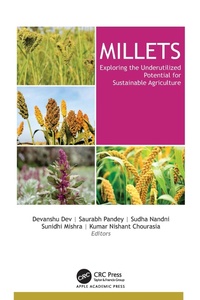
Millets
Exploring the Underutilized Potential for Sustainable Agriculture
Published on 21. October 2025
450 pages
978-1-040-59894-8 (ISBN)
Description

Millets have long been overshadowed by more mainstream crops, yet their potential is vast and largely untapped. This new volume meets an urgent need to raise awareness about the nutritional benefits, processing techniques, crop protection strategies, and breeding tools and techniques for underutilized millets.
The volume first provides readers with a foundational understanding of the historical, nutritional, and ecological significance of these grains, setting the stage for a deeper exploration into their underutilized potential and the transformative role they can play in global agriculture.
One of the key strengths of this book lies in its commitment to addressing the multifaceted challenges faced by millet cultivation. It goes beyond the traditional narrative, shedding light on pest and disease management strategies crucial for the success of millet crops, providing a holistic and practical guide for farmers and researchers alike.
Chapters look at plant protection aspects, covering the gamut of challenges to millet cultivation and production, such as stress from environmental factors, fungal diseases, insect pests, along with effective management techniques.
The authors explore how today's rapid and cutting-edge technology is used in practices and breeding methodologies that not only enhance millet production but also contribute to the overall sustainability of agricultural systems, serving as a valuable resource for those at the forefront of agricultural innovation. These include genetic solutions for disease resistance, improved yields, enhanced nutritional quality, improved stress response, etc.
The volume also, importantly, takes an in-depth look at the effect of climate change on diseases and insect pests of millet crops.
Millets: Exploring the Underutilized Potential for Sustainable Agriculture stands as a comprehensive guide that bridges the gap between the potential of millets and their actualization in sustainable farming practices. It is a valuable resource for researchers, farmers, policymakers, and anyone passionate about the intersection of agriculture, sustainability, and resilience. This book is not just an exploration of millets; it is a roadmap for a more sustainable and secure future for agriculture and food systems worldwide.
The volume first provides readers with a foundational understanding of the historical, nutritional, and ecological significance of these grains, setting the stage for a deeper exploration into their underutilized potential and the transformative role they can play in global agriculture.
One of the key strengths of this book lies in its commitment to addressing the multifaceted challenges faced by millet cultivation. It goes beyond the traditional narrative, shedding light on pest and disease management strategies crucial for the success of millet crops, providing a holistic and practical guide for farmers and researchers alike.
Chapters look at plant protection aspects, covering the gamut of challenges to millet cultivation and production, such as stress from environmental factors, fungal diseases, insect pests, along with effective management techniques.
The authors explore how today's rapid and cutting-edge technology is used in practices and breeding methodologies that not only enhance millet production but also contribute to the overall sustainability of agricultural systems, serving as a valuable resource for those at the forefront of agricultural innovation. These include genetic solutions for disease resistance, improved yields, enhanced nutritional quality, improved stress response, etc.
The volume also, importantly, takes an in-depth look at the effect of climate change on diseases and insect pests of millet crops.
Millets: Exploring the Underutilized Potential for Sustainable Agriculture stands as a comprehensive guide that bridges the gap between the potential of millets and their actualization in sustainable farming practices. It is a valuable resource for researchers, farmers, policymakers, and anyone passionate about the intersection of agriculture, sustainability, and resilience. This book is not just an exploration of millets; it is a roadmap for a more sustainable and secure future for agriculture and food systems worldwide.
More details
Language
English
Place of publication
United Kingdom
Publishing group
Taylor & Francis Ltd
Target group
College/higher education
Professional and scholarly
Illustrations
5 Line drawings, color; 19 Line drawings, black and white; 10 Halftones, color; 19 Halftones, black and white; 15 Illustrations, color; 38 Illustrations, black and white
File size
83,21 MB
ISBN-13
978-1-040-59894-8 (9781040598948)
Copyright in bibliographic data and cover images is held by Nielsen Book Services Limited or by the publishers or by their respective licensors: all rights reserved.
Schweitzer Classification
Other editions
Additional editions
Devanshu Dev | Saurabh Pandey | Sudha Nandni
Millets
Exploring the Underutilized Potential for Sustainable Agriculture
Book
10/2025
1st Edition
Apple Academic Press
€287.60
Shipment within 3-4 weeks
Persons
Devanshu Dev, PhD, is an Assistant Professor of Plant Pathology at the Dr. Kalam Agricultural College, India. He earlier served as a Subject Matter Specialist at Krishi Vigyan Kendra (Sheohar), part of Dr. Rajendra Prasad Central Agricultural University, Pusa. He has over seven years of experience in research, teaching, and the extension of plant disease management. He has published research papers along with book chapters and over 35 popular articles.
Saurabh Pandey, PhD, is an Assistant Professor in the Department of Molecular Biology and Biotechnology, Indira Gandhi Agricultural University, India. He has eight years of experience in areas of plant biotechnology. He has published about half a dozen research papers in various journals and authored many book chapters on molecular marker, genomics, plant breeding, and plant molecular virology, catering to the needs of modern agriculture research.
Sudha Nandini, PhD, is an Assistant Professor of Plant Pathology at the Tirhut College of Agriculture of Rajendra Prasad Central Agricultural University, India. Dr. Nandini has experience in research and teaching and extension of plant pathology and diseases and their management and mushroom cultivation technology. She has published research papers in international journals as well as book chapters and popular articles. She has received several awards for her work.
Sunidhi Mishra, PhD, is an Assistant Professor at the College of Agriculture and Research Station, Kurud, of Indira Gandhi Agricultural University, India. She has more than eight years of experience in different areas of vegetable sciences. Currently, she is working on vegetable improvement of brinjal and potato. She has published more than a dozen research papers in journals of international repute as well as book chapters and popular articles.
Kumar Nishant Chourasia, PhD, is a Scientist at the Division of Crop Improvement at the ICARCentral Research Institute for Jute and Allied Fibres, India. Dr. Chourasia has more than seven years of experience in research in the field of plant breeding and genetics in different crops like potato, tubers, and fiber crops and has also handled many projects related to those crops. He has published more than a dozen research papers as well as many book chapters and popular articles.
Saurabh Pandey, PhD, is an Assistant Professor in the Department of Molecular Biology and Biotechnology, Indira Gandhi Agricultural University, India. He has eight years of experience in areas of plant biotechnology. He has published about half a dozen research papers in various journals and authored many book chapters on molecular marker, genomics, plant breeding, and plant molecular virology, catering to the needs of modern agriculture research.
Sudha Nandini, PhD, is an Assistant Professor of Plant Pathology at the Tirhut College of Agriculture of Rajendra Prasad Central Agricultural University, India. Dr. Nandini has experience in research and teaching and extension of plant pathology and diseases and their management and mushroom cultivation technology. She has published research papers in international journals as well as book chapters and popular articles. She has received several awards for her work.
Sunidhi Mishra, PhD, is an Assistant Professor at the College of Agriculture and Research Station, Kurud, of Indira Gandhi Agricultural University, India. She has more than eight years of experience in different areas of vegetable sciences. Currently, she is working on vegetable improvement of brinjal and potato. She has published more than a dozen research papers in journals of international repute as well as book chapters and popular articles.
Kumar Nishant Chourasia, PhD, is a Scientist at the Division of Crop Improvement at the ICARCentral Research Institute for Jute and Allied Fibres, India. Dr. Chourasia has more than seven years of experience in research in the field of plant breeding and genetics in different crops like potato, tubers, and fiber crops and has also handled many projects related to those crops. He has published more than a dozen research papers as well as many book chapters and popular articles.
Content
Introduction PART I: MILLETS: INTRODUCTION 1. Nutritional Profile and Health Benefits of Millets 2. Biofortified Millets: An Approach to Nutritional Security 3. Small Millets: Ethnobotanical Study and Their Role in the Agricultural System of Tribal Communities PART II: UNDERUTILIZED MILLETS: PLANT PROTECTION ASPECTS 4. Diagnosis, Comprehensive Management, and Emergence of Resistance Mechanisms for Diseases and Insects Affecting Finger Millet 5. Diseases of Pennisetum glaucum and Disease Resistance Mechanisms 6. Blast Disease of Finger Millet: A Major Threat to Nutritional Security 7. Abiotic Stress in Underutilized Millets and Their Management Strategies 8. Insect Pests of Millets and Their Management PART III: MILLETS: PRODUCTION TECHNOLOGY AND ADVANCED BREEDING TECHNIQUES 9. Recent Advances in the Production Technology and Breeding of Pearl Millet 10. From Genes to Fields: Advancing Disease Resistance in Millet Crop Using Recent Tools 11.Advances in Genome Editing Technologies for Breeding Millets and Improving Human Nutrition 12. Improving Stress Response of Millets Through Multi-Omics Approaches: A Climate Change Perspective PART IV: MILLETS: CLIMATE CHANGE PERSPECTIVE 13. Effect of Climate Shift on Diseases and Insect Pests of Millet Crops
