

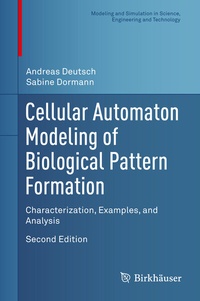
Cellular Automaton Modeling of Biological Pattern Formation
Characterization, Examples, and Analysis
2nd Edition
Published on 9. March 2018
XXII, 464 pages
978-1-4899-7980-3 (ISBN)
Description

This text explores the use of cellular automata in modeling pattern formation in biological systems. It describes several mathematical modeling approaches utilizing cellular automata that can be used to study the dynamics of interacting cell systems both in simulation and in practice. New in this edition are chapters covering cell migration, tissue development, and cancer dynamics, as well as updated references and new research topic suggestions that reflect the rapid development of the field.
The book begins with an introduction to pattern-forming principles in biology and the various mathematical modeling techniques that can be used to analyze them. Cellular automaton models are then discussed in detail for different types of cellular processes and interactions, including random movement, cell migration, adhesive cell interaction, alignment and cellular swarming, growth processes, pigment cell pattern formation, tissue development, tumor growth and invasion, and Turing-type patterns and excitable media. In the final chapter, the authors critically discuss possibilities and limitations of the cellular automaton approach in modeling various biological applications, along with future research directions. Suggestions for research projects are provided throughout the book to encourage additional engagement with the material, and an accompanying simulator is available for readers to perform their own simulations on several of the models covered in the text. QR codes are included within the text for easy access to the simulator.
With its accessible presentation and interdisciplinary approach, Cellular Automaton Modeling of Biological Pattern Formation is suitable for graduate and advanced undergraduate students in mathematical biology, biological modeling, and biological computing. It will also be a valuable resource for researchers and practitioners in applied mathematics, mathematical biology, computational physics, bioengineering, and computer science. PRAISE FOR THE FIRST EDITION
" An ideal guide for someone with a mathematical or physical background to start exploring biological modelling. Importantly, it will also serve as an excellent guide for experienced modellers to innovate and improve their methodologies for analysing simulation results ." -Mathematical Reviews
The book begins with an introduction to pattern-forming principles in biology and the various mathematical modeling techniques that can be used to analyze them. Cellular automaton models are then discussed in detail for different types of cellular processes and interactions, including random movement, cell migration, adhesive cell interaction, alignment and cellular swarming, growth processes, pigment cell pattern formation, tissue development, tumor growth and invasion, and Turing-type patterns and excitable media. In the final chapter, the authors critically discuss possibilities and limitations of the cellular automaton approach in modeling various biological applications, along with future research directions. Suggestions for research projects are provided throughout the book to encourage additional engagement with the material, and an accompanying simulator is available for readers to perform their own simulations on several of the models covered in the text. QR codes are included within the text for easy access to the simulator.
With its accessible presentation and interdisciplinary approach, Cellular Automaton Modeling of Biological Pattern Formation is suitable for graduate and advanced undergraduate students in mathematical biology, biological modeling, and biological computing. It will also be a valuable resource for researchers and practitioners in applied mathematics, mathematical biology, computational physics, bioengineering, and computer science. PRAISE FOR THE FIRST EDITION
" An ideal guide for someone with a mathematical or physical background to start exploring biological modelling. Importantly, it will also serve as an excellent guide for experienced modellers to innovate and improve their methodologies for analysing simulation results ." -Mathematical Reviews
Reviews / Votes
"In this book the authors concentrate on modelling biological pattern formation using cellular automata . . The book would be useful to someone with a mathematical background interested in modelling spatio-temporal dynamics of biological cells at this level of description." (Carlo Laing, zbMATH 1403.37001, 2019)More details
Series
Edition
2nd ed. 2017
Language
English
Place of publication
Boston
United States
Publishing group
Birkhäuser Boston
Target group
Primary & secondary/elementary & high school
Product notice
Reflowable
Illustrations
XXII, 464 p. 174 illus., 80 illus. in color.
ISBN-13
978-1-4899-7980-3 (9781489979803)
DOI
10.1007/978-1-4899-7980-3
Schweitzer Classification
Other editions
Additional editions
Andreas Deutsch | Sabine Dormann
Cellular Automaton Modeling of Biological Pattern Formation
Characterization, Examples, and Analysis
Book
03/2018
2nd Edition
Birkhauser Boston Inc
€71.68
Shipment within 15-20 days
Persons
Andreas Deutsch, PhD, Department for Innovative Methods of Computing, Center for Information Services and High Performance Computing, Technische Universität Dresden.
Sabine Dormann, PhD, Universität Osnabrück
Sabine Dormann, PhD, Universität Osnabrück
Content
Introduction and Outline.- On the Origin of Patterns.- Modeling Biological Pattern Formation.- Cellular Automata.- Random Movement.- Cell Migration.- Adhesive Cell Interaction.- Alignment and Cellular Swarming.- Growth Processes.- Pigment Cell Pattern Formation.- Tissue Development.- Tumor Growth and Invasion.- Turing Patterns and Excitable Media.- Discussion and Outlook.- Appendix A: Cell Migration.- Appendix B: Growth Processes.- Appendix C: Tumor Growth and Invasion.- Appendix D: Turing Patterns.- Appendix E: Excitable Media.- Appendix F: Isotropy, Lattices, and Tensors.- References.- Index.
