

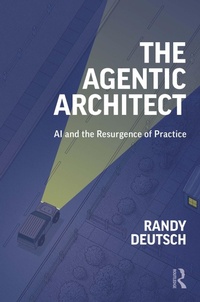
The Agentic Architect
AI and the Resurgence of Practice
Will be published approx. on 15. July 2026
164 pages
978-1-040-75519-8 (ISBN)
Description

Architectural education and the profession are at a crossroads, grappling with the climate crisis, housing shortages, migration, and the omnipresent rise of AI. While AI excels at generating visuals, its true value for architects lies not in replicating existing strengths, but in solving practical, time-consuming problems. This frees architects to tackle larger societal challenges and leverage their core competencies for the public good.
The Agentic Architect explores how current and future architects can harness AI to become indispensable. The book addresses the critical gap between AI's current (mis)use in academia and practice and how to pivot towards its full, effective adoption. Central to this pivot is the concept of agency. Agentic AI autonomously completes tasks; an agentic architect acts with purpose, meaning, and fulfillment, making informed decisions and contributing unique insights. Many architects, however, are experiencing a crisis of agency, feeling disempowered and immobilized. This book reveals how agency is lost-from school through professional life-and provides concrete solutions for rebuilding it for career growth, workforce relevance, and societal impact. Beyond technical skills, The Agentic Architect emphasizes educating the "whole architect" to prevent demoralization in the face of powerful AI. It focuses on identifying and cultivating agency, showing how to work agentically with AI throughout one's career. This isn't a doom-and-gloom narrative, but an optimistic, practical guide on "who we need to be" to thrive alongside AI.
The Agentic Architect is a high-level, tool-agnostic resource for students, faculty, design professionals, and firm leaders.
The Agentic Architect explores how current and future architects can harness AI to become indispensable. The book addresses the critical gap between AI's current (mis)use in academia and practice and how to pivot towards its full, effective adoption. Central to this pivot is the concept of agency. Agentic AI autonomously completes tasks; an agentic architect acts with purpose, meaning, and fulfillment, making informed decisions and contributing unique insights. Many architects, however, are experiencing a crisis of agency, feeling disempowered and immobilized. This book reveals how agency is lost-from school through professional life-and provides concrete solutions for rebuilding it for career growth, workforce relevance, and societal impact. Beyond technical skills, The Agentic Architect emphasizes educating the "whole architect" to prevent demoralization in the face of powerful AI. It focuses on identifying and cultivating agency, showing how to work agentically with AI throughout one's career. This isn't a doom-and-gloom narrative, but an optimistic, practical guide on "who we need to be" to thrive alongside AI.
The Agentic Architect is a high-level, tool-agnostic resource for students, faculty, design professionals, and firm leaders.
More details
Language
English
Place of publication
London
United Kingdom
Publishing group
Taylor & Francis Ltd
Target group
College/higher education
Professional and scholarly
Product notice
Reflowable
Illustrations
16 Line drawings, black and white; 16 Illustrations, black and white
File size
2,66 MB
ISBN-13
978-1-040-75519-8 (9781040755198)
Copyright in bibliographic data and cover images is held by Nielsen Book Services Limited or by the publishers or by their respective licensors: all rights reserved.
Schweitzer Classification
Other editions
Additional editions
Book
approx. 07/2026
1st Edition
Routledge
€47.50
Not yet published
Book
approx. 07/2026
1st Edition
Routledge
€192.50
Not yet published
Person
Randy Deutsch, FAIA, LEED AP, is an educator, author, highly respected international keynote speaker, workshop leader, AI researcher, design technology authority and licensed architect. He is a Senior Fellow of the Design Futures Council and currently serves as Clinical Associate Professor in the School of Architecture at the University of Illinois Urbana-Champaign where he served as the Associate Director for Graduate Studies until 2019, teaching and conducting research in AI, design, design futures, professional practice, building technology and digital technology.
Content
Introduction: Contemplating & Responding to our Existential Moment. PART 1: FOUNDATIONS OF AGENCY. 1. Architecture and AI today: What we're missing. 2. Education, Agency and AI: Learning, Fulfillment and Career Advancement. 3. This Appears to Be a Long Chapter. Let AI Summarize It for You. 4. A Day in the Life of an Agentic Architect. PART 2. AGENCY IN ACTION. 5. Identifying, Acquiring and Growing Agency. 6. How to Develop, Build and Protect Your Agency. 7. What We Will Always do Better Than AI. 8. Augmenting, Amplifying and Aligning Architects with AI. Conclusion: Actions to Assure We Not Only Survive but Thrive
