

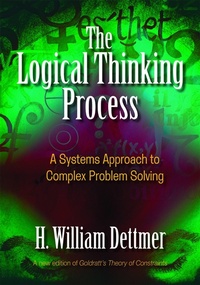
The Logical Thinking Process
A Systems Approach to Complex Problem Solving
Published on 24. May 2007
449 pages
978-0-87389-588-0 (ISBN)
Description

A major rewrite of Dettmer's classic Goldratt's Theory of Constraints, this new edition presents a whole new approach to building and applying logic trees. The logical thinking process referred to in the title is nothing less than a broadly applicable, systems-level approach to policy analysis.Dettmer has streamlined the process of constructing the logic trees while simultaneously ensuring that the results are more logically sound and closer representations of reality than ever before. He explains an easier, more logically sound way to integrate Current Reality Trees with Evaporating Clouds. His new version of the thinking process "retires" the Transition Tree in favor of the marriage of a more detailed Prerequisite Tree and critical chain project management.This book contains new examples of logic trees from a variety of real-world applications. Most of the diagrams and illustrations are new and improved. Explanations and procedures for constructing the logic trees are considerably simplified.
More details
Other editions
Additional editions
H. William Dettmer
Logical Thinking Process: A Systems Approach to Complex Problem Solving
A Systems Approach to Complex Problem Solving
Book
05/2007
2nd Edition
ASQ Quality Press
€107.40
Shipment within 10-20 days
Person
H. William "Bill" Dettmer is Senior Partner at Goal Systems International, a consortium of management professionals with more than 120 years of combined experience. He has twenty-three years' experience in military operations, logistics, strategic planning, operational planning, training, large-scale systems deployment, project management, and contracting. Since 1996, Dettmer has applied the thinking process in commercial companies, government agencies, and not-for-profit organizations throughout the U.S., South America, Europe, Japan, Korea, and Australia. He is author of Goldratt's Theory of Constraints (ASQ Quality Press, 1997), Breaking the Constraints to World-Class Performance (ASQ Quality Press, 1998), Strategic Navigation (ASQ Quality Press, 2003), and Brainpower Networking Using the Crawford Slip Method (Trafford Publishing, 2003), as well as co-author (with Eli Schragenheim) of Manufacturing at Warp Speed (CRC St. Lucie Press, 2000).
Content
- Cover
- Title page
- Copyright
- Table of Contents
- List of Illustrations
- Preface
- Acknowledgments
- Introduction
- Part I The Destination
- 1 Introduction to the Theory of Constraints
- SYSTEMS AND "PROFOUND KNOWLEDGE"
- THE SYSTEM'S GOAL
- THE MANAGER'S ROLE
- Who Is a Manager?
- What Is the Goal?
- Goal, Critical Success Factor, or Necessary Condition?
- THE CONCEPT OF SYSTEM CONSTRAINTS
- Systems as Chains
- The "Weakest Link"
- Constraints and Non-constraints
- A Production Example
- RELATION OF CONSTRAINTSTO QUALITY IMPROVEMENT
- CHANGE AND THE THEORY OF CONSTRAINTS
- TOC PRINCIPLES
- Systems as Chains
- Local vs. System Optima
- Cause and Effect
- Undesirable Effects and Critical Root Causes
- Solution Deterioration
- Physical vs. Policy Constraints
- Ideas Are Not Solutions
- THE FIVE FOCUSING STEPS OF TOC
- 1. Identify the System Constraint
- 2. Decide How to Exploit the Constraint
- 3. Subordinate Everything Else
- 4. Elevate the Constraint
- 5. Go Back to Step 1, But Beware of "Inertia"
- THROUGHPUT, INVENTORY, AND OPERATING EXPENSE
- Throughput (T)
- Inventory/Investment (I)
- Operating Expense (OE)
- Which Is Most Important: T, I, or OE?
- T, I, and OE: An Example
- T, I, and OE in Not-for-Profit Organizations
- Universal Measures of Value
- Passive Inventory
- Active Inventory (Investment)
- Managing T Through Undesirable Effects
- THE TOC PARADIGM
- Applications and Tools
- Drum-Buffer-Rope
- Critical Chain Project Management
- Replenishment and Distribution
- Throughput Accounting
- The Logical Thinking Process
- THE INTERMEDIATE OBJECTIVES MAP
- THE CURRENT REALITY TREE
- THE EVAPORATING CLOUD:A CONFLICT RESOLUTION DIAGRAM
- THE FUTURE REALITY TREE
- THE PREREQUISITE TREE
- THE TRANSITION TREE
- THE CATEGORIES OF LEGITIMATE RESERVATION
- THE LOGICAL TOOLS AS ACOMPLETE "THINKING PROCESS"
- Figure 1.19 The six logical tools as an integrated thinking process
- 2 Categories of Legitimate Reservation
- DEFINITION
- PURPOSE
- ASSUMPTIONS
- HOW TO USE THIS CHAPTER
- DESCRIPTION OF THE CATEGORIESOF LEGITIMATE RESERVATION
- 1. Clarity
- Why Clarity Comes First
- What Clarity Means
- 2. Entity Existence
- Completeness
- Structure
- Validity
- 3. Causality Existence
- 4. Cause Insufficiency
- The Ellipse
- Relative Magnitude of Dependent Causes
- How Many Arrows?
- The Concept of "Oxygen"
- 5. A dditional Cause
- Magnitude
- Test
- A Unique Variation of Additional Cause
- COMPLEX CAUSALITY
- What Is It?
- Cause Sufficiency
- Conceptual "AND"
- Additional Cause
- Magnitudinal "AND"
- Exclusive "OR"
- Symbols
- 6. Cause-Effect Reversal
- The "Fishing Is Good" Example
- The Statistical Example
- The Medical Example
- Test
- 7. Predicted Effect Existence
- Conflict or Differences in Magnitude?
- Tangible or Intangible?
- Verbalizing Predicted Effect Existence
- 8. Tautology (Circular Logic)
- Baseball Example
- Vampire Example
- Test
- USING THE CLR IN A GROUP
- CLR Known by All
- CLR Known Only by the Tree Builder
- SUFFICIENCY-BASED VS. NECESSITY-BASED LOGIC TREES
- SYMBOLS AND LOGIC TREE CONVENTIONS
- Three Reasons to Standardize
- Credibility
- Ergonomics
- Miscommunication of Logic
- A Standard Symbol Set
- A Standard Convention for Logical Connections
- SUMMARY
- Figure 2.36 Categories of legitimate reservation: self-scrutiny checklist
- 3 Intermediate Objectives Map
- INTRODUCTION
- DEFINITION
- PURPOSE
- ASSUMPTIONS
- HOW TO USE THIS CHAPTER
- SYSTEM BOUNDARIES, SPAN OFCONTROL, AND SPHERE OF INFLUENCE
- Span of Control
- Sphere of Influence
- The External Environment
- Control vs. Influence
- DOING THE RIGHT THINGS vs. DOING THINGS RIGHT
- The Goal
- Who Sets the Goal?
- Critical Success Factors and Necessary Conditions
- DESCRIPTION OF THE INTERMEDIATE OBJECTIVES (IO) MAP
- Strategic Application
- A Hierarchy of Systems
- IO Maps Are Unique
- Characteristics of the IO Map
- Examples of Strategic Intermediate Objectives Maps
- Process-Level IO Map
- System-Level IO Map
- HOW TO CONSTRUCT AN INTERMEDIATE OBJECTIVES (IO) MAP
- 1. Define the System
- 2. Determine the System Goal
- 3. Determine the Critical Success Factors
- 4. Determine Key Necessary Conditions
- 5. Arrange the IO Map Components
- 6. Connect the Goal, Critical Success Factors, and Necessary Conditions
- 7. Verify the Connections
- The "10,000-Foot Test"
- 8. Enlist Outside Scrutiny of the Entire IO Map
- Figure 3.14 Procedures for constructing an Intermediate Objectives (IO) Map - abbreviatedchecklist
- SUMMARY AND CONCLUSION
- Figure 3.15 Example: a real-world IO Map
- Part II Gap Analysis and Correction
- 4 Current Reality Tree
- DEFINITION
- PURPOSE
- ASSUMPTIONS
- HOW TO USE THIS CHAPTER
- DESCRIPTION OF THE CURRENT REALITY TREE
- A Single Tool or Part of a Set
- Span of Control and Sphere of Influence
- Correlation vs. Cause and Effect
- Predicting Rain in Siberia: A Simple Example of Correlation
- Fibromyalgia and Myofascial Pain: A Complex Real-World Example
- Undesirable Effects
- Undesirable by What Standard?
- How to Identify and Check for Undesirability
- Existence in Reality
- Why the Emphasis on UDEs?
- Root Causes
- Core Problems and Root Causes
- The "70 Percent" Criterion
- Inability to Act on a Core Problem
- A Solution to the Core Problem Conundrum
- Critical Root Cause: A Definition
- Main Body of the CRT
- Archetypical CRTs
- Depicting a Current Reality Tree
- Entities
- Entities i n a Current Reality Tree
- Arrows
- Underlying Assumptions
- Ellipses, Magnitudinal ANDs, and Exclusive ORs
- Ellipses
- Magnitudinal AND
- Exclusive ORs
- Variations on a Theme
- Numbering Entities in a Tree
- THE MOST COMMON LOGICAL ERRORSIN A SUFFICIENCY TREE
- Clarity in the Arrow
- Don't Induce Confusion
- Don't Miss Opportunities to Break the Chain of Cause and Effect
- Cause Insufficiency
- The Concept of "Oxygen" Revisited
- Entity Existence
- READING A CURRENT REALITY TREE
- NEGATIVE REINFORCING LOOPS
- Reading a Negative Reinforcing Loop
- HOW TO CONSTRUCT A CURRENT REALITY TREE
- Gather Materials
- 1. Define the System to be Modeled
- 2. Determine the Undesirable Effects
- Compare Reality with Benchmarks of System Success
- Create a Starting Matrix
- 3. Determine the First Two Levels of Causality
- Transfer UDEs and Causes to Post-it Notes
- 4. Begin the Current Reality Tree
- 5. Improve the Logic of the Initial Clusters
- 6. Identify Possible Additional Causes
- Two Criteria for Additional Causes
- 7. Look for Lateral Connections
- 8. Build the Cause-and-Effect Chains Downward
- 9. Scrutinize the Entire Current Reality Tree
- 10. Decide Which Root Causes to Attack
- SCRUTINIZING THE CURRENT REALITY TREE
- The Categories of Legitimate Reservation
- Techniques for "Shortstopping" Logical Challenges
- When "All" or "None" Are Not Acceptable
- Inclusive and Exclusive
- Qualifying Words
- Too Many Arrows?
- Simple Logical Aid #1: Means, Method, and Motivation
- Simple Logical Aid #2: The Syllogism
- USING THE CRT WITH OTHER PARTS OF THE THINKING PROCESS
- The Current Reality Tree and the Evaporating Cloud
- The Current Reality Tree and the Future Reality Tree
- SUMMARY
- Figure 4.45 Procedures for constructing a Current Reality Tree (CRT) - abbreviated checklist
- Figure 4.46 Current Reality Tree: Fordyce Corporation
- 5 Evaporating Cloud
- DEFINITION
- PURPOSE
- ASSUMPTIONS
- HOW TO USE THIS CHAPTER
- DESCRIPTION OF THE EVAPORATING CLOUD
- The Nature of Conflict
- Conflict Is Not Always Obvious
- Two Types of Conflict
- Opposite Conditions
- Different Alternatives
- Compromise, "Win-Lose" or "Win-Win"?
- Compromise
- "Win-Lose"
- "Win-Win"
- An Indication of Hidden Conflict
- "Breakthrough" Solutions
- Elements of the Evaporating Cloud
- Symbology
- Objective
- Requirements
- Prerequisites
- How the Evaporating Cloud Relates to the Current Reality Tree
- Why Do Root Causes of Undesirable Effects Exist?
- Policies and Constraints
- Policy Constraints: A Source of Conflict
- Conflict is Usually Embedded in the CRT
- Assumptions
- Invalid Assumptions
- Some Assumptions Can Be Invalidated
- "Win-Win" vs. "Win-Lose"
- Five Potential "Break Points"
- Invalid Assumptions: An Example
- Injections: The Role of Invalid Assumptions
- How Are Injections Related to Assumptions?
- Injections: Actions or Conditions?
- "Silver Bullets"
- Creating "Breakthrough" Ideas to Resolve Conflict
- All Arrows Are Fair Game
- Is the Idea Feasible?
- Reading an Evaporating Cloud
- Verbalizing Assumptions
- WHAT TO REMEMBER ABOUT EVAPORATING CLOUDS
- HOW TO CONSTRUCT AN EVAPORATING CLOUD
- A Nine-Step Path to Conflict Resolution
- 1. Construct a Blank Evaporating Cloud
- 2. Articulate the Conflicting "Wants" of Each Side
- 3. Determine the "Needs" of Each Side
- The "Easy Way" to Articulate Requirements
- 4. Formulate the Objective
- Why Use an Intermediate Objectives Map?
- 5. Evaluate the Whole Relationship
- 6. Develop Underlying Assumptions
- Extreme Wording
- 7. Evaluate Assumptions
- 8. Create Injections
- 9. Select the Best Injection(s)
- SCRUTINIZING AN EVAPORATING CLOUD
- Reflection of Current Reality
- Perception
- Figure 5.32 Procedures for constructing an Evaporating Cloud (EC) - abbreviated checklist
- Figure 5.33 Evaporating Cloud (EC): master blank form.
- Figure 5.34 Evaporating Cloud: Wurtzburg Corporation
- SUMMARY
- 6 Future Reality Tree
- DEFINITION
- PURPOSE
- ASSUMPTIONS
- HOW TO USE THIS CHAPTER
- DESCRIPTION OF THE FUTURE REALITY TREE
- A Real-World Example
- A Framework for Change
- Negative Branches
- The Positive Reinforcing Loop
- Future Reality Tree Symbology
- Injections
- Injections: Actions or Conditions?
- The Risk of Actions as Injections
- Build Upward, from Injections to Desired Effects
- Example: Building a House
- Multiple Injections: The "Silver Bullet" Fallacy
- Where Injections Come From
- The Future Reality Tree and Other Thinking Process Trees
- The Future Reality Tree and the Current Reality Tree
- The Logical Structure of Reality, Current and Future
- The Future Reality Tree and the Evaporating Cloud
- The Future Reality Tree and the Prerequisite Tree
- The Future Reality Tree as a "Safety Net"
- Negative Branches
- Using the Negative Branch as a "Stand-Alone"
- Added Realities
- Assumptions
- "Trimming" Negative Branches
- When to Raise Negative Branch Reservations
- Positive Reinforcing Loops
- Strategic Planning with a Future Reality Tree
- HOW TO CONSTRUCT A FUTURE REALITY TREE
- 1. Gather Necessary Information and Materials
- 2. Formulate Desired Effects
- Positive, Not Neutral
- Use Present Tense
- Lay Out Desired Effects
- 3. Add Injection(s) and Evaporating Cloud Requirements
- Where Do We Find Injections?
- Injections at the Bottom
- 4. Fill in the Gaps
- Build Upward
- Continue Building from the Expected Effect
- 5. Build In Positive Reinforcing Loops
- 6. Look for Negative Branches
- 7. Develop Negative Branches
- 8. Trim Negative Branches
- 9. Incorporate the "Branch-Trimming" Injection into the FRT
- 10. Scrutinize the Entire FRT
- SCRUTINIZING A FUTURE REALITY TREE
- Existence Reservations
- Additional Cause
- Scrutinizing Injections
- "Oxygen"
- SUMMARY
- Figure 6.27 Procedures for constructing a Future Reality Tree
- Figure 6.28 Using the negative branch (NB) as a stand-alone tool
- Figure 6.29 Future Reality Tree: Fordyce Corporation
- Part III Executing Change
- 7 Prerequisite and Transition Trees
- A CONSOLIDATION OF TWO TREES
- DEFINITION
- PURPOSE
- ASSUMPTIONS
- HOW TO USE THIS CHAPTER
- DESCRIPTION OF THE PREREQUISITE TREE
- Necessity vs. Sufficiency
- Depicting a Prerequisite Tree
- The Objective
- Intermediate Objectives
- Different Alternatives
- Not Always a One-to-One Relationship
- Obstacles
- Overcome, Not Obliterate
- Enlist Assistance to Identify Obstacles
- A Single Tool or Part of a Set
- Intermediate Objectives: Actions or Conditions?
- Obstacles: Always Conditions
- Sequence Dependency
- Parallelism
- Reading a Prerequisite Tree
- Top to Bottom
- Bottom to Top
- BUILDING A PREREQUISITE TREE
- 1. Determine the Objective
- 2. Identify All Intermediate Objectives
- 3. Surface All Possible Obstacles
- 4. Organize the Intermediate Objectives and Obstacles
- 5. Sequence the Intermediate Objectives Within Each Branch
- 6. Connect the Intermediate Objectives
- 7. Overcome the Obstacles
- 8. Integrate the Branches
- 9. Connect the Main Body of the Tree to the Objective
- 10. Scrutinize the Entire Tree
- SCRUTINIZING A PREREQUISITE TREE
- Entity Existence
- Cause Sufficiency
- Additional Cause
- The IO-Obstacle Validity Test
- THE TRANSITION TREE
- A Little History
- Prerequisite Tree and Transition Tree: Original Concept
- Transition Tree Structure
- The Five-Element Transition Tree
- IN SEARCH OF ROBUST EXECUTION
- Managing Change as a Project
- Critical Chain Project Management
- What Critical Chain Project Management Does
- What Critical Chain Project Management Requires
- A Three-Phase Change Management Framework
- SUMMARY
- Figure 7.31 Procedures for constructing a Prerequisite Tree
- Figure 7.32 Prerequisite Tree self-scrutiny checklist
- Figure 7.33 Prerequisite Tree: conference planning and management
- 8 Changing the Status Quo
- PURPOSE
- ASSUMPTIONS
- HOW TO USE THIS CHAPTER
- THE KEY TO SYSTEM IMPROVEMENT
- The Elements of System Improvement
- Reinforcement
- HUMAN BEHAVIOR
- Active Resistance
- Passive Resistance
- Is Behavior Logical?
- Changing Minds, or Changing Behavior?
- Why Do People Resist Change?
- Maslow
- Herzberg
- McClelland
- Adams
- Anaclitic Depression Blues
- Security or Satisfaction?
- The Impact on Solutions
- LEADERSHIP
- Leadership Is About People
- Leadership and the Blitzkrieg
- Mutual Trust
- Personal Professional Skill
- Moral Contract
- Focus
- Level 5 Leadership
- LEADERSHIP AND BEHAVIOR
- The Leader's Behavior
- Subordinates' Behavior
- CREATING AND SUSTAINING DESIRED BEHAVIORS
- Behavior Change is a Leadership Function
- A Behavioral Approach to Change
- Rewards or Reinforcement?
- A GENERAL STRATEGY FOR IMPLEMENTING CHANGE
- A Common Scenario
- Assumptions
- How Change "Gets In"
- The Leader as Change Agent-in-Chief
- A Model for Implementing Change
- 1. Leader Commitment
- 2. Modified Behavior Defined
- 3. Mission/Task Charter Communicated
- 4. Leader Commitment Demonstrated
- 5. Subordinate Commitment
- 6. Performance Management Process
- A Last Thought about Ensuring Effective Change
- SUMMARY
- Epilogue
- Appendix A Strategic Intermediate Objective Map
- Appendix B Executive Summary Trees
- Appendix C Current Reality Tree Exercise
- Appendix D Evaporating Cloud Exercise
- Appendix E The 3-UDE Cloud
- Appendix F The Challenger Conflict
- Appendix G Correlation vs. Cause and Effect
- Appendix H Theories of Motivation
- Appendix I Legal Application of the Thinking Process
- Appendix J Transformation Logic Tree Software
- Glossary of Thinking Process Terms
- Bibliography
- Index
