

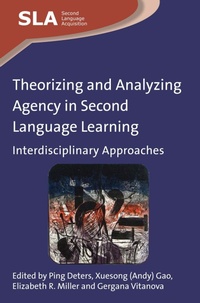
Theorizing and Analyzing Agency in Second Language Learning
Interdisciplinary Approaches
Published on 5. December 2014
280 pages
978-1-78309-291-8 (ISBN)
Description

This book showcases how language learner agency can be understood and researched from varying perspectives by providing, for the first time, a collection of diverse approaches in one volume. The volume is organised into three main sections:the first sections offers an introduction to varying theoretical approaches to agency; the second section presents analyses of agency in a variety of empirical studies; and the third section focuses on the pedagogical implications of data-based studies of agency. The volume includes the work of researchers working in languages including English (ESL and EFL), Greek, Spanish, Swedish, Italian, Hindi, Marathi, Gujarati and Truku (an indigenous language in Taiwan) and with both child and adult language learners. This collection will serve as a key reference for researchers of language learning and teaching, sociolinguistics and language and identity.
Reviews / Votes
This volume thoroughly surveys the different approaches to the question of agency in second-language learning. A particularly strong point of this volume is the range of learning contexts that arepresented. This focus on a range of unique learning experiences emphasizes the richness of agency as an area of research in second-language learning. This book will be a valuable resource for postgraduate students, teachers, and researchers of agency, identity, and second-language learning. -- David McLoughlin, Meiji University, Tokyo, Japan * Applied Linguistics 2016: 1-5 * In my opinion, the greatest strength of the book lies principally in it being an interesting collection of different perspectives from which agency in language learning can be viewed, as well as a first-class inspiration for readers to reflect and even take action in the context of multiple agency on issues raised by the contributors. Therefore, the book itself can mediate agency in both scholars and practitioners, be it through their researching or replicating the various study proposals, or implementing the contributors' insights into their own language classrooms. -- Dorota Werbinska, Pomeranian Academy, Poland * System 50 (2015) 69-77 * This edited volume fills a large gap in second language learning research by focusing on the critical construct of agency and provides novel ways of both theoretically and methodologically exploring how this construct is conceptualized, used and studied. Kudos to the editors and the contributors for such a fascinating and thought-provoking book. * Manka Varghese, University of Washington, USA * In an educational environment increasingly driven by market-place concerns and forms of hyper-regulation, careful assessment of the potential for teacher and student agency is a most timely and welcome development. This is an outstanding collection of theoretical and pedagogical perspectives - the 'go to' book on agency in second language education. * Brian Morgan, Glendon College/York University, Canada * This wide-ranging anthology is the first ever collection of the diverse theoretical, analytical and pedagogical approaches to the study of language learner agency. Reflecting a broad spectrum of research conducted by leading figures in the field, this book not only makes an excellent reader for any course on second language learning, but also a handy research reference, due to the breadth and depth of the information it conveys. * Mingyue (Michelle) Gu, Chinese University of Hong Kong, Hong Kong *
More details
Series
Language
English
Place of publication
Bristol
United Kingdom
Publishing group
Channel View Publications Ltd
Target group
Professional and scholarly
ISBN-13
978-1-78309-291-8 (9781783092918)
Copyright in bibliographic data and cover images is held by Nielsen Book Services Limited or by the publishers or by their respective licensors: all rights reserved.
Schweitzer Classification
Other editions
Additional editions
Ping Deters | Xuesong (Andy) Gao | Elizabeth R. Miller
Theorizing and Analyzing Agency in Second Language Learning
Interdisciplinary Approaches
Book
12/2014
Multilingual Matters
€48.60
Shipment within 10-20 days
Persons
Ping Deters is a Professor in the English Language Institute of Seneca College in Toronto, Canada.
Xuesong (Andy) Gao is an Associate Professor in the Division of English Language Education, Faculty of Education, The University of Hong Kong.
Elizabeth R. Miller is an Associate Professor in the Department of English at the University of North Carolina at Charlotte, USA.
Gergana Vitanova is an Associate Professor in the Department of Modern Languages and Literatures at the University of Central Florida, USA.
Xuesong (Andy) Gao is an Associate Professor in the Division of English Language Education, Faculty of Education, The University of Hong Kong.
Elizabeth R. Miller is an Associate Professor in the Department of English at the University of North Carolina at Charlotte, USA.
Gergana Vitanova is an Associate Professor in the Department of Modern Languages and Literatures at the University of Central Florida, USA.
Content
1. Gergana Vitanova, Elizabeth R. Miller, Xuesong (Andy) Gao, Ping Deters: Introduction to Theorizing and Analyzing Agency in Second Language Learning: Interdisciplinary Approaches
Section I. Theoretical Approaches to Agency
2. David Block: Structure, Agency, Individualization and the Critical Realist Challenge
3. Hannele Dufva and Mari Aro: Dialogical View on Language Learners' Agency: Connecting Intrapersonal with Interpersonal
4. Patricia A. Duff and Liam Doherty: Examining Agency in (Second) Language Socialization Research
5. Chatwara Suwannamai Duran: Theorizing Young Language Learner Agency through the Lens of Multilingual Repertoires: A Socio-Cultural Perspective
6. Carola Mick: Sociological Approaches to Second Language Learning and Agency
Section II. Analytical Approaches to Investigating Agency
7. Sangeeta Bagga-Gupta: Agency, Agents and Artifacts. Accounting Practices and Identity Performances
8. Hayriye Kayi-Aydar: "He's the Star!": Positioning as a Tool of Analysis to Investigate Agency and Access to Learning Opportunities in a Classroom Environment
9. Adnan Ajsic: 'Crossing' into the L2 and Back: Agency and Ultimate Attainment by a Post-Critical Period Learner
10. Peter William Stanfield: Analyzing Learner Agency: a Place-Based Approach
Section III. Pedagogical Practices for Agency
11. Christina Gkonou: Agency, Anxiety, and Activity: Understanding the Classroom Behaviour of EFL Learners
12. Prospero N. Garcia: Verbalizing in the Second Language Classroom: Exploring the Role of Agency in the Internalization of Grammatical Categories
13. Theron Muller: Critical Discourse Analysis in a Medical English Course: Examining Learner Agency through Student Written Reflections
14. Man-Chiu Amay Lin: Towards a Relationship-Oriented Framework: Revisiting Agency by Listening to the Voices of Children
15. Anna de Fina: Afterword
Section I. Theoretical Approaches to Agency
2. David Block: Structure, Agency, Individualization and the Critical Realist Challenge
3. Hannele Dufva and Mari Aro: Dialogical View on Language Learners' Agency: Connecting Intrapersonal with Interpersonal
4. Patricia A. Duff and Liam Doherty: Examining Agency in (Second) Language Socialization Research
5. Chatwara Suwannamai Duran: Theorizing Young Language Learner Agency through the Lens of Multilingual Repertoires: A Socio-Cultural Perspective
6. Carola Mick: Sociological Approaches to Second Language Learning and Agency
Section II. Analytical Approaches to Investigating Agency
7. Sangeeta Bagga-Gupta: Agency, Agents and Artifacts. Accounting Practices and Identity Performances
8. Hayriye Kayi-Aydar: "He's the Star!": Positioning as a Tool of Analysis to Investigate Agency and Access to Learning Opportunities in a Classroom Environment
9. Adnan Ajsic: 'Crossing' into the L2 and Back: Agency and Ultimate Attainment by a Post-Critical Period Learner
10. Peter William Stanfield: Analyzing Learner Agency: a Place-Based Approach
Section III. Pedagogical Practices for Agency
11. Christina Gkonou: Agency, Anxiety, and Activity: Understanding the Classroom Behaviour of EFL Learners
12. Prospero N. Garcia: Verbalizing in the Second Language Classroom: Exploring the Role of Agency in the Internalization of Grammatical Categories
13. Theron Muller: Critical Discourse Analysis in a Medical English Course: Examining Learner Agency through Student Written Reflections
14. Man-Chiu Amay Lin: Towards a Relationship-Oriented Framework: Revisiting Agency by Listening to the Voices of Children
15. Anna de Fina: Afterword
