

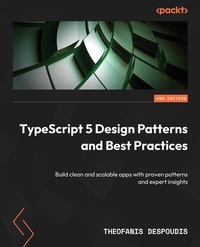
TypeScript 5 Design Patterns and Best Practices
Description

Key Features
Avoid common pitfalls and anti-patterns in TypeScript app development
Leverage functional and reactive paradigms for effective TypeScript development
Discover how to improve your application's code reusability and testability
Purchase of the print or Kindle book includes a free PDF eBook
Book DescriptionDesign patterns are the foundation of many world-class software applications, from commercial solutions to open-source projects. This guide equips you with the skills to architect robust, scalable, and maintainable TypeScript 5 applications. Whether you're looking to master modern TypeScript or apply proven software architecture patterns effectively, this book is your go-to resource. Written by Theofanis Despoudis, a recognized TypeScript expert, this second edition is fully updated with TypeScript 5's latest features, including improved type inference, union enums, and decorators. These updates will help you write cleaner, more maintainable code that adapts to future changes. You'll dive into classic Gang of Four design patterns through both traditional and modern real-world implementations, gaining hands-on experience with practical applications. You'll also gain a clear understanding of the power of functional and reactive programming patterns specifically designed for idiomatic TypeScript development. By the end of this book, you'll be able to identify and apply the right design pattern for any scenario and craft well-structured, maintainable, and testable code. *Email sign-up and proof of purchase required What you will learn
Understand the principles of design patterns and their role in TypeScript development
Learn essential patterns, including creational, structural, and behavioral, with TypeScript
Differentiate between patterns and design concepts and apply them effectively
Gain hands-on experience implementing patterns in real-world TypeScript projects
Explore advanced techniques from functional and reactive programming paradigms
Write efficient, high-quality TypeScript code that enhances performance and flexibility
Who this book is forIf you are a TypeScript developer working on frontend, backend, or full-stack applications looking to learn how to apply established design patterns to solve common programming problems instead of reinventing solutions, you'll find this book useful. Prior knowledge of design patterns is not necessary-all you need is basic TypeScript knowledge to get started with this book.
All prices
More details
Other editions
Additional editions
Person
Theofanis Despoudis lives in Ireland, where he works as a senior staff software engineer for WP Engine. He is the co-author of The React Workshop and Advanced Go Programming in 7 Days, and maintains many open source projects on GitHub. Theofanis works extensively with Faust.js, a Next.js framework written in TypeScript, and is actively developing a next-generation Headless WordPress toolkit leveraging TSDocs. He is also passionate about experimenting with AI technologies and exploring their applications in modern development workflows.
Content
Getting Started with TypeScript 5
TypeScript Core Principles
Creational Design Patterns
Structural Design Patterns
Behavioral Design Patterns for Object Communication
Behavioral Design Patterns for Managing State and Behavior
Functional Programming with TypeScript
Reactive and Asynchronous Programming
Developing Modern and Robust TypeScript Applications
Anti-Patterns and Workarounds
Exploring Design Patterns in Open Source Architectures
Preface
TypeScript has rapidly become one of the most popular languages for developing large-scale applications. Its combination of strong typing, modern JavaScript features, and seamless integration with popular frameworks has made it a go-to tool for developers aiming to write more reliable and maintainable code.
This book, TypeScript 5 Design Patterns and Best Practices, explores how developers can leverage TypeScript to build scalable applications by mastering design patterns, best practices, and advanced programming concepts. The goal is to empower developers to write cleaner, more efficient code while embracing TypeScript's powerful type system.
Based on the success of the first edition, in this edition, I incorporated valuable reader feedback to deliver an even more comprehensive and user-friendly learning experience. Here's a breakdown of the key improvements:
- Enhanced clarity and organization: This edition prioritizes clear and efficient learning. I've restructured the content based on reader feedback, ensuring a smoother flow and better alignment with your learning goals. Additionally, references to previous topics are now linked throughout the book, allowing you to easily revisit key concepts and navigate the material seamlessly.
- Expanded coverage: I've listened to your requests and expanded on valuable topics. The Criticisms section, after each explained pattern, now dives deeper into anti-patterns, providing real-world examples to help you understand how to avoid common pitfalls and write cleaner, more efficient code. Furthermore, the testing code is now integrated throughout relevant sections, allowing you to solidify your understanding of best practices by putting them into action.
- Added content: This edition is packed with new content to enhance your learning journey. I've included a comprehensive exploration of the popular Model-View-Controller (MVC) pattern (Chapter 9) to equip you with a foundational approach to web application development. Additionally, the chapter on functional programming section (Chapter 7) has been improved to provide a more focused and practical understanding of this paradigm. Finally, I've added a brand-new chapter (Chapter 11) that demonstrates the real-world usage of design patterns in two popular open source projects.
- Content refinements: I've meticulously reviewed and refined the content to provide you with the best possible learning experience. Typos and inconsistencies have been addressed to ensure all code examples function as expected. Complex figures have been simplified for better understanding, with a focus on the needs of TypeScript beginners.
This comprehensive list of updates ensures you receive the relevant and effective material for mastering TypeScript development.
Who this book is for
This book is ideal for TypeScript developers seeking to enhance their skills in building scalable and maintainable applications. It's also valuable for software engineers, architects, and development team leads who aim to improve code quality and development practices in TypeScript projects.
Readers should have a basic understanding of TypeScript fundamentals, including syntax, data types, and basic language features. Familiarity with software development concepts and best practices is beneficial but not required.
What this book covers
Chapter 1, Getting Started with TypeScript 5, introduces TypeScript 5, a powerful extension of JavaScript with type-checking capabilities. The chapter also covers how to set up TypeScript with VSCode and introduces UML diagrams as a tool for modeling design patterns.
Chapter 2, TypeScript Core Principles, discusses fundamental object-oriented programming (OOP) principles in TypeScript, such as encapsulation, inheritance, and polymorphism. You will learn how TypeScript bridges the gap between JavaScript and OOP and how to use TypeScript in both browser and server environments, and will receive an introduction to design patterns, which will be expanded upon in later chapters.
Chapter 3, Creational Design Patterns, explores patterns such as Singleton, Prototype, Builder, Factory Method, and Abstract Factory. Each pattern will be explained with practical examples and use cases in TypeScript to showcase how they simplify object creation and resource management.
Chapter 4, Structural Design Patterns, delves into patterns such as Decorator, Façade, Composite, Proxy, Bridge, and Flyweight, with practical applications in TypeScript, illustrating how these patterns can reduce complexity and improve flexibility in code.
Chapter 5, Behavioral Design Patterns for Object Communication, focuses on behavioral design patterns that handle communication between objects. Patterns such as Strategy, Chain of Responsibility, Command, Mediator, and Observer are explored in depth.
Chapter 6, Behavioral Design Patterns for Managing State and Behavior, explores those patterns that govern the control and management of an object's state or behavior over time, such as Iterator, Memento, State, Template Method, and Visitor. These patterns show how to manage object life cycles and data flow efficiently in TypeScript applications.
Chapter 7, Functional Programming with TypeScript, teaches you about key concepts such as immutability, recursion, function composition, and higher-order functions, alongside advanced functional programming techniques such as Monads, Functors, and Lenses, all aimed at improving code maintainability and reusability.
Chapter 8, Reactive and Asynchronous Programming, explains Promises, Futures, and Observables, as well as how to apply reactive programming principles to manage.
Chapter 9, Developing Modern and Robust TypeScript Applications, shifts toward best practices for building modern TypeScript applications. By combining design patterns with utility types, domain-driven design (DDD), and SOLID principles, you will be well equipped to design scalable and maintainable applications.
Chapter 10, Anti-Patterns and Workarounds, focuses on anti-patterns, which are common mistakes made in TypeScript development. This chapter identifies these pitfalls and offers practical workarounds to avoid them. Topics include class overuse, incorrect type handling, and common type inference mistakes.
Chapter 11, Exploring Design Patterns in Open Source Architectures, is the final chapter. It explores the application of design patterns in popular TypeScript frameworks such as tRPC and Apollo Client. By studying real-world examples, you'll gain insights into how design patterns enhance the architecture and maintainability of TypeScript applications.
To get the most out of this book
All code examples have been tested using TypeScript 5 with Node.js 18 on macOS. However, they should work with future version releases too.
Software/hardware covered in the book
Operating system requirements
Node.js 18 and above
Windows, macOS, or Linux
TypeScript 5.0 and above
A browser such as Chrome or Firefox
No additional setup is required beyond having a code editor (e.g., VSCode) and Node.js installed on your system to follow the examples in the book. The code examples can be executed in any environment that supports modern JavaScript and TypeScript.
If you are using the digital version of this book, we advise you to type the code yourself or access the code from the book's GitHub repository (a link is available in the next section). Doing so will help you avoid any potential errors related to the copying and pasting of code.
Download the example code files
You can download the example code files for this book from GitHub at https://github.com/PacktPublishing/TypeScript-5-Design-Patterns-and-Best-Practices. If there's an update to the code, it will be updated in the GitHub repository.
We also have other code bundles from our rich catalog of books and videos available at https://github.com/PacktPublishing/. Check them out!
Conventions used
There are a number of text conventions used...
